January 24, 2012 feature
Blunt nanostructures could make high-efficiency solar cells easier to fabricate
(PhysOrg.com) -- One of the most promising methods for increasing the efficiency of solar cells consists of coating the cells’ surfaces with a thin layer of metal nanoparticles. The nanoparticles scatter incoming light in different directions, which allows the solar cells to absorb more light than they otherwise would. The scattering occurs when the incoming light stimulates the nanoparticles’ surface plasmons (SPs), which are coherent electron oscillations in the metal atoms that can reach a resonance mode when the electrons’ frequency matches the photons’ frequency. Under these conditions, the resulting “surface plasmon resonance” induces light scattering and enhances the light absorption of the surface.
Until recently, scientists thought that metallic nanoparticles usually have SP resonances only at quantized, rather than continuous, frequencies. But in 2010, Professor Sir John Pendry of Imperial College London, along with Alexandre Aubry, Yu Luo, and others, found that this no longer holds true for nanostructures with sharp edges or corners. Such geometrical features act as singularities for the SP frequencies, causing them to propagate toward the singularity, slowing down as they approach but never reaching the singularity. As a result, light energy builds up at these points and the SP resonance modes are continuous.
Theoretically, the singularities in these sharp-cornered metal nanoparticles could greatly increase the light absorption and efficiency of solar cells and other devices. However, in reality, such perfectly sharp corners are nearly impossible to fabricate.
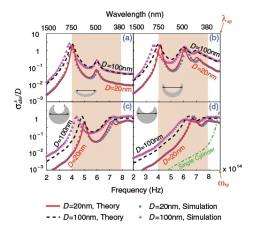
Now in a new study, Pendry, Luo, Dang Yuan Lei, and Stefan Maier, all from Imperial College London, have investigated just how sharp the nanoparticles’ corners need to be to have a continuous SP spectrum and provide an increase in light absorption. Surprisingly, they found that some nanostructures with blunt corners, as long as they obey certain other parameters, can provide the same large field enhancement and increased light harvesting efficiency as sharp-cornered nanostructures. The study is published in a recent issue of Physical Review Letters.
In the study, the researchers theoretically analyzed how rounding off the corners of a crescent moon-shaped nanostructure alters its optical properties. While some previous studies have also analyzed the optical properties of other blunt-edged nanostructures, they have not used a systematic strategy like the scientists used here. The new analytical model, which is based on transformation optics, applies to a wide variety of blunt plasmonic nanostructures such as wedges and cylinders. The advantage of having a general model is that it may enable researchers to more easily design light-harvesting devices in the future.
“I think the greatest significance of our work is that it presents a systematic strategy to analytically deal with the effect of edge rounding,” Luo told PhysOrg.com. “The approach itself is very general; therefore it can be used to study a variety of nanoparticles with sharp geometrical features, and to facilitate efficient modeling and fast optimization of plasmonic nanostructures.”
As the scientists explained, increasing the edge bluntness generally decreases the number of SP modes exponentially. However, here they found that adjusting the crescent thickness as well as the crescent tip angle could make a nanostructure’s light absorbing properties nearly independent of its tip bluntness. The robustness holds for 2D nanostructures that are smaller than 100 nanometers in diameter. As Luo explained, this finding could greatly improve the light-to-electricity conversion process in solar cells.
“A solar cell is an electrical device that converts the energy of light into electricity,” he said. “However, the wavelength of light in free space is usually much larger than that of electrons. Therefore, the conversion process often requires gathering light on the micron-sized scale of the wavelength and concentrating it to nanoscale active centers where the energy of photons can be efficiently converted into electrical energy. And the nanostructures designed with our approach can achieve this light harvesting effect over a very broad frequency band.
“Of course, apart from light harvesting, the efficiency of solar cells is also related to some other parameters (such as the recombination and resistive losses), which are not considered in our study. But as the general analytic model proposed in our paper enables us a profound understanding and accurate estimation of the optical properties of different nanostructures, we anticipate that it could assist engineers in their design of solar cell nanoparticles.”
Some other applications of the study could include Raman scattering, single-molecule detection, ultrafast nonlinearity, and flammable gas detection, among others. Such applications will benefit from the new approach’s capability to efficiently harvest and concentrate light energy into deep-subwavelength hot spots and to achieve significant field enhancement.
In the future, the scientists plan to extend the approach to 3D, as 3D blunt structures are easier to engineer and more suitable for practical use. Another goal is to account for the retardation effect, which could extend the theory to nanostructures larger than 100 nanometers.
More information: Yu Luo, et al. “Broadband Light Harvesting Nanostructures Robust to Edge Bluntness.” Physical Review Letters 108, 023901 (2012). DOI: 10.1103/PhysRevLett.108.023901
Journal information: Physical Review Letters
Copyright 2012 PhysOrg.com.
All rights reserved. This material may not be published, broadcast, rewritten or redistributed in whole or part without the express written permission of PhysOrg.com.


