BMW shows hands-free driving on Autobahn (w/ video)
January 24, 2012 by Nancy Owano report
BMW shows hands-free driving on Autobahn (w/ video)

Enlarge

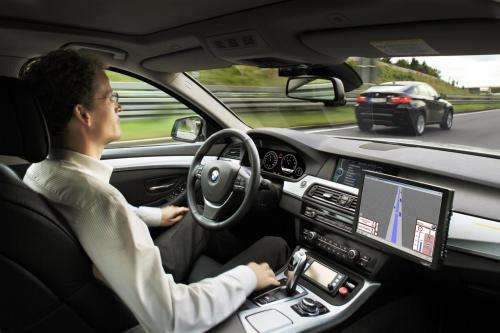
(PhysOrg.com) -- Move over, Google, or better still, stay off the Autobahn, best not to interfere with the main show, which now stars BMW and its technology feats with self-driving cars. BMW has been drawing press interest in its recent show of what will be possible in self-driving cars 10 to 15 years from now. BMW had announced in August its “ConnectedDrive Connect (CDC) system. This week, a video was released showing a BMW on CDC realtime. BMW put it on the Autobahn, along with a human driver who nonetheless kept hands off the wheel of the car, a BMW 5 series model.

The video message was that the car was capable of on its own in certain circumstances but the driver is the one responsible, and the driver must be able to take over the driving task at all times.

This video is not supported by your browser at this time.

“The car adheres to all traffic laws,” assured the moderator. With the CDC system, the car can brake, accelerate and pass other vehicles while analyzing the traffic conditions. This BMW system uses radar, cameras, laser scanners, and ultrasound distance sensors to get the information it needs.

According to BMW the system can also steer the car to pass a slower vehicle. If the car senses there’s a slow mover in front of it, it will search for an open lane where it can safely merge, pass the slow car, and return to the original lane.

“Our main challenge was to develop algorithms that can handle entirely new situations. In principle, the system works on all freeways that we have mapped out beforehand with [a] centimeter accuracy,” said Nico Kaempchen, project manager of Highly Automated Driving. at BMW Group Research and Technology.

This is no out of the box prototype destined for car showrooms in 2013, however. The video, with its cautious comments about driverless driving and a needed driver, is nowhere near showoff mode as to how the driver can just leave the driving to the vehicle tomorrow. The Autobahn feat was to show a system that might be available ten to 15 years from now, or, as the BMW put it, a “technology study” for use in advancing existing technologies.

Overall, the European vendor approach in self-driving cars is not an aggressive play for headlines but rather a promotion of “driver-assistance” technologies that will incrementally lead to more and more driving automation.

Driverless technology, say industry observers, will first show its face as a luxury option for high end cars before settling into the mainstream marketplace.

Auto makers are selling cars with adaptive cruise control which applies the brakes during highway driving if traffic slows. , according to Technology Review, will work on that kind of capability in its upcoming i3 series of electric cars.

The company will offer a “traffic-jam feature” that allows the to speed up, slow down, and steer on its own at speeds of up to 25 miles per hour, as long as the driver leaves a hand on the wheel.

© 2011 PhysOrg.com

4.6 /5 (12 votes)  

Filter


Move the slider to adjust rank threshold, so that you can hide some of the comments.


Display comments: newest first

antialias_physorg
Jan 24, 2012

Rank: 4.6 / 5 (5)
Impressive. Getting this to work on the autobahn in dense traffic is no mean feat.
Especially for older people this will extend mobility indefinitely.
KillerKopy
Jan 24, 2012

Rank: not rated yet
The driver is the one responsible for the computer if it makes a mistake. I can't wait to see how the courts handle that. Plus if the driver is responsible for everything, then I should try to make a self driving car and try it out on everyone. Buckle up!!
CreepyD
Jan 24, 2012

Rank: 5 / 5 (3)
If your car is driving itself totally, and you going to be watching the road the whole time? On a 3 hour journey just sitting there watching the road with no control? Really?
Either the car drives itself or we drive it, I don't think it will work if is a grey area of who is in control.
Bob_Kob
Jan 24, 2012

Rank: not rated yet
Well hopefully if there is a situation where driver control is needed, the car will alert the driver to this - not a situation where the car or driver is both unaware.
HydraulicsNath
Jan 24, 2012

Rank: 4 / 5 (1)
If your car is driving itself totally, and you going to be watching the road the whole time? On a 3 hour journey just sitting there watching the road with no control? Really?
Either the car drives itself or we drive it, I don't think it will work if is a grey area of who is in control.


Hence why it is a developing study which means that its only a progressive point from which they can improve from.
antialias_physorg
Jan 24, 2012

Rank: 5 / 5 (2)
I can't wait to see how the courts handle that.

Just like with pilots who use an autopilot.

On a 3 hour journey just sitting there watching the road with no control? Really?

What do you think front seat passengers do now?
wealthychef
Jan 24, 2012

Rank: not rated yet

On a 3 hour journey just sitting there watching the road with no control? Really?

What do you think front seat passengers do now?

They have the option to distract themselves any way they please -- put their feet up on the dash, read a book, look out the window, go to sleep. A driver that is responsible at all times would have to watch the road at all times, which if he is not interacting would become dangerously dull.
jwilcos
Jan 24, 2012

Rank: 5 / 5 (3)
Nice, but seems like the Google car is way ahead of this. They drove on regular streets (not just highways), in full traffic, including tasks such as taking an exit.

Either way this is great because by the time I retire in 20 years, these systems will be good enough so old people don't need to drive.
MrVibrating
Jan 24, 2012

Rank: not rated yet
Nothing short of a fully sentient - and then massively redundant - intelligence should be allowed anywhere near a public road imho.

The current biggest challenges to driverless vehicles have nothing whatsoever to do with the robotic aspects of driving...
jimbo92107
Jan 24, 2012

Rank: not rated yet
Highly competent engineering, with a conservative approach to bragging. Das ist gut.
bredmond
Jan 24, 2012

Rank: not rated yet
They should add a breathalyser to cars also. That way drunks wont be able to get into cars and drive, but they can get back to their homes and be sick there and off the streets.
plasticpower
Jan 24, 2012

Rank: not rated yet
The day cars fully drive themselves is the day alcohol consumption is going to skyrocket! I'm sorry, liver, but your end is coming...
dan42day
Jan 25, 2012

Rank: not rated yet
Nothing short of a fully sentient - and then massively redundant - intelligence should be allowed anywhere near a public road imho.


That disqualifies at least half of the human drivers I see every day.

I agree with Chef's comment about driving becoming dangerously dull. Airline pilots have already shown the potential dangers of falling asleep on autopilot.

I don't want to be woken up by my BMW tersly yelling "ACHTUNG!" and find my car sailing off a cliff. My current one already annoys me by flashing "TAIL LIGHT FAILURE" in bright red letters every couple weeks. The tail lights seem to be working just fine...
chthonic
Jan 25, 2012

Rank: not rated yet
The guy sitting behind the wheel looks like he's praying ^_^
Rank 4.6 /5 (12 votes)
Relevant PhysicsForums posts

More news stories

Stanford research team cracks animated NuCaptcha

(PhysOrg.com) -- The research team from Stanford University, led by Elie Bursztein, that previously had cracked regular CAPTCHAs and then audio CAPTCHAs, now has also successfully cracked the animated version called NuCapt ...

Technology / Computer Sciences

created 17 hours ago | popularity 5 / 5 (3) | comments 6 | with audio podcast report

Tiny, implantable medical device can propel itself through bloodstream

Someday, your doctor may turn to you and say, "Take two surgeons and call me in the morning." If that day arrives, you may just have Ada Poon to thank.

Technology / Engineering

created 17 hours ago | popularity 5 / 5 (9) | comments 8 | with audio podcast

Italian engineer invents floating solar panels

Rays of the winter sun bounce off gleaming mirrors on the tiny lake of Colignola in Italy, where engineers have built a cost-effective prototype for floating, rotating solar panels.

Technology / Energy & Green Tech

created 21 hours ago | popularity 4.7 / 5 (6) | comments 5

Microsoft hits Motorola, Google with EU complaint

Microsoft on Wednesday lodged a formal complaint with the European Union's competition regulator against Motorola Mobility and its soon-to-be owner Google, saying Motorola's aggressive enforcement of patent ...

Technology / Business

created 16 hours ago | popularity 2 / 5 (1) | comments 2

Calif. pledges better mobile privacy disclosures

(AP) -- Mobile applications seeking to collect personal information will have to forewarn users as part of an agreement reached in California.

Technology / Internet

created 9 hours ago | popularity not rated yet | comments 0


Researchers build first physical 'metatronic' circuit

(PhysOrg.com) -- The technological world of the 21st century owes a tremendous amount to advances in electrical engineering, specifically, the ability to finely control the flow of electrical charges using ...

Spitzer finds solid buckyballs in space

(PhysOrg.com) -- Astronomers using data from NASA's Spitzer Space Telescope have, for the first time, discovered buckyballs in a solid form in space. Prior to this discovery, the microscopic carbon spheres ...

Faster than light neutrinos? More like faulty wiring

You can shelf your designs for a warp drive engine (for now) and put the DeLorean back in the garage; it turns out neutrinos may not have broken any cosmic speed limits after all.

Physicists surprised by disappearing and reappearing superconductivity in iron selenium chalcogenides

Superconductivity is a rare physical state in which matter is able to conduct electricity -- maintain a flow of electrons -- without any resistance. This phenomenon can only be found in certain materials at low temperatures, ...

CT colonography shown to be comparable to standard colonoscopy

Computerized tomographic (CT) colonography (CTC), also known as virtual colonoscopy, is comparable to standard colonoscopy in its ability to accurately detect cancer and precancerous polyps in people ages 65 and older, according ...

Study: Virtual colonoscopy effective screening tool for adults over 65

Computed tomography (CT) colonography can be used as a primary screening tool for colorectal cancer in adults over the age of 65, according to a new study published online in the journal Radiology.