Bubble-propelled microrockets could operate in the human stomach
January 18, 2012 by Lisa Zyga
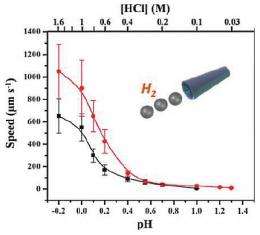
The microrockets’ speed depends on the pH of the solution. Red and black curves represent microrockets with diameters of 5 and 2 micrometers, respectively. Image credit: Wei Gao, et al. ©2012 American Chemical Society
(PhysOrg.com) -- Recently, researchers have been designing a wide variety of self-propelled micromotors, many of which operate using an oxygen-bubble propulsion mechanism that requires a high concentration of hydrogen peroxide fuel. Since hydrogen peroxide is hazardous at high concentrations, this requirement has hindered practical applications, especially biomedical uses. Now in a new study, scientists have designed and built a new type of micromotor that propels itself through acidic environments with hydrogen bubbles, and requires no additional fuels. At extremely low pH levels, the micromotors can travel at speeds of up to 100 body lengths per second, prompting the scientists to call them microrockets.
The researchers, Wei Gao, Aysegul Uygun, and Joseph Wang from the University of California, San Diego, have published their study on the hydrogen-bubble-propelled microrockets in a recent issue of the Journal of the American Chemical Society.
This is the first reported example of chemically-powered microrockets that can be self-propelled without an external fuel (such as the common hydrogen peroxide), Wang told PhysOrg.com. Such acid-powered microrockets could greatly expand the scope of applications of nano-/microscale motors toward new extreme environments (e.g., the human stomach or silicon wet-etching baths) and could thus lead to diverse new biomedical or industrial applications ranging from targeted drug delivery or nanoimaging to the monitoring of industrial processes.

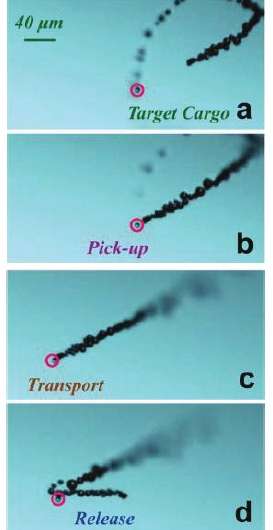
Time-lapse images of a microrocket (a) approaching, (b) capturing, (c) transporting, and (d) releasing a target sphere. Image credit: Wei Gao, et al. ©2012 American Chemical Society
The microrockets are in the shape of tiny tubes, measuring about 10 micrometers long with diameters varying from 2 to 5 micrometers. The researchers fabricated the tubes out of the common polymer polyaniline (PANI) in templates, and then electrodeposited a thin layer of zinc on the inner surface. When the microrockets are immersed in any highly acidic solution, the zinc loses electrons and due to having a more negative redox potential than hydrogen promotes the production of hydrogen bubbles. The researchers experimented with using other metals, such as iron and lead, but they did not produce as many bubbles as zinc.Tests showed that the microrockets speed increases as the pH of the solution decreases. The fastest speed of 1,050 micrometers per second (equivalent to about 100 body lengths per second) was achieved by a 5-micrometer-diameter microrocket at a pH of -0.2. The speed decreased to about 10 micrometers per second at a pH of 1.3. Although the microckets have a limited pH range, the researchers noted that they could be useful in the stomach, which has a pH range of 0.8-2.0, as well as in some types of human serum.
This video is not supported by your browser at this time.
Slow-motion video of a microrocket self-propelled at a speed of about 500 micrometers per second. Video credit: Wei Gao, et al. ©2012 American Chemical Society
Tests also showed that the lifetime of the microrockets can vary from 10 seconds to 2 minutes, depending on the rate of zinc dissolution. The more zinc the rocket has, and the higher the pH of the solution, the longer the microrockets lifetime.
While the microrockets can move autonomously in this way, the researchers also showed that its possible to control their direction and even to make them pick up and release cargo. The scientists did this by depositing a magnetic layer on the microckets outer surface, and then magnetically guiding the device in the preferred direction. They showed that a microcket could magnetically capture a polystyrene cargo, transport it on a predetermined path, and then release it by rapidly changing the magnetic field direction.
This video is not supported by your browser at this time.
Magnetically guided movement of a microrocket at a speed of about 100 micrometers per second. Video credit: Wei Gao, et al. ©2012 American Chemical Society
The scientists predict that this capability could prove especially useful for a variety of biomedical applications as well as monitoring industrial processes such as semiconductor processing. In addition, because the microrockets speed is directly related to the solutions pH, the devices could be used for sensitive pH sensing, such as detecting changes in stomach acidity. With its biggest advantage of being fueled by its acidic environment, without the need for additional fuel, the microrockets could further expand the scope of micromotor applications in many directions.With further improvements and optimization, we hope to improve and expand the working environments to milder conditions and extend the lifetime of such microrockets to longer periods, Wang said. We are also exploring new materials to broaden the scope of our microengines towards new environments.
More information: Wei Gao, et al. Hydrogen-Bubble-Propelled Zinc-Based Microrockets in Strongly Acidic Media. Journal of the American Chemical Society. DOI: 10.1021/ja210874s
Copyright 2012 PhysOrg.com.
All rights reserved. This material may not be published, broadcast, rewritten or redistributed in whole or part without the express written permission of PhysOrg.com.
-
Tiny battery is also a nanomotor
Oct 19, 2011 |
not rated yet |
0
-
Fast, easy way to make hydrogen nanosensors found by scientists
Jan 13, 2011 |
not rated yet |
0
-
Zinc 'sparks' fly from egg within minutes of fertilization
Jul 22, 2011 |
not rated yet |
0
-
Scientists discover recycling method to advance fuel cell practicality
Mar 21, 2011 |
not rated yet |
0
-
Teaching algae to make fuel
May 24, 2011 |
not rated yet |
0
-
Stars containing dark matter should look different from other stars
Feb 20, 2012 |
4.5 / 5 (17) |
11
-
Physicists discover evidence of rare hypernucleus, a component of strange matter
Feb 17, 2012 |
4.7 / 5 (38) |
22
-
Fast photon control brings quantum photonic technologies closer
Feb 13, 2012 |
5 / 5 (8) |
1
-
Engineers build first sub-10-nm carbon nanotube transistor
Feb 01, 2012 |
4.9 / 5 (36) |
32
-
Something old, something new: Evolution and the structural divergence of duplicate genes
Jan 31, 2012 |
4.6 / 5 (7) |
1
-
Cis-trans Selectivity in Wittig Reactions
4 hours ago
-
Chemical Kinetics
4 hours ago
-
heat-driven chemical reaction and thermodynamics
11 hours ago
-
phenol to benzene
15 hours ago
-
TQM, QA and QC
16 hours ago
-
oxidising power
22 hours ago
- More from Physics Forums - Chemistry
More news stories
Scientists create potent molecules aimed at treating muscular dystrophy
While RNA is an appealing drug target, small molecules that can actually affect its function have rarely been found. But now scientists from the Florida campus of The Scripps Research Institute have for the first time designed ...
9 hours ago |
5 / 5 (4) |
0
|
Flesh-eating bacteria inspire superglue
(PhysOrg.com) -- A bio-inspired superglue has been developed by Oxford University researchers that cant be matched for sticking molecules together and not letting go.
20 hours ago |
5 / 5 (8) |
3
|
Researchers discover what cancer cells need to travel
(PhysOrg.com) -- Cancer cells must prepare for travel before invading new tissues, but new Cornell research has found a possible way to stop these cells from ever hitting the road.
19 hours ago |
4.9 / 5 (12) |
0
|
New microfluidic device could be used to diagnose and monitor cancer and other diseases
Separating complex mixtures of cells, such as those found in a blood sample, can offer valuable information for diagnosing and treating disease. However, it may be necessary to search through billions of other ...
Chemistry / Analytical Chemistry
19 hours ago |
5 / 5 (2) |
0
|
New way to tap largest remaining treasure trove of potential new antibiotics
Scientists are reporting use of a new technology for sifting through the world's largest remaining pool of potential antibiotics to discover two new antibiotics that work against deadly resistant microbes, ...
12 hours ago |
5 / 5 (4) |
0
Researchers build first physical 'metatronic' circuit
(PhysOrg.com) -- The technological world of the 21st century owes a tremendous amount to advances in electrical engineering, specifically, the ability to finely control the flow of electrical charges using ...
Spitzer finds solid buckyballs in space
(PhysOrg.com) -- Astronomers using data from NASA's Spitzer Space Telescope have, for the first time, discovered buckyballs in a solid form in space. Prior to this discovery, the microscopic carbon spheres ...
Faster than light neutrinos? More like faulty wiring
You can shelf your designs for a warp drive engine (for now) and put the DeLorean back in the garage; it turns out neutrinos may not have broken any cosmic speed limits after all.
Physicists surprised by disappearing and reappearing superconductivity in iron selenium chalcogenides
Superconductivity is a rare physical state in which matter is able to conduct electricity -- maintain a flow of electrons -- without any resistance. This phenomenon can only be found in certain materials at low temperatures, ...
CT colonography shown to be comparable to standard colonoscopy
Computerized tomographic (CT) colonography (CTC), also known as virtual colonoscopy, is comparable to standard colonoscopy in its ability to accurately detect cancer and precancerous polyps in people ages 65 and older, according ...
Stanford research team cracks animated NuCaptcha
(PhysOrg.com) -- The research team from Stanford University, led by Elie Bursztein, that previously had cracked regular CAPTCHAs and then audio CAPTCHAs, now has also successfully cracked the animated version called NuCapt ...