Bus-sized asteroid shaves by Earth
January 28, 2012 by Kerry Sheridan
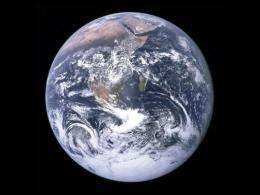
This NASA image shows a view of Earth from Apollo 17. An asteroid about the size of a bus shaved by Earth on Friday in what spacewatchers described as a "near-miss," though experts were not concerned about the possibility of an impact.
An asteroid about the size of a bus shaved by Earth on Friday in what spacewatchers described as a "near-miss," though experts were not concerned about the possibility of an impact.
The asteroid, named 2012 BX34, measured between six and 19 meters in diameter (20 to 62 feet), said Gareth Williams, associate director of the US-based Minor Planet Center which tracks space objects.
The asteroid, which had been unknown before it popped into view from a telescope in Arizona on Wednesday, came within about 60,000 kilometers (37,000 miles) of Earth on Friday at about 1500 GMT, he said.
"It's a near miss. It makes the top 20 list of closest approaches ever observed," Williams told AFP.
NASA had announced on Twitter on Thursday that the asteroid would "safely pass Earth on January 27."
Williams explained that since the asteroid was so small, it could only be detected when it was close to the Earth, but that the fly-by, while a surprise, was not terribly uncommon.
"This came about a sixth of the distance from the Moon," he said. "In the past year we have had some 30 objects that were observed to come within the orbit of the Moon."
Williams said his pager went off in the middle of the night Wednesday after the asteroid was first sighted, but once he checked he went right back to sleep because he knew it would not hit Earth from its projected distance.
But where it goes next is less certain.
"If we have radar on it from last night then we can probably predict it decades into the future," he said.
"If we don't have radar, then we only have a two- to three-day arc of observations and extrapolating that into the future will be very uncertain."
However, since the asteroid is so diminutive, it poses little threat to the vast Earth, he added.
"This object is so small that even if it hits us the next time around it won't survive passage through the atmosphere in one piece," Williams said.
"Objects in that size range -- six to 19 meters -- will typically break up due to the force of entering the atmosphere. All that may remain are a few fist- or football-sized rocks that make it to the ground as meteorites."
In November last year, a much a larger asteroid called 2005 YU55 made its closest fly-by of Earth in 200 years.
The near-spherical asteroid, 1,300 feet (400 meters) in diameter, passed by at a distance of 201,700 miles (324,600 kilometers), as measured from the center of Earth, NASA said.
In 2008, a small asteroid estimated to be a few meters (yards) wide sparked a fireball in the night sky plunged down over Sudan, scattering fragments over the Nubian desert, NASA said.
(c) 2012 AFP
-
NASA captures new images of large asteroid passing Earth
Nov 08, 2011 |
not rated yet |
0
-
Small asteroid to pass within Earth-Moon system Tuesday
Oct 11, 2010 |
not rated yet |
0
-
Asteroid to Make Rare Close Flyby of Earth
Jan 24, 2008 |
not rated yet |
0
-
NASA in final preparations for Nov. 8 asteroid flyby
Oct 27, 2011 |
not rated yet |
0
-
8-meter-wide asteroid will pass close to Earth today
Jan 27, 2012 |
not rated yet |
0
-
Stars containing dark matter should look different from other stars
Feb 20, 2012 |
4.5 / 5 (17) |
11
-
Physicists discover evidence of rare hypernucleus, a component of strange matter
Feb 17, 2012 |
4.7 / 5 (38) |
22
-
Fast photon control brings quantum photonic technologies closer
Feb 13, 2012 |
5 / 5 (8) |
1
-
Engineers build first sub-10-nm carbon nanotube transistor
Feb 01, 2012 |
4.9 / 5 (36) |
32
-
Something old, something new: Evolution and the structural divergence of duplicate genes
Jan 31, 2012 |
4.6 / 5 (7) |
1
-
What is this spectrum I took?
8 hours ago
-
Orientation of Space
9 hours ago
-
Geologically Active Moon Now: NASA
16 hours ago
-
advice on building a science fair telescope
21 hours ago
-
Rise of the Sun
22 hours ago
-
Uncertainty of planetary orbital period
Feb 19, 2012
- More from Physics Forums - General Astronomy
More news stories
Spitzer finds solid buckyballs in space
(PhysOrg.com) -- Astronomers using data from NASA's Spitzer Space Telescope have, for the first time, discovered buckyballs in a solid form in space. Prior to this discovery, the microscopic carbon spheres ...
11 hours ago |
4.7 / 5 (12) |
6
|
Going up: Japan builder eyes space elevator
A Japanese construction firm claimed Wednesday it could execute an out-of-this-world plan to put tourists in space within 40 years by building an elevator that stretches a quarter of the way to the moon.
Space & Earth / Space Exploration
18 hours ago |
3.5 / 5 (13) |
24
ENASA satellite finds Earth's clouds are getting lower
(PhysOrg.com) -- Earth's clouds got a little lower -- about one percent on average -- during the first decade of this century, finds a new NASA-funded university study based on NASA satellite data. The results ...
Space & Earth / Earth Sciences
15 hours ago |
5 / 5 (8) |
9
|
Fresh scandal embroils US climate science debate
A fresh scandal over climate change has erupted in the United States after leaked documents appeared to show a right-wing funded campaign to influence how climate science is taught in schools.
7 hours ago |
4.4 / 5 (7) |
6
World's oceans get an acid bath
Among the repercussions of global climate change, the effect of ocean acidification on marine life is one of the least-understood variables.
14 hours ago |
4.3 / 5 (6) |
4
|
Researchers build first physical 'metatronic' circuit
(PhysOrg.com) -- The technological world of the 21st century owes a tremendous amount to advances in electrical engineering, specifically, the ability to finely control the flow of electrical charges using ...
Faster than light neutrinos? More like faulty wiring
You can shelf your designs for a warp drive engine (for now) and put the DeLorean back in the garage; it turns out neutrinos may not have broken any cosmic speed limits after all.
Physicists surprised by disappearing and reappearing superconductivity in iron selenium chalcogenides
Superconductivity is a rare physical state in which matter is able to conduct electricity -- maintain a flow of electrons -- without any resistance. This phenomenon can only be found in certain materials at low temperatures, ...
Scientists create potent molecules aimed at treating muscular dystrophy
While RNA is an appealing drug target, small molecules that can actually affect its function have rarely been found. But now scientists from the Florida campus of The Scripps Research Institute have for the first time designed ...
Stanford research team cracks animated NuCaptcha
(PhysOrg.com) -- The research team from Stanford University, led by Elie Bursztein, that previously had cracked regular CAPTCHAs and then audio CAPTCHAs, now has also successfully cracked the animated version called NuCapt ...
Less is more: Study of tiny droplets could have big impact on industrial applications
(PhysOrg.com) -- Under a microscope, a tiny droplet slides between two fine hairs like a roller coaster on a set of rails until poof it suddenly spreads along them, a droplet no more.
Jan 28, 2012
Rank: 1.9 / 5 (23)
Jan 28, 2012
Rank: 4.1 / 5 (23)
Claiming that anyone is spending trillions combating global warming is beyond ludicrous. Calling a bus sized space object a killer asteroid indicates to me almost certainly didn't read the article your commenting on.
Was it your intent to make yourself look like an idiot?
Jan 28, 2012
Rank: 4.7 / 5 (15)
Jan 28, 2012
Rank: 4.3 / 5 (7)
Jan 28, 2012
Rank: 2 / 5 (5)
Read N. N. Taleb's The Black Swan: The *Impact* of the Highly Improbable. The killer asteroid will be an object lesson.
Jan 28, 2012
Rank: 1.9 / 5 (13)
If you added up all subsidies for "renewable" energy it will be close to 1 trillion. Greenpeace's renewables plan will cost close to 225 trillion.
"The total bill for WWS comes to around $225 trillion over the next 20 years."
http://www.thegwp...wer.html
Jan 28, 2012
Rank: 2.1 / 5 (11)
"There are a lot of NEOs and these are only the ones we know about. Some 6613 have been identified, of which 800 are bigger than 1 kilometer across and about 146 are identified as PHA's ("potentially hazardous asteroids," a.k.a. "near-earth-objects-that-can-kill-us-all")."
http://news.disco...eat.html
Note: This object was 6-19m across. Tunguska was only 40m.
Jan 28, 2012
Rank: 5 / 5 (3)
http://ssd.jpl.na...34;orb=1
Jan 28, 2012
Rank: 3.2 / 5 (9)
Okay , you not only look like an idiot. You really are an idiot.
Jan 28, 2012
Rank: 4.3 / 5 (3)
We're overdue unfortunately.
Jan 28, 2012
Rank: 2 / 5 (8)
I assume you are too stupid to do the math ...
Example of one country's subsidies. Probably 150 to 200 billion so far just for Feed in Tariffs. Double or triple that for total money wasted.
"As of 2012, the FiT costs about 14 billion euros (US$18 billion) per year to subsidize new wind and solar installations."
http://en.wikiped..._Germany
Jan 28, 2012
Rank: 5 / 5 (2)
the difference is positive..
Jan 28, 2012
Rank: 3.4 / 5 (8)
Also, I agree that with you that we should be paying attention to NEOs, but good luck convincing the public that we need to spend taxpayer dollars on that project. Unfortunately your average taxpayer wants nothing to do with projects like that even when the economy is booming, hence very few politicians will back it. Since there is no profit motive in searching for asteroids (sort of like doing the short term research on alternative energy unless you can afford operating at a loss for a while), it is unlikely that private companies will take up that burden.
Jan 29, 2012
Rank: 2.3 / 5 (3)
Jan 29, 2012
Rank: 4 / 5 (4)
Jan 29, 2012
Rank: 5 / 5 (3)
Jan 29, 2012
Rank: 1.8 / 5 (4)
See if you can breath when a Tunguska sized asteroid hits within 800km of where you are standing ...
Jan 29, 2012
Rank: 3.7 / 5 (3)
"Based on these simulations and comparisons to observations, Tunguska-class (blast-dominated) aerial bursts recur on time intervals of about 100 years. "
104 years ago ...
" LDG-class (radiation-dominated) aerial bursts recur on time intervals of about 10,000 years."
"The LDG event represents a much different aerial burst regime, with different phenomenology. Glass fragments are scattered over an area spanning 6500 km2"
http://craterhunt...-threat/
Jan 29, 2012
Rank: 5 / 5 (1)
Feb 01, 2012
Rank: not rated yet
Not really. The event was a miss. The use of the word near to describe what kind of miss it was is entirely appropriate.
I've seen two really dramatic meteors in my lifetime. The first was just before sunset. It was bright enough to see it even with the sun still above the horizon. It left a trail of smoke in the sky. I was standing with a group of people and they were all facing me, so none of them saw it. I was like "wow! look at that!" but it was gone before any of them looked.
For the second one I was on the south side of the house and I saw a light from the other side of the house. Thought it was a helicopter. As I started to walk around and look, it passed off to the west side of the house and scared me to death when it came around. It was so bright it cast shadows. That one visibly broke up into red pieces off to the west.
Feb 01, 2012
Rank: not rated yet
http://www.magpic...ncholia/