Cambridge team uses solar cells in OLED screen to power smartphones
January 22, 2012 by Nancy Owano
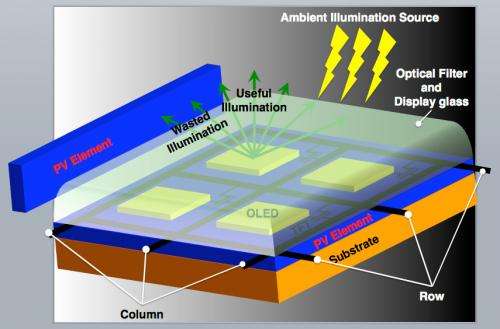
A thin-film system harvests energy from wasted light in an OLED display. Image credit: Arokia Nathan (via IEEE)
(PhysOrg.com) -- With the world's showroom floors crammed with prototype smartphones promising advanced functions, bigger displays, stunning resolution, wouldnt you think the biggest crowd-pleasers would dominate? The ultimate attraction in a smartphone, the one that never has to be charged again? This ultimate solution at least has scientists working toward that end, to bring in an easier time where users will not need to worry about the batteries wearing out.
A team of researchers at the University of Cambridge are getting closer. Their idea is to harvest energy from wasted light in an OLED display. They are working on technology where users will not need to plug in their smartphones for recharging at least as often. In their project, an OLED screen uses solar cells to absorb scattered and wasted light, sending it back into the screen.
IEEE Fellow Arokia Nathan along with the Cambridge team have developed a prototype device that converts ambient light into electricity. Solar cells used in the prototype are made of thin film hydrogenated amorphous silicon, within the smartphone screen.
Only around 36 percent of the light produced by an OLED display is projected forwards; the rest escapes around the edges, in the form of scatter and bleeding from the edges. The researchers worked on a solution where they could harvest whats lost by installing photovoltaic cells on the back and sides of OLED screens to capture the loss.
They also worked out a solutiona thin-film transistor circuit--to even out the voltage spikes produced by the solar cells, as fluctuations in the voltage provided by the solar cell could damage the phones battery. The device captures both ambient light and the otherwise wasted screen light leaking around the edges.
According to reports, the team worked with the energy group at Cambridge's Centre for Advanced Photonics and Electronics to integrate a thin-film supercapacitor for intermediate energy storage.
The end result is a system that makes use of photovoltaics, transistors, and supercapacitor. The system would achieve an efficiency of 11 percent and peak efficiency, 18 percent.
The numbers, for the smartphone user, would promise at least less strain on their battery. The Cambridge teams effort is not promising never-again recharging but an ability for the user to save a fraction of power.
More work is ahead. The team is exploring different circuit designs and materials with the aim of increasing the energy harvesting systems efficiency. Nathan has said other energy scavenging schemes such as MEMS based kinetic energy harvesting may bring improvements.
More information:
via IEEE
© 2011 PhysOrg.com
-
Colored solar cells could make display screens more efficient
Oct 07, 2011 |
not rated yet |
0
-
Design optimization could help maximize the power conversion efficiency of thin-film silicon solar cells
Sep 05, 2011 |
not rated yet |
0
-
E-paper unplugged is key draw at Japan show
Nov 01, 2011 |
not rated yet |
0
-
Nano-tuned solar cells
May 18, 2011 |
not rated yet |
0
-
Nanostructures improve solar cell efficiency
May 26, 2011 |
not rated yet |
0
-
Stars containing dark matter should look different from other stars
Feb 20, 2012 |
4.5 / 5 (17) |
11
-
Physicists discover evidence of rare hypernucleus, a component of strange matter
Feb 17, 2012 |
4.7 / 5 (38) |
22
-
Fast photon control brings quantum photonic technologies closer
Feb 13, 2012 |
5 / 5 (8) |
1
-
Engineers build first sub-10-nm carbon nanotube transistor
Feb 01, 2012 |
4.9 / 5 (36) |
32
-
Something old, something new: Evolution and the structural divergence of duplicate genes
Jan 31, 2012 |
4.6 / 5 (7) |
1
-
Calculating forces involved in seesaw motion
4 hours ago
-
Writing shear and moment equations for a simple beam problem?
5 hours ago
-
Furnace Shell Spray Cooling Design
21 hours ago
-
Ways to measure the speed of a golf ball?
Feb 21, 2012
-
Water Skin Effect in Plastic Pipe
Feb 21, 2012
-
Undergraduate Engineering Physics To Graduate Aerospace Engineering
Feb 21, 2012
- More from Physics Forums - General Engineering
More news stories
Stanford research team cracks animated NuCaptcha
(PhysOrg.com) -- The research team from Stanford University, led by Elie Bursztein, that previously had cracked regular CAPTCHAs and then audio CAPTCHAs, now has also successfully cracked the animated version called NuCapt ...
Tiny, implantable medical device can propel itself through bloodstream
Someday, your doctor may turn to you and say, "Take two surgeons and call me in the morning." If that day arrives, you may just have Ada Poon to thank.
17 hours ago |
5 / 5 (9) |
8
|
Italian engineer invents floating solar panels
Rays of the winter sun bounce off gleaming mirrors on the tiny lake of Colignola in Italy, where engineers have built a cost-effective prototype for floating, rotating solar panels.
Technology / Energy & Green Tech
21 hours ago |
4.7 / 5 (6) |
5
Microsoft hits Motorola, Google with EU complaint
Microsoft on Wednesday lodged a formal complaint with the European Union's competition regulator against Motorola Mobility and its soon-to-be owner Google, saying Motorola's aggressive enforcement of patent ...
16 hours ago |
2 / 5 (1) |
2
Calif. pledges better mobile privacy disclosures
(AP) -- Mobile applications seeking to collect personal information will have to forewarn users as part of an agreement reached in California.
9 hours ago |
not rated yet |
0
Researchers build first physical 'metatronic' circuit
(PhysOrg.com) -- The technological world of the 21st century owes a tremendous amount to advances in electrical engineering, specifically, the ability to finely control the flow of electrical charges using ...
Spitzer finds solid buckyballs in space
(PhysOrg.com) -- Astronomers using data from NASA's Spitzer Space Telescope have, for the first time, discovered buckyballs in a solid form in space. Prior to this discovery, the microscopic carbon spheres ...
Faster than light neutrinos? More like faulty wiring
You can shelf your designs for a warp drive engine (for now) and put the DeLorean back in the garage; it turns out neutrinos may not have broken any cosmic speed limits after all.
Physicists surprised by disappearing and reappearing superconductivity in iron selenium chalcogenides
Superconductivity is a rare physical state in which matter is able to conduct electricity -- maintain a flow of electrons -- without any resistance. This phenomenon can only be found in certain materials at low temperatures, ...
CT colonography shown to be comparable to standard colonoscopy
Computerized tomographic (CT) colonography (CTC), also known as virtual colonoscopy, is comparable to standard colonoscopy in its ability to accurately detect cancer and precancerous polyps in people ages 65 and older, according ...
Study: Virtual colonoscopy effective screening tool for adults over 65
Computed tomography (CT) colonography can be used as a primary screening tool for colorectal cancer in adults over the age of 65, according to a new study published online in the journal Radiology.
Jan 22, 2012
Rank: 3 / 5 (4)
Jan 22, 2012
Rank: 2 / 5 (8)
Where does it spend the majority of time? In your pocket, where the sun doesn't shine.
Jan 22, 2012
Rank: 1.5 / 5 (2)
Jan 22, 2012
Rank: 2.5 / 5 (4)
If this film can collect light from the bottom then combine the film back to back to collect light from both sides.
Jan 22, 2012
Rank: 3.7 / 5 (6)
Jan 22, 2012
Rank: 3.4 / 5 (5)
All you had to do is look at the diagram at the top and it show you the film on top of the screen collecting light escaping from the screen.
Jan 22, 2012
Rank: 5 / 5 (5)
Actually, my phone spends more time sitting on my desk or a table. Also, one of purposes of this is to capture the light lost when your phone's screen is lit up.
This might not be the best solution for you; if you don't have your phone's screen on for more than 15 or 20 minutes a day, that would be understandable. That doesn't mean it couldn't greatly benefit some people (myself included) who would be pleased to see this further on in it's development.
Jan 22, 2012
Rank: 3.5 / 5 (2)
Jan 22, 2012
Rank: 4 / 5 (6)
Anyone who proposes censorship outside of racist and hate-mongering remarks on this forum is out of line, but still has the right to post it. Self-promotion of one's business, though, is in bad form, I'd say.
Jan 23, 2012
Rank: 1.3 / 5 (3)
If 64% of OLED light is wasted as scatter, and 18% can be converted to electricity that means 11.5% of the power used by can potentially be saved. Im not sure what percentage of power is used to run the screen, lets be generous and say 80%. So thats 9.2% increase in battery life from this add on, if your phone usually lasts 24 hours between charges, it will now last 2.208 hours longer.
A revolution this is not, and given the cost of the device it will never be put into production since its only saving a few cents worth of power.
@JazzyLawnService : Put down the GreenPeace guide to internet propoganda, try to resist your obviously facist nature and learn some maths.
Jan 23, 2012
Rank: 5 / 5 (1)
There's infrared radiation in your pocket. If the solar cells are tweaked to use primarily that (even though the energy is lower) it could be worth it.
The article also mentions that in addition to the wasted light from the OLED it captures ambient light.
Jan 23, 2012
Rank: 1 / 5 (2)
Jan 28, 2012
Rank: 1 / 5 (1)
Yes it uses ambient light as well as light from the screen
No article doesant claim it will never need recharging just that the reserchers are iming for that goal and currently with this tech plugging in to charge will be less often.
Also Jazzy is largly right - exept of course for the somewhat over the top oppinion that any that dissagreed needed to be shall i be kind and say stay silent.
Feb 07, 2012
Rank: 1 / 5 (1)
I never claimed the author said it never needed recharging, i merely claimed the author barely held back from doing so in their breathless desperation to overhype this trivial advance. Regarding reading comprehension, people in glass houses Marky...