Carnivorous plant traps worms with sticky leaves
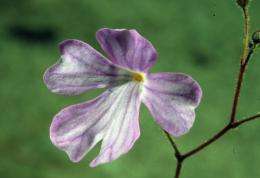
January 9, 2012 By Katharine Gammon
Credit: Rafael Oliveira
Plants eat the darndest things. Scientists have discovered a small flowering plant living in the sandy soils of Brazil that traps nematodes, or roundworms, with sticky underground leaves -- and gobbles them up.
"It's a great example of how plants, which can't move to find food and water, are able to develop interesting mechanisms to deal [with] extreme environments," said Rafael Oliveira, a professor of botany at the State University of Campinas, in Sao Paulo, in Brazil, who described the plant in research published today in the Proceedings of the National Academy of Sciences.
The plant, called Philcoxia minensis, lives in sandy soils in a tiny region of the Cerrado, a tropical savannah region in Brazil. In addition to regular leaves which are suspended above ground and use the energy of the sun to convert carbon dioxide into sugars, Philcoxia also has a network of tiny underground leaves, each about the size of a pinhead, able to grab sunlight through the white sandy soil.
Those underground leaves also have a darker purpose: they contain glands secreting a sticky mucus that traps tiny worms and starts to digest them.
To test if the plant was truly digesting the worms or simply trapping them to create more organic matter in the soil, the scientists fed the plants lab-raised nematodes that were marked with an uncommon isotope of nitrogen, a form that contains eight neutrons instead of the usual seven. They then tested the hungry plant's leaves, and found the same stable isotope present -- telling them that the worms were indeed digested with enzymes and not just broken down by microbes in the soil.
Oliveira first learned about Philcoxia from a colleague who had visited the remote site where it lives and described a plant with underground leaves. "I had never seen a plant with underground leaves before," he said. "It doesn't make a lot of sense to have leaves underground because there is less sunlight -- so we hypothesized they're getting some other kind of benefit from the leaves."
The discovery is also a call for more conservation in the Cerrado, one of the world's 34 biodiversity hotspots and the region where Oliveira was born. He said that while most efforts to preserve plants and animals focus on the rainforest, other fascinating ecosystems like the Cerrado don't often get much attention or conservation.
Carnivorous plants are often found in tough environments with few nutrients, a deficit they make up with protein from insects, or even small rodents as in the case of a type of pitcher plant. Protein-devouring plants seem to capture the imagination of everyone, and fortunately for Hollywood, there are likely many more waiting to be discovered.
"Carnivorous plants are like orchids: there is a lot of interest in finding more plants," said Aaron Ellison, a researcher at Harvard Forest in Petersham, Mass.. "I suspect as we look for more, "we'll find more than the 600 or so spread across the plant world."
On the other hand, said Ellison, almost all plants get their nutrients from organic matter somehow. They just don't directly trap and digest it.
"There are certainly other plants with modified underground leaves that are carnivorous in some way -- some eat protozoa, others eat zooplankton or small insects," said Ellison. He added that welcoming another carnivorous plant into a new family, especially one that has the ability to trap and eat nematodes with sticky leaves, is good for natural history.
Barry Rice, a carnivorous plant expert at Sierra College, in Rocklin, Calif., who previously worked at the Nature Conservancy, said Philcoxia's sticky underground leaves are a novel -- and surprising -- strategy. "What else have we missed? It never stops to embarrass me that we spend so little on exploring our own planet."
More information: Underground leaves of Philcoxia trap and digest nematodes, PNAS, Published online before print January 9, 2012, doi: 10.1073/pnas.1114199109
Abstract
The recently described genus Philcoxia comprises three species restricted to well lit and low-nutrient soils in the Brazilian Cerrado. The morphological and habitat similarities of Philcoxia to those of some carnivorous plants, along with recent observations of nematodes over its subterranean leaves, prompted the suggestion that the genus is carnivorous. Here we report compelling evidence of carnivory in Philcoxia of the Plantaginaceae, a family in which no carnivorous members are otherwise known. We also document both a unique capturing strategy for carnivorous plants and a case of a plant that traps and digests nematodes with underground adhesive leaves. Our findings illustrate how much can still be discovered about the origin, distribution, and frequency of the carnivorous syndrome in angiosperms and, more generally, about the diversity of nutrient-acquisition mechanisms that have evolved in plants growing in severely nutrient-impoverished environments such as the Brazilian Cerrado, one of the world's 34 biodiversity hotspots.
Provided by IInside Science News Service
-
For carnivorous plants, slow but steady wins the race
Sep 14, 2009 |
not rated yet |
0
-
Snaring bigger bugs gave flytraps evolutionary edge
Aug 26, 2009 |
not rated yet |
0
-
Insects use plant like a telephone
Apr 23, 2008 |
not rated yet |
0
-
Discovery of plant protein holds promise for biofuel production
Aug 16, 2008 |
not rated yet |
0
-
Leaves of carnivorous plants emit flower scents to attract their prey
May 07, 2010 |
not rated yet |
0
-
Stars containing dark matter should look different from other stars
Feb 20, 2012 |
4.5 / 5 (17) |
11
-
Physicists discover evidence of rare hypernucleus, a component of strange matter
Feb 17, 2012 |
4.7 / 5 (38) |
22
-
Fast photon control brings quantum photonic technologies closer
Feb 13, 2012 |
5 / 5 (8) |
1
-
Engineers build first sub-10-nm carbon nanotube transistor
Feb 01, 2012 |
4.9 / 5 (36) |
32
-
Something old, something new: Evolution and the structural divergence of duplicate genes
Jan 31, 2012 |
4.6 / 5 (7) |
1
-
Eye biology videos
3 hours ago
-
Flowering Plant Revived After 30,000 Years in Permafrost
Feb 21, 2012
-
Toba volcano eruptions - 1.000 - 10,000 breeding pairsunb
Feb 20, 2012
-
How is a specific gene removed from DNA
Feb 20, 2012
-
Reproduction and Human evolution
Feb 19, 2012
-
Viruses: Living or Non-living organisms
Feb 19, 2012
- More from Physics Forums - Biology
More news stories
Surprising diversity at a synapse hints at complex diversity of neural circuitry
A new study reveals a dazzling degree of biological diversity in an unexpected place a single neural connection in the body wall of flies.
10 hours ago |
5 / 5 (4) |
0
|
Men might not 'become extinct' after all: Theory of the 'rotting' Y chromosome dealt a fatal blow
If you were to discover that a fundamental component of human biology has survived virtually intact for the past 25 million years, you'd be quite confident in saying that it is here to stay.
13 hours ago |
5 / 5 (6) |
1
|
New family of legless amphibians found in India
Since before the age of dinosaurs it has burrowed unbothered beneath the monsoon-soaked soils of remote northeast India - unknown to science and mistaken by villagers as a deadly, miniature snake.
20 hours ago |
5 / 5 (8) |
3
Climate change affects bird migration timing in North America
Bird migration timing across North America has been affected by climate change, according to a study published Feb. 22 in the open access journal PLoS ONE.
9 hours ago |
4.5 / 5 (2) |
2
New iridescent lizard species found in Cambodia
A new species of lizard with striking iridescent rainbow skin, a long tail and very short legs has been discovered in the rainforest in northeast Cambodia, conservationists announced Wednesday.
9 hours ago |
not rated yet |
0
Researchers build first physical 'metatronic' circuit
(PhysOrg.com) -- The technological world of the 21st century owes a tremendous amount to advances in electrical engineering, specifically, the ability to finely control the flow of electrical charges using ...
Spitzer finds solid buckyballs in space
(PhysOrg.com) -- Astronomers using data from NASA's Spitzer Space Telescope have, for the first time, discovered buckyballs in a solid form in space. Prior to this discovery, the microscopic carbon spheres ...
Faster than light neutrinos? More like faulty wiring
You can shelf your designs for a warp drive engine (for now) and put the DeLorean back in the garage; it turns out neutrinos may not have broken any cosmic speed limits after all.
CT colonography shown to be comparable to standard colonoscopy
Computerized tomographic (CT) colonography (CTC), also known as virtual colonoscopy, is comparable to standard colonoscopy in its ability to accurately detect cancer and precancerous polyps in people ages 65 and older, according ...
Physicists surprised by disappearing and reappearing superconductivity in iron selenium chalcogenides
Superconductivity is a rare physical state in which matter is able to conduct electricity -- maintain a flow of electrons -- without any resistance. This phenomenon can only be found in certain materials at low temperatures, ...
Study: Virtual colonoscopy effective screening tool for adults over 65
Computed tomography (CT) colonography can be used as a primary screening tool for colorectal cancer in adults over the age of 65, according to a new study published online in the journal Radiology.
Jan 09, 2012
Rank: 1.4 / 5 (10)
But what is the comment that "plants are able to develop mechanisms..."? Finding such a mechanism in a plant is zero proof of anything that has to do with evolution. Trying to connect the two is fraud science at best.
Please stick with real science.
Jan 09, 2012
Rank: 5 / 5 (1)
Jan 10, 2012
Rank: not rated yet
do you mean: "It's a great example of how plants, which can't move to find food and water, are able to develop interesting mechanisms to deal [with] extreme environments,"
To be honest, there's nothing there that actually mentions evolution. We can't actually 'prove' evolution anyway, but we can make educated guesses. This plant has developed a mechanism to allow it to deal with harsh environments, which we believe has occured because the plants which were less fit were selected against.
Jan 10, 2012
Rank: not rated yet