Chemists unlock potential target for drug development
January 19, 2012
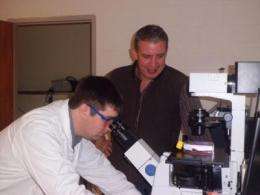
Chemistry professor Dana Spence, right, is seen working in his lab with a graduate student. Credit: MSU University Relations
A receptor found on blood platelets whose importance as a potential pharmaceutical target has long been questioned may in fact be fruitful in drug testing, according to new research from Michigan State University chemists.
A team led by Dana Spence of MSU's Department of Chemistry has revealed a way to isolate and test the receptor known as P2X1. By creating a new, simple method to study it after blood is drawn, the team has unlocked a potential new drug target for many diseases that impact red blood cells, such as diabetes, hypertension and cystic fibrosis.
Researchers can evaluate the receptor not only in developing new drugs but also re-testing existing medications that could work now by attaching to the receptor.
"Scientists are always looking for new 'druggable' receptors in the human body," Spence said. "This receptor, P2X1, has long been viewed as not important in platelets; our studies show that is not necessarily true. The receptor is very active; you just need to be careful in working with it."
The research is published in the current issue of Analytical Methods, a journal from the Royal Society of Chemistry in London.
The main job of platelets is to help prevent bleeding via clotting, Spence said. They work by getting sticky in the bloodstream, but the problem with some diseases such as diabetes or sickle-cell anemia is that the platelets get sticky even when they shouldn't, preventing proper blood flow and blocking vessels.
Platelets are activated when their receptors are "turned on"; currently, researchers have always focused on the P2Y receptor, which is easily studied. On the other hand, the P2X1 receptor was not thought to play a major role in platelet activation, and it proved very troublesome to study since it became desensitized once blood is drawn from the body, Spence said.
Though scientists tried a pair of methods to get around that issue by using different additives or enzymes the results did not prove fruitful in studying the receptor.
What Spence and his team found is that by adding a simple molecule called NF449 originally thought to block the receptor they were able to activate the P2X1 receptor in platelets after a blood draw.
"We have discovered a way to prepare and handle platelets so that we can study the receptor authentically," he said. "This research opens up new avenues of study and will allow researchers and pharmaceutical companies to re-appraise this receptor as a druggable target."
More information: The research paper can be found at Analytical Methods at http://pubs.rsc.or … y/c1ay05530e
-
How life-threatening blood clots take hold
Apr 16, 2009 |
not rated yet |
0
-
Control of blood clotting by platelets described; provides medical promise
Nov 24, 2009 |
not rated yet |
0
-
Method for manufacturing patient-specific human platelets
Nov 22, 2010 |
not rated yet |
0
-
New molecule could be key to anti-heart attack drug
Apr 18, 2008 |
not rated yet |
0
-
Snake venom studies yield insights for development of therapies for heart disease and cancer
Jul 29, 2010 |
not rated yet |
0
-
Stars containing dark matter should look different from other stars
Feb 20, 2012 |
4.5 / 5 (17) |
11
-
Physicists discover evidence of rare hypernucleus, a component of strange matter
Feb 17, 2012 |
4.7 / 5 (38) |
22
-
Fast photon control brings quantum photonic technologies closer
Feb 13, 2012 |
5 / 5 (8) |
1
-
Engineers build first sub-10-nm carbon nanotube transistor
Feb 01, 2012 |
4.9 / 5 (36) |
32
-
Something old, something new: Evolution and the structural divergence of duplicate genes
Jan 31, 2012 |
4.6 / 5 (7) |
1
-
Cis-trans Selectivity in Wittig Reactions
3 hours ago
-
Chemical Kinetics
3 hours ago
-
heat-driven chemical reaction and thermodynamics
10 hours ago
-
phenol to benzene
14 hours ago
-
TQM, QA and QC
15 hours ago
-
oxidising power
21 hours ago
- More from Physics Forums - Chemistry
More news stories
Scientists create potent molecules aimed at treating muscular dystrophy
While RNA is an appealing drug target, small molecules that can actually affect its function have rarely been found. But now scientists from the Florida campus of The Scripps Research Institute have for the first time designed ...
9 hours ago |
5 / 5 (4) |
0
|
Flesh-eating bacteria inspire superglue
(PhysOrg.com) -- A bio-inspired superglue has been developed by Oxford University researchers that cant be matched for sticking molecules together and not letting go.
20 hours ago |
5 / 5 (8) |
3
|
Researchers discover what cancer cells need to travel
(PhysOrg.com) -- Cancer cells must prepare for travel before invading new tissues, but new Cornell research has found a possible way to stop these cells from ever hitting the road.
19 hours ago |
4.9 / 5 (12) |
0
|
New microfluidic device could be used to diagnose and monitor cancer and other diseases
Separating complex mixtures of cells, such as those found in a blood sample, can offer valuable information for diagnosing and treating disease. However, it may be necessary to search through billions of other ...
Chemistry / Analytical Chemistry
19 hours ago |
5 / 5 (2) |
0
|
New way to tap largest remaining treasure trove of potential new antibiotics
Scientists are reporting use of a new technology for sifting through the world's largest remaining pool of potential antibiotics to discover two new antibiotics that work against deadly resistant microbes, ...
12 hours ago |
5 / 5 (4) |
0
Researchers build first physical 'metatronic' circuit
(PhysOrg.com) -- The technological world of the 21st century owes a tremendous amount to advances in electrical engineering, specifically, the ability to finely control the flow of electrical charges using ...
Spitzer finds solid buckyballs in space
(PhysOrg.com) -- Astronomers using data from NASA's Spitzer Space Telescope have, for the first time, discovered buckyballs in a solid form in space. Prior to this discovery, the microscopic carbon spheres ...
Faster than light neutrinos? More like faulty wiring
You can shelf your designs for a warp drive engine (for now) and put the DeLorean back in the garage; it turns out neutrinos may not have broken any cosmic speed limits after all.
CT colonography shown to be comparable to standard colonoscopy
Computerized tomographic (CT) colonography (CTC), also known as virtual colonoscopy, is comparable to standard colonoscopy in its ability to accurately detect cancer and precancerous polyps in people ages 65 and older, according ...
Physicists surprised by disappearing and reappearing superconductivity in iron selenium chalcogenides
Superconductivity is a rare physical state in which matter is able to conduct electricity -- maintain a flow of electrons -- without any resistance. This phenomenon can only be found in certain materials at low temperatures, ...
Study: Virtual colonoscopy effective screening tool for adults over 65
Computed tomography (CT) colonography can be used as a primary screening tool for colorectal cancer in adults over the age of 65, according to a new study published online in the journal Radiology.