China's drive for 'green' cars hits roadblocks
January 18, 2012 by Bill Savadove
China currently only has around 100,000 electric and hybrid vehicles

Enlarge

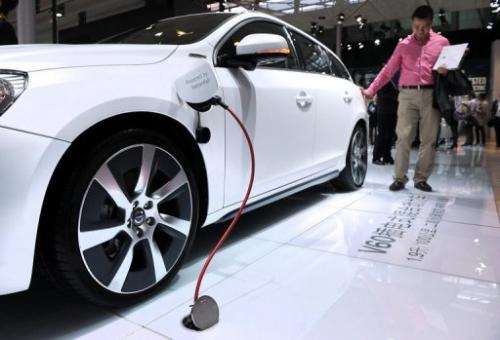
A man looks at a Volvo V60 electric car displayed at the Shanghai Auto Show in Shanghai last April. Car makers are struggling to sell environmentally friendly vehicles in China, even as Beijing pumps billions into clean energy.

Foreign and domestic car makers are struggling to sell environmentally friendly vehicles in China, the world's largest auto market, even as Beijing pumps billions into clean energy.

China wants five million "new energy" vehicles on the streets by 2020 to ease chronic pollution and reduce reliance on oil imports, but high prices, lack of infrastructure and consumer reluctance are creating major roadblocks.

The number of electric and hybrid vehicles currently in the country is tiny at about 100,000, mostly in government fleets, according to an industry estimate.

A salesman at the main Shanghai showroom of Chinese BYD said the dealer sold only one electric car and two -- which combine a conventional and an electric motor -- last year.

BYD, which is backed by US investment titan Warren Buffett, launched a fully electric vehicle for private buyers in October priced at 370,000 yuan ($60,000), though subsidies cut the cost by at least 16 percent.

"People hesitate to choose cars with a high price," said BYD sales manager Zhang Jiankun. "Although the government can provide subsidies for alternative-energy cars, the lack of charging stations is a main concern."

China had an estimated 243 charging stations at the end of 2011, but Beijing plans to invest 100 billion yuan over the next 10 years to build up the new-energy vehicle sector as a whole, focusing on electric models.

Foreign are also promoting the new technology in China.
Foreign auto makers are promoting electric cars in China but sales are slow
Enlarge

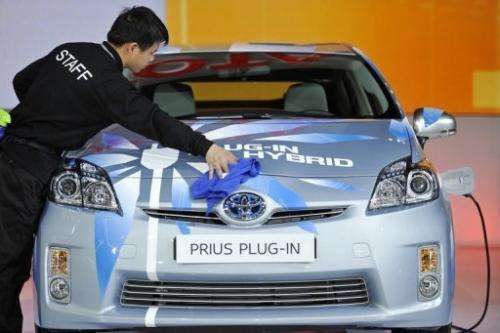
A worker cleans a Toyota Hybrid Prius displayed at the Shanghai Auto Show in April 2011. Car makers are struggling to sell environmentally friendly vehicles in China, even as Beijing pumps billions into clean energy.

US giant General Motors imported its first Chevrolet Volts into China in December and will begin selling the hybrids in early 2012 at 13 dealerships in eight cities.

But the Volt could suffer a potential image problem even as sales get under way in China as the vehicle faces a US government probe after damaged caught fire following crash tests.

GM says it has addressed the safety issue by reinforcing the battery.

The company is also developing a separate electric vehicle with its Chinese partner, domestic auto giant SAIC Motor, which itself launched five new energy vehicles in November.

"It seems every major company has its own electric-vehicle programme," Ray Bierzynski, executive director for electrification strategy of GM China, told reporters last year.

China overtook the US to become the world's top in 2009 and is increasingly important for global players as economic turmoil hits demand in developed markets.

But the push for clean-energy cars comes as China's overall sales slow. Auto sales rose just 2.5 percent to 18.51 million units last year, compared with an increase of more than 32 percent in 2010.

China wants five million "new energy" vehicles on the streets by 2020 to ease chronic pollution
Enlarge

Drivers get stuck in traffic in Beijing on a "Car Free Day" in 2010. Car makers are struggling to sell environmentally friendly vehicles in China, even as Beijing pumps billions into clean energy.

China had hoped to vault its car companies into the top ranks of electric-vehicle producers but in recent months has reconsidered that strategy given the technological lead of foreign firms, and is now focusing more on hybrids.

The government is keen to build up its domestic auto industry so it has slapped import tariffs on some US passenger cars and sports utility vehicles, and said it would "withdraw support" for foreign investment in the sector.

"At the beginning the objective was, literally, to leapfrog. They have realised this is far too over ambitious," said Klaus Paur, director for automotive analysis at market research agency Ipsos in China.

"Currently, the government is re-visiting the strategy on (fully) electric vehicles. This is why they push more into the hybrids," he said.

However, one industry executive said the move did not indicate a "dramatic shift" in China's commitment to electrification.

"As we move down that path, there's a more realistic view of how quickly people can move and how some of the challenges can be addressed," Kevin Wale, president and managing director of GM China Group, told reporters.

The challenge includes building the infrastructure for charging batteries and convincing consumers to trust the technology. China has set up 15 pilot zones for electric vehicles across the country to this aim.

But in a country where car culture is only two decades old and fuel prices are controlled by the government, flashy luxury brands carry more appeal.

"To me, the performance of a car is the top priority, including how powerful it is," said marketing manager Gu Jiahuan, who is shopping for a car.

"Alternative-energy cars are not mature enough. And pure electric cars cannot go very far."

(c) 2012 AFP

Filter


Move the slider to adjust rank threshold, so that you can hide some of the comments.


Display comments: newest first

Burnerjack
Jan 18, 2012

Rank: not rated yet
Last time I looked, amid horrific pollution (all types, air in particular), their cars are STILL not equipped with catalytic converters. I suspect any "push" for green cars would be to limit the financial impact of foreign oil imports. Quality of life, or even national health does not appear to be a priority. Yet.
bredmond
Jan 19, 2012

Rank: not rated yet
Mao had similar ideas about leapfroging. he didnt use those words though. Anyway, he wanted to "Pass america and catch up to russia" in terms of production. They ended all agricultural production except for grain, and they appropriated all metal and kitchen equipment and formed backyard forges for smelting, including for equipment for communal kitchens. with their excessive fertilization and seeding, almost nothing grew. the backyard forges were not good enough and the equipment they made broke. there was not enough food, and 30 million people died. It was called the second five year plan, or 'the great leap forwrd'. http://en.wikiped..._forward
Rank not rated yet
Related Stories
Relevant PhysicsForums posts

More news stories

Stanford research team cracks animated NuCaptcha

(PhysOrg.com) -- The research team from Stanford University, led by Elie Bursztein, that previously had cracked regular CAPTCHAs and then audio CAPTCHAs, now has also successfully cracked the animated version called NuCapt ...

Technology / Computer Sciences

created 17 hours ago | popularity 5 / 5 (3) | comments 6 | with audio podcast report

Tiny, implantable medical device can propel itself through bloodstream

Someday, your doctor may turn to you and say, "Take two surgeons and call me in the morning." If that day arrives, you may just have Ada Poon to thank.

Technology / Engineering

created 17 hours ago | popularity 5 / 5 (9) | comments 8 | with audio podcast

Italian engineer invents floating solar panels

Rays of the winter sun bounce off gleaming mirrors on the tiny lake of Colignola in Italy, where engineers have built a cost-effective prototype for floating, rotating solar panels.

Technology / Energy & Green Tech

created 21 hours ago | popularity 4.7 / 5 (6) | comments 5

Microsoft hits Motorola, Google with EU complaint

Microsoft on Wednesday lodged a formal complaint with the European Union's competition regulator against Motorola Mobility and its soon-to-be owner Google, saying Motorola's aggressive enforcement of patent ...

Technology / Business

created 16 hours ago | popularity 2 / 5 (1) | comments 2

Calif. pledges better mobile privacy disclosures

(AP) -- Mobile applications seeking to collect personal information will have to forewarn users as part of an agreement reached in California.

Technology / Internet

created 9 hours ago | popularity not rated yet | comments 0


Researchers build first physical 'metatronic' circuit

(PhysOrg.com) -- The technological world of the 21st century owes a tremendous amount to advances in electrical engineering, specifically, the ability to finely control the flow of electrical charges using ...

Spitzer finds solid buckyballs in space

(PhysOrg.com) -- Astronomers using data from NASA's Spitzer Space Telescope have, for the first time, discovered buckyballs in a solid form in space. Prior to this discovery, the microscopic carbon spheres ...

Faster than light neutrinos? More like faulty wiring

You can shelf your designs for a warp drive engine (for now) and put the DeLorean back in the garage; it turns out neutrinos may not have broken any cosmic speed limits after all.

Physicists surprised by disappearing and reappearing superconductivity in iron selenium chalcogenides

Superconductivity is a rare physical state in which matter is able to conduct electricity -- maintain a flow of electrons -- without any resistance. This phenomenon can only be found in certain materials at low temperatures, ...

CT colonography shown to be comparable to standard colonoscopy

Computerized tomographic (CT) colonography (CTC), also known as virtual colonoscopy, is comparable to standard colonoscopy in its ability to accurately detect cancer and precancerous polyps in people ages 65 and older, according ...

Study: Virtual colonoscopy effective screening tool for adults over 65

Computed tomography (CT) colonography can be used as a primary screening tool for colorectal cancer in adults over the age of 65, according to a new study published online in the journal Radiology.