Resolving controversy at the water's edge
January 27, 2012
Resolving controversy at the water’s edge

Enlarge

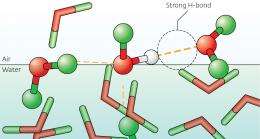
Figure 1: A ‘snapshot’ from a molecular dynamic simulation reveals that water molecules align at air-water interfaces as coordinated pairs linked by hydrogen bonds. Credit: 2012 RIKEN

Water (H2O) has a simple composition, but its dizzyingly interconnected hydrogen-bonded networks make structural characterizations challenging. In particular, the organization of water surfaces—a region critical to processes in cell biology and atmospheric chemistry—has caused profound disagreements among scientists. Now, Tahei Tahara and colleagues from the RIKEN Advanced Science Institute in Wako, in collaboration with researchers in Japan and Europe, have uncovered the presence of strongly bonded water pairs at the air–water interface, rather than previously hypothesized ‘ice-like’ surface structures. 

Observing surface molecules, just a few monolayers thick, requires special experimental techniques that prevent interference by more plentiful bulk particles. One such approach is called vibrational sum frequency generation (VSFG), a laser-based method that selectively vibrates interfacial molecules. Previous VSFG measurements of surface water showed two vibrations that resemble signals recorded from bulk ice and liquid water states. Some scientists have proposed that these vibrations correspond to a partially disordered mix of liquid and four-coordinated ice-like surface structures—a theory at odds with thermodynamic evidence. 

Other VSFG experiments, however, have suggested that the two vibrations arise from one structure undergoing coupling interactions. To resolve this dispute, Tahara and colleagues turned to heterodyne-detected VSFG (HD-VSFG), a high-level spectroscopic method that detects how the phase of the vibrational signals shifts with respect to the incident laser beam—information that can pinpoint molecular orientation at interfaces.

The researchers then employed a trick using isotopes to account for coupling effects of water molecules: they added the deuterium (D)-bearing compounds HOD and D2O to pure water. By gradually diluting the number of oxygen– (OH) bonds in the liquid, these isotopes suppress the interactions between the vibrational modes that normally occur. The remaining ‘stretching’ vibrations that extend and contract OH  bonds then provide clear information about the interfacial water structure. 

The team’s experiments revealed that as the isotopic dilution progressed, the two OH bands merged into a single peak, which is clear evidence of vibrational coupling within a single structure. After performing molecular dynamic simulations and comparing the results to the HD-VSFG data, a new picture emerged of the air–water interface (Fig. 1): the low-frequency OH vibrations were due to tightly joined pairs of liquid water molecules.

“We were wondering what kind of structure can have strong hydrogen-bonds other than ice at water surfaces,” says Tahara. “When our experiments and [co-author] Morita’s simulation answered the question, rather than surprise I felt that ‘This is it!’ because its structure is quite reasonable.”

More information: Nihonyanagi, S., et al. Unified molecular view of air/water interface based on experimental and theoretical χ(2) spectra of isotopically diluted water surface. Journal of the American Chemical Society 133, 16875–16880 (2011).

Provided by RIKEN (news : web)

4.5 /5 (4 votes)  

Filter


Move the slider to adjust rank threshold, so that you can hide some of the comments.


Display comments: newest first

Callippo
Jan 27, 2012

Rank: not rated yet
presence of strongly bonded water pairs at the airwater interface
It could be analogy of anyon (cooper pair) formation inside of thin layers of superconductors or the nucleon pair formation at the surface of atoms. The pairing of sun spots is the symmetry breaking of the same category.
Rank 4.5 /5 (4 votes)
Tags

Relevant PhysicsForums posts

More news stories

Researchers build first physical 'metatronic' circuit

(PhysOrg.com) -- The technological world of the 21st century owes a tremendous amount to advances in electrical engineering, specifically, the ability to finely control the flow of electrical charges using ...

Physics / General Physics

created 10 hours ago | popularity 4.7 / 5 (17) | comments 5 | with audio podcast

Faster than light neutrinos? More like faulty wiring

You can shelf your designs for a warp drive engine (for now) and put the DeLorean back in the garage; it turns out neutrinos may not have broken any cosmic speed limits after all.

Physics / General Physics

created 10 hours ago | popularity 4.2 / 5 (22) | comments 23 | with audio podcast

Physicists surprised by disappearing and reappearing superconductivity in iron selenium chalcogenides

Superconductivity is a rare physical state in which matter is able to conduct electricity -- maintain a flow of electrons -- without any resistance. This phenomenon can only be found in certain materials at low temperatures, ...

Physics / Superconductivity

created 14 hours ago | popularity 5 / 5 (5) | comments 2 | with audio podcast

Less is more: Study of tiny droplets could have big impact on industrial applications

(PhysOrg.com) -- Under a microscope, a tiny droplet slides between two fine hairs like a roller coaster on a set of rails until — poof — it suddenly spreads along them, a droplet no more.

Physics / General Physics

created 11 hours ago | popularity 3.7 / 5 (3) | comments 0 | with audio podcast

Study reveals switching mechanism in promising computer memory device

(PhysOrg.com) -- Sometimes knowing that a new technology works is not enough. You also must know why it works to get marketplace acceptance. New information from the National Institute of Standards and Technology ...

Physics / General Physics

created 18 hours ago | popularity 4 / 5 (4) | comments 0 | with audio podcast


Spitzer finds solid buckyballs in space

(PhysOrg.com) -- Astronomers using data from NASA's Spitzer Space Telescope have, for the first time, discovered buckyballs in a solid form in space. Prior to this discovery, the microscopic carbon spheres ...

Stanford research team cracks animated NuCaptcha

(PhysOrg.com) -- The research team from Stanford University, led by Elie Bursztein, that previously had cracked regular CAPTCHAs and then audio CAPTCHAs, now has also successfully cracked the animated version called NuCapt ...

Going up: Japan builder eyes space elevator

A Japanese construction firm claimed Wednesday it could execute an out-of-this-world plan to put tourists in space within 40 years by building an elevator that stretches a quarter of the way to the moon.

Flesh-eating bacteria inspire superglue

(PhysOrg.com) -- A bio-inspired superglue has been developed by Oxford University researchers that can’t be matched for sticking molecules together and not letting go.

ENASA satellite finds Earth's clouds are getting lower

(PhysOrg.com) -- Earth's clouds got a little lower -- about one percent on average -- during the first decade of this century, finds a new NASA-funded university study based on NASA satellite data. The results ...

Scientists create potent molecules aimed at treating muscular dystrophy

While RNA is an appealing drug target, small molecules that can actually affect its function have rarely been found. But now scientists from the Florida campus of The Scripps Research Institute have for the first time designed ...