DNA motor programmed to navigate a network of tracks
January 22, 2012
DNA motor programmed to navigate a network of tracks

Enlarge

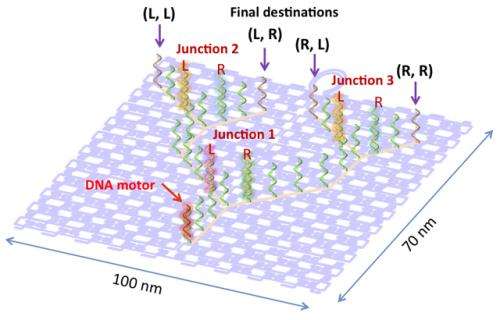
A depiction of a DNA origami tile with a built-in network of tracks. The DNA engine or motor, in red, can be programmed to navigate a series of junctions to reach one of four desired end points. Credit: Sugiyama Lab, Kyoto University iCeMS.

Expanding on previous work with engines traveling on straight tracks, a team of researchers at Kyoto University and the University of Oxford have successfully used DNA building blocks to construct a motor capable of navigating a programmable network of tracks with multiple switches. The findings, published in the January 22 online edition of the journal Nature Nanotechnology, are expected to lead to further developments in the field of nanoengineering.

The research utilizes the technology of DNA origami, where strands of are sequenced in a way that will cause them to self-assemble into desired 2D and even . In this latest effort, the scientists built a network of tracks and switches atop DNA origami tiles, which made it possible for to travel along these rail systems.

"We have demonstrated that it is not only possible to build that function autonomously," explained Dr. Masayuki Endo of Kyoto University's Institute for Integrated Cell-Material Sciences (iCeMS), "but that we can cause such devices to produce predictable outputs based on different, controllable starting conditions."

The team, including lead author Dr. Shelley Wickham at Oxford, expects that the work may lead to the development of even more complex systems, such as programmable molecular assembly lines and sophisticated sensors.

"We are really still at an early stage in designing DNA origami-based engineering systems," elaborated iCeMS Prof. Hiroshi Sugiyama. "The promise is great, but at the same time there are still many technical hurdles to overcome in order to improve the quality of the output. This is just the beginning for this new and exciting field."

More information: The article, "A DNA-based molecular motor that can navigate a network of tracks" by Shelley F. J. Wickham, Jonathan Bath, Yousuke Katsuda, Masayuki Endo, Kumi Hidaka, Hiroshi Sugiyama, and Andrew J. Turberfield was published online in the January 22, 2011 issue of Nature Nanotechnology. DOI: 10.1038/NNANO.2011.253

Provided by Kyoto University

Filter


Move the slider to adjust rank threshold, so that you can hide some of the comments.


Display comments: newest first

Argiod
Jan 23, 2012

Rank: not rated yet
Awesome: NanoRobotics... can't wait for the commercial nano robotics kit for experimenters...
Shifty0x88
Jan 24, 2012

Rank: not rated yet
Good luck seeing the results, at 100nmx70nm that's awful small...
Rank 5 /5 (7 votes)
Related Stories
Relevant PhysicsForums posts
  • Eye biology videos
    created3 hours ago
  • Flowering Plant Revived After 30,000 Years in Permafrost
    createdFeb 21, 2012
  • Toba volcano eruptions - 1.000 - 10,000 breeding pairsunb
    createdFeb 20, 2012
  • How is a specific gene removed from DNA
    createdFeb 20, 2012
  • Reproduction and Human evolution
    createdFeb 19, 2012
  • Viruses: Living or Non-living organisms
    createdFeb 19, 2012
  • More from Physics Forums - Biology

More news stories

New nanotechnology converts heat into power when it's needed most

Never get stranded with a dead cell phone again. A promising new technology called Power Felt, a thermoelectric device that converts body heat into an electrical current, soon could create enough juice to make another call ...

Nanotechnology / Nanophysics

created 16 hours ago | popularity 4 / 5 (8) | comments 6 | with audio podcast

Researchers discover how different nanomaterial surfaces affect proteins

A new study led by nanotechnology and biotechnology experts at Rensselaer Polytechnic Institute is providing important details on how proteins in our bodies interact with nanomaterials. In their new study, published in the ...

Nanotechnology / Bio & Medicine

created 10 hours ago | popularity 5 / 5 (2) | comments 1 | with audio podcast

Graphene is thinnest known anti-corrosion coating

New research has established the "miracle material" called graphene as the world's thinnest known coating for protecting metals against corrosion. Their study on this potential new use of graphene appears ...

Nanotechnology / Nanomaterials

created 13 hours ago | popularity 4.6 / 5 (7) | comments 2 | with audio podcast

New technique produces free-standing piezoelectric ferroelectric nanostructures from PZT material

(PhysOrg.com) -- Researchers have developed a “soft template infiltration” technique for fabricating free-standing piezoelectrically active ferroelectric nanotubes and other nanostructures from PZT ...

Nanotechnology / Nanophysics

created 17 hours ago | popularity 5 / 5 (5) | comments 4 | with audio podcast

A new twist on nanowires

Nanowires — microscopic fibers that can be “grown” in the lab — are a hot research topic today, with a variety of potential applications including light-emitting diodes (LEDs) and sensors. ...

Nanotechnology / Nanophysics

created 19 hours ago | popularity 4.8 / 5 (4) | comments 0 | with audio podcast


Researchers build first physical 'metatronic' circuit

(PhysOrg.com) -- The technological world of the 21st century owes a tremendous amount to advances in electrical engineering, specifically, the ability to finely control the flow of electrical charges using ...

Spitzer finds solid buckyballs in space

(PhysOrg.com) -- Astronomers using data from NASA's Spitzer Space Telescope have, for the first time, discovered buckyballs in a solid form in space. Prior to this discovery, the microscopic carbon spheres ...

Faster than light neutrinos? More like faulty wiring

You can shelf your designs for a warp drive engine (for now) and put the DeLorean back in the garage; it turns out neutrinos may not have broken any cosmic speed limits after all.

CT colonography shown to be comparable to standard colonoscopy

Computerized tomographic (CT) colonography (CTC), also known as virtual colonoscopy, is comparable to standard colonoscopy in its ability to accurately detect cancer and precancerous polyps in people ages 65 and older, according ...

Physicists surprised by disappearing and reappearing superconductivity in iron selenium chalcogenides

Superconductivity is a rare physical state in which matter is able to conduct electricity -- maintain a flow of electrons -- without any resistance. This phenomenon can only be found in certain materials at low temperatures, ...

Study: Virtual colonoscopy effective screening tool for adults over 65

Computed tomography (CT) colonography can be used as a primary screening tool for colorectal cancer in adults over the age of 65, according to a new study published online in the journal Radiology.