What drove the lunar dynamo? Moon's molten core was likely sustained by alternative power source
January 27, 2012 by Jennifer Chu
What drove the lunar dynamo?

Enlarge

Image: NASA

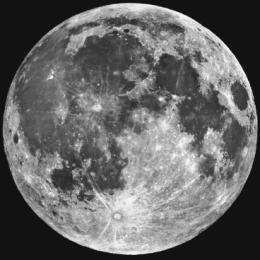
New evidence from an ancient lunar rock suggests that the moon once harbored a long-lived dynamo — a molten, convecting core of liquid metal that generated a strong magnetic field 3.7 billion years ago. The findings, published today in Science, point to a dynamo that lasted much longer than scientists previously thought, and suggest that an alternative energy source may have powered the dynamo.

“The has this protracted history that’s surprising,” says co-author Benjamin Weiss, an associate professor of planetary science at MIT. “This provides evidence of a fundamentally new way of making a magnetic field in a planet a new power source.”

The new paper is the latest piece in a puzzle that planetary scientists have been working out for decades. In 1969, the Apollo 11 mission brought the first lunar rocks back to Earth — souvenirs from Neil Armstrong and Buzz Aldrin’s historic moonwalk. Since then, scientists have probed the rocky remnants for clues to the moon’s history. They soon discovered that many rocks were magnetized, which suggested that the moon was more than a cold, undifferentiated pile of space rubble. Instead, it may have harbored a convecting metallic core that produced a large magnetic field, recorded in the moon’s rocks.

Exactly what powered the dynamo remains a mystery. One possibility is that the lunar dynamo was self-sustaining, like Earth’s: As the planet has cooled, its liquid core has moved in response, sustaining the dynamo and the magnetic field it produces. In the absence of a long-lived heat supply, most planetary bodies will cool within hundreds of millions of years of formation.

A dynamo still exists within Earth because heat, produced by the radioactive decay of elements within the planet, maintains the core’s convection. Models have shown that if a lunar dynamo were powered solely by cooling of the moon’s interior, it would have been able to sustain itself only for a few hundred million years after the moon formed — dissipating by 4.2 billion years ago, at the very latest.

Heavy metal rock

However, Weiss and his colleagues found some surprising evidence in a bit of lunar basalt dubbed 10020. The Apollo 11 astronauts collected the at the southwestern edge of the Sea of Tranquility; scientists believe it was likely ejected from deep within the moon 100 million years ago, after a meteor impact. The group confirmed previous work dating the rock at 3.7 billion years old, and found that it was magnetized — a finding that clashes with current dynamo models.

Weiss collaborated with researchers at the University of California at Berkeley and the Berkeley Geochronology Center, who determined the rock’s age using radiometric dating. After a rock forms, a radioactive potassium isotope decays to a stable argon isotope at a known rate. The group measured the ratio of potassium to argon in a small piece of the rock, using this information to ascertain that the rock cooled from magma 3.7 billion years ago.

Weiss and graduate student Erin Shea then measured the rock’s magnetization, and found that the rock was magnetized. However, this didn’t necessarily mean that the rock, and the moon, had a dynamo-generated 3.7 billion years ago: Subsequent impacts may have heated the rock and reset its magnetization.

To discard this possibility, the team examined whether the rock experienced any significant heating since its ejection onto the moon’s surface. Again, they looked to isotopes of potassium and argon, finding that the only heating the rock had experienced since it was ejected onto the lunar surface came from simple exposure to the sun’s rays.

“It’s basically been in cold storage for 3.7 billion years, essentially undisturbed,” Weiss says. “It retains a beautiful magnetization record.”

Stirring things up

Weiss says the rock’s evidence supports a new mechanism of dynamo generation that was proposed last year by scientists at University of California at Santa Cruz (UCSC). This hypothesis posits that the moon’s dynamo may have been powered by Earth’s gravitational pull. Billions of years ago, the moon was much closer to Earth than it is today; terrestrial gravity may have had a stirring effect within the moon’s core, keeping the liquid metal moving even after the lunar body had cooled.

Francis Nimmo, a professor of earth and planetary sciences at UCSC and one of the researchers who originally put forth the new dynamo theory, says Weiss’ evidence provides scientists with a new picture of the moon’s evolution.

“We generally assume that cooling is the main mechanism for driving a anywhere,” says Nimmo, who was not involved in the current study. “This lunar data is telling us that other mechanisms may also play a role, not just at the moon, but elsewhere, too.”

More information: http://www.science … 067/453.full

Provided by Massachusetts Institute of Technology (news : web)

This story is republished courtesy of MIT News (http://web.mit.edu/newsoffice/), a popular site that covers news about MIT research, innovation and teaching.

4.3 /5 (13 votes)  

Filter


Move the slider to adjust rank threshold, so that you can hide some of the comments.


Display comments: newest first

tadchem
Jan 27, 2012

Rank: 3.3 / 5 (3)
The dynamo core need not have been metallic, if the molten rock is also conductive, as has recently been claimed for the Earth: "Experimental and Theoretical Evidence for Pressure-Induced Metallization in FeO with Rocksalt-Type Structure"
- Kenji Ohta, R. E. Cohen, Kei Hirose, Kristjan Haule, Katsuya Shimizu, and Yasuo Ohishi - Phys. Rev. Lett. 108, 026403 (2012)
Parsec
Jan 27, 2012

Rank: 5 / 5 (1)
The dynamo core need not have been metallic, if the molten rock is also conductive, as has recently been claimed for the Earth: "Experimental and Theoretical Evidence for Pressure-Induced Metallization in FeO with Rocksalt-Type Structure"
- Kenji Ohta, R. E. Cohen, Kei Hirose, Kristjan Haule, Katsuya Shimizu, and Yasuo Ohishi - Phys. Rev. Lett. 108, 026403 (2012)

Not enough heat and pressure on the moon.
GSwift7
Jan 27, 2012

Rank: 2 / 5 (1)
I'll bet they are wishing they had more rocks from other locations so that they could verify this. They sound prety sure about it, but I sure would want to look at rocks from other places on the Moon if I was them.

The dynamo core need not have been metallic, if the molten rock is also conductive


But we are prety sure the moon does have a metalic core anyway. We have a very good measurement of the density of the moon, so we are fairly certain that it has a metallic core.
Rank 4.3 /5 (13 votes)
Relevant PhysicsForums posts
  • Calculating the magnitude
    created2 hours ago
  • What is this spectrum I took?
    created12 hours ago
  • Orientation of Space
    created12 hours ago
  • Geologically Active Moon Now: NASA
    created19 hours ago
  • advice on building a science fair telescope
    createdFeb 22, 2012
  • Rise of the Sun
    createdFeb 22, 2012
  • More from Physics Forums - General Astronomy

More news stories

Spitzer finds solid buckyballs in space

(PhysOrg.com) -- Astronomers using data from NASA's Spitzer Space Telescope have, for the first time, discovered buckyballs in a solid form in space. Prior to this discovery, the microscopic carbon spheres ...

Space & Earth / Astronomy

created 14 hours ago | popularity 4.7 / 5 (12) | comments 8 | with audio podcast

Going up: Japan builder eyes space elevator

A Japanese construction firm claimed Wednesday it could execute an out-of-this-world plan to put tourists in space within 40 years by building an elevator that stretches a quarter of the way to the moon.

Space & Earth / Space Exploration

created 21 hours ago | popularity 3.5 / 5 (13) | comments 26

ENASA satellite finds Earth's clouds are getting lower

(PhysOrg.com) -- Earth's clouds got a little lower -- about one percent on average -- during the first decade of this century, finds a new NASA-funded university study based on NASA satellite data. The results ...

Space & Earth / Earth Sciences

created 18 hours ago | popularity 5 / 5 (8) | comments 13 | with audio podcast

Fresh scandal embroils US climate science debate

A fresh scandal over climate change has erupted in the United States after leaked documents appeared to show a right-wing funded campaign to influence how climate science is taught in schools.

Space & Earth / Environment

created 10 hours ago | popularity 4.1 / 5 (9) | comments 8

World's oceans get an acid bath

Among the repercussions of global climate change, the effect of ocean acidification on marine life is one of the least-understood variables.

Space & Earth / Environment

created 17 hours ago | popularity 4.3 / 5 (6) | comments 4 | with audio podcast


Researchers build first physical 'metatronic' circuit

(PhysOrg.com) -- The technological world of the 21st century owes a tremendous amount to advances in electrical engineering, specifically, the ability to finely control the flow of electrical charges using ...

Faster than light neutrinos? More like faulty wiring

You can shelf your designs for a warp drive engine (for now) and put the DeLorean back in the garage; it turns out neutrinos may not have broken any cosmic speed limits after all.

Physicists surprised by disappearing and reappearing superconductivity in iron selenium chalcogenides

Superconductivity is a rare physical state in which matter is able to conduct electricity -- maintain a flow of electrons -- without any resistance. This phenomenon can only be found in certain materials at low temperatures, ...

CT colonography shown to be comparable to standard colonoscopy

Computerized tomographic (CT) colonography (CTC), also known as virtual colonoscopy, is comparable to standard colonoscopy in its ability to accurately detect cancer and precancerous polyps in people ages 65 and older, according ...

Stanford research team cracks animated NuCaptcha

(PhysOrg.com) -- The research team from Stanford University, led by Elie Bursztein, that previously had cracked regular CAPTCHAs and then audio CAPTCHAs, now has also successfully cracked the animated version called NuCapt ...

Study: Virtual colonoscopy effective screening tool for adults over 65

Computed tomography (CT) colonography can be used as a primary screening tool for colorectal cancer in adults over the age of 65, according to a new study published online in the journal Radiology.