Envelope for an artificial cell
January 25, 2012
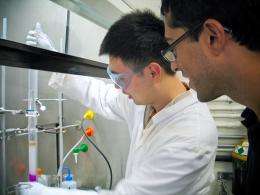
Neal Davaraj watches as undergraduate student Weilong Li works on a next step in their quest to create an entirely artificial cell.
(PhysOrg.com) -- Chemists have taken an important step in making artificial life forms from scratch. Using a novel chemical reaction, they have created self-assembling cell membranes, the structural envelopes that contain and support the reactions required for life.
Neal Devaraj, assistant professor of chemistry at the University of California, San Diego, and Itay Budin, a graduate student at Harvard University, report their success in the Journal of the American Chemical Society.
One of our long term, very ambitious goals is to try to make an artificial cell, a synthetic living unit from the bottom up to make a living organism from non-living molecules that have never been through or touched a living organism, Devaraj said. Presumably this occurred at some point in the past. Otherwise life wouldnt exist.
By assembling an essential component of earthly life with no biological precursors, they hope to illuminate lifes origins.
We dont understand this really fundamental step in our existence, which is how non-living matter went to living matter, Devaraj said. So this is a really ripe area to try to understand what knowledge we lack about how that transition might have occurred. That could teach us a lot even the basic chemical, biological principles that are necessary for life.
Molecules that make up cell membranes have heads that mix easily with water and tails that repel it. In water, they form a double layer with heads out and tails in, a barrier that sequesters the contents of the cell.
Devaraj and Budin created similar molecules with a novel reaction that joins two chains of lipids. Nature uses complex enzymes that are themselves embedded in membranes to accomplish this, making it hard to understand how the very first membranes came to be.
In our system, we use a sort of primitive catalyst, a very simple metal ion, Devaraj said. The reaction itself is completely artificial. Theres no biological equivalent of this chemical reaction. This is how you could have a de novo formation of membranes.
They created the synthetic membranes from a watery emulsion of an oil and a detergent. Alone its stable. Add copper ions and sturdy vesicles and tubules begin to bud off the oil droplets. After 24 hours, the oil droplets are gone, consumed by the self-assembling membranes.
Although other scientists recently announced the creation of a synthetic cell, only its genome was artificial. The rest was a hijacked bacterial cell. Fully artificial life will require the union of both an information-carrying genome and a three-dimensional structure to house it.
The real value of this discovery might reside in its simplicity. From commercially available precursors, the scientists needed just one preparatory step to create each starting lipid chain.
Its trivial and can be done in a day, Devaraj said. New people who join the lab can make membranes from day one.
Provided by University of California - San Diego (news : web)
-
Scientists develop new tool for the study of spatial patterns in living cells
Nov 01, 2011 |
not rated yet |
0
-
Plastic cell membranes for faster and cheaper drug development
Jul 05, 2011 |
not rated yet |
0
-
Scientists take first step towards creating 'inorganic life'
Sep 12, 2011 |
not rated yet |
0
-
Closer look at cell membrane shows cholesterol 'keeping order'
Mar 31, 2011 |
not rated yet |
0
-
New soft motor more closely resembles real muscles (w/ video)
Apr 18, 2011 |
not rated yet |
0
-
Stars containing dark matter should look different from other stars
Feb 20, 2012 |
4.5 / 5 (17) |
11
-
Physicists discover evidence of rare hypernucleus, a component of strange matter
Feb 17, 2012 |
4.7 / 5 (38) |
22
-
Fast photon control brings quantum photonic technologies closer
Feb 13, 2012 |
5 / 5 (8) |
1
-
Engineers build first sub-10-nm carbon nanotube transistor
Feb 01, 2012 |
4.9 / 5 (36) |
32
-
Something old, something new: Evolution and the structural divergence of duplicate genes
Jan 31, 2012 |
4.6 / 5 (7) |
1
-
Cis-trans Selectivity in Wittig Reactions
3 hours ago
-
Chemical Kinetics
3 hours ago
-
heat-driven chemical reaction and thermodynamics
10 hours ago
-
phenol to benzene
14 hours ago
-
TQM, QA and QC
15 hours ago
-
oxidising power
21 hours ago
- More from Physics Forums - Chemistry
More news stories
Scientists create potent molecules aimed at treating muscular dystrophy
While RNA is an appealing drug target, small molecules that can actually affect its function have rarely been found. But now scientists from the Florida campus of The Scripps Research Institute have for the first time designed ...
9 hours ago |
5 / 5 (4) |
0
|
Flesh-eating bacteria inspire superglue
(PhysOrg.com) -- A bio-inspired superglue has been developed by Oxford University researchers that cant be matched for sticking molecules together and not letting go.
20 hours ago |
5 / 5 (8) |
3
|
Researchers discover what cancer cells need to travel
(PhysOrg.com) -- Cancer cells must prepare for travel before invading new tissues, but new Cornell research has found a possible way to stop these cells from ever hitting the road.
19 hours ago |
4.9 / 5 (12) |
0
|
New microfluidic device could be used to diagnose and monitor cancer and other diseases
Separating complex mixtures of cells, such as those found in a blood sample, can offer valuable information for diagnosing and treating disease. However, it may be necessary to search through billions of other ...
Chemistry / Analytical Chemistry
19 hours ago |
5 / 5 (2) |
0
|
New way to tap largest remaining treasure trove of potential new antibiotics
Scientists are reporting use of a new technology for sifting through the world's largest remaining pool of potential antibiotics to discover two new antibiotics that work against deadly resistant microbes, ...
12 hours ago |
5 / 5 (4) |
0
Researchers build first physical 'metatronic' circuit
(PhysOrg.com) -- The technological world of the 21st century owes a tremendous amount to advances in electrical engineering, specifically, the ability to finely control the flow of electrical charges using ...
Spitzer finds solid buckyballs in space
(PhysOrg.com) -- Astronomers using data from NASA's Spitzer Space Telescope have, for the first time, discovered buckyballs in a solid form in space. Prior to this discovery, the microscopic carbon spheres ...
Faster than light neutrinos? More like faulty wiring
You can shelf your designs for a warp drive engine (for now) and put the DeLorean back in the garage; it turns out neutrinos may not have broken any cosmic speed limits after all.
CT colonography shown to be comparable to standard colonoscopy
Computerized tomographic (CT) colonography (CTC), also known as virtual colonoscopy, is comparable to standard colonoscopy in its ability to accurately detect cancer and precancerous polyps in people ages 65 and older, according ...
Physicists surprised by disappearing and reappearing superconductivity in iron selenium chalcogenides
Superconductivity is a rare physical state in which matter is able to conduct electricity -- maintain a flow of electrons -- without any resistance. This phenomenon can only be found in certain materials at low temperatures, ...
Study: Virtual colonoscopy effective screening tool for adults over 65
Computed tomography (CT) colonography can be used as a primary screening tool for colorectal cancer in adults over the age of 65, according to a new study published online in the journal Radiology.
Jan 25, 2012
Rank: 5 / 5 (7)
Just because we do not fully understand this detail right now does mean that the correct answer is to chalk it up to intelligent design. Yes, the odds are astronomical, but so are the odds of winning the lottery, yet almost every week someone hits the jackpot. And we aren't talking about throwing some molecules into a petri dish and waiting 20 minutes. We are talking about the combined surface area of every planet in the universe over the course of 13 billion years.
Jan 25, 2012
Rank: not rated yet
that seems more in line with evolutionary pricipals than trying to create what we currently observe.
@kevin -- please remember that science tries to determine what could happen naturally based on observation of what is going on. To experiment with an "evolutionary" process is to conjecture what might have happened at an unobservable time based on the "laws" of nature not changing over vast time scales. This seems reasonable parameters on which experimentation of this sort happens.
Jan 25, 2012
Rank: 5 / 5 (1)
indeed Kevin science has no answer with the evolution paradigm as to how proceation started -- and niether why or how the sexes developed with one species... indeed fertilization seems extreme from a chemical standpoint -- and ineffecient.
in the attempt to debunk evolution those knowledgable in the subject should attack its weaknesses not it's strengths as an arguement.
Attack what evolution cannot explain gracefully - this is the way to tear down a paradigm -- but unfortunately you will in the process create a new paradigm that is stronger and more complete.
Jan 25, 2012
Rank: 5 / 5 (3)
Jan 25, 2012
Rank: 1 / 5 (4)
Jan 25, 2012
Rank: 1 / 5 (3)
Links to background info http://pubs.acs.o...a9029818
Devaraj's articles http://www.ncbi.n...erm=Neal Devaraj
Jan 25, 2012
Rank: 3.7 / 5 (3)
Jan 26, 2012
Rank: 5 / 5 (2)
Also i am suprised you basically said aliens were responsable for life here, you are usually such a Bible Humper? Are you ok?
Jan 26, 2012
Rank: not rated yet
Jan 26, 2012
Rank: not rated yet
Nobody attacks his arguments because he never had a legitimate argument. He doesn't know anything about science. Liposomes form spontaneously in solution because they're energetically favorable. Lipid membranes don't need any fancy handiwork to form.