Eureka! Kitchen gadget inspires scientist to make more effective plastic electronics
January 27, 2012
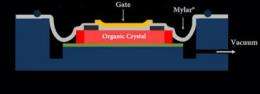
This is a cross-section of an organic transistor with vacuum-applied polymer insulator. Credit: H. T. Yi, et. al., Rutgers University
One day in 2010, Rutgers physicist Vitaly Podzorov watched a store employee showcase a kitchen gadget that vacuum-seals food in plastic. The demo stuck with him. The simple concept an airtight seal around pieces of food just might apply to his research: developing flexible electronics using lightweight organic semiconductors for products such as video displays or solar cells.
"Organic transistors, which switch or amplify electronic signals, hold promise for making video displays that bend like book pages or roll and unroll like posters," said Podzorov. But traditional methods of fabricating a part of the transistor known as the gate insulator often end up damaging the transistor's delicate semiconductor crystals.
Drawing inspiration from the food-storage gadget, Podzorov and his colleagues tried an experiment. They suspended a thin polymer membrane above the organic crystal and created a vacuum underneath, causing the membrane to collapse gently and evenly onto the crystal's surface. The result: a smooth, defect-free interface between the organic semiconductor and the gate insulator.
The researchers reported their success in the journal Advanced Materials. In the article, Podzorov and three colleagues describe how a single-crystal organic field effect transistor (OFET) made with this thin polymer gate insulator boosted electrical performance. The researchers further reported that they could remove and reapply membranes to the same crystal several times without degrading its surface.
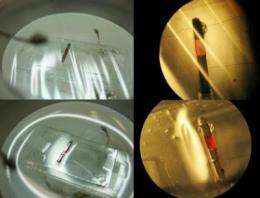
This image shows fabricating single crystal organic field-effect transistors using ultra-thin polymer membrane for a gate insulator. In the upper row, the membrane is stretched over the transistor before vacuum is applied. In the lower row, the vacuum has been applied and the membrane is adhering to the organic crystal. Photos on the right are close-up views of the transistor, with the organic semiconductor crystal in red. Credit: H. T. Yi, et. al., Rutgers University
Organic transistors electrically resemble silicon transistors in computer chips, but they are made of flexible carbon-based molecules that can be printed on sheets of plastic. Silicon transistors are made in rigid, brittle wafers of silicon.The methods that scientists previously applied to organic transistor fabrication were based on silicon semiconductor processing, explained Podzorov, assistant professor in the Department of Physics and Astronomy, School of Arts and Sciences. These involved high temperatures, high-energy plasmas or chemical reactions, all of which could damage the delicate organic crystal surface and hinder the transistor's performance.
"People have tendencies to go with something they've known for a long time," he said. "In this case, it doesn't work right."
Podzorov's innovation builds upon a decade of Rutgers research in this field, including his invention of the first single crystal organic transistor in 2003. While his latest innovation is still a ways from commercial reality, he sees an immediate application in the classroom.
"Our technique takes 10 minutes," he said. "It should be exciting for students to actually build these devices and immediately see them work, all within one lab session."
Podzorov was actually trying to solve another problem when he first recalled the food packaging demo. He was thinking about how to protect organic crystals from airborne impurities when his lab shipped samples to collaborating scientists in California and overseas.
"We could place our samples between plastic sheets and pull a vacuum," he said. "Then I thought, 'why don't we try doing this for our gate insulator?'"
-
Discovery paves way for development of efficient, inexpensive plastic solar cells
Oct 10, 2010 |
not rated yet |
0
-
Organic chips - not just in your kitchen anymore
Feb 22, 2011 |
not rated yet |
0
-
New transistor for plastic electronics exhibits the best of both worlds
Jan 27, 2011 |
not rated yet |
0
-
Japanese researchers develop method for printing single crystal thin-film transistors
Jul 20, 2011 |
not rated yet |
0
-
UMC Announces a Device Technique that Enhances Silicon-on-Insulator (SOI) Transistor Performance
May 26, 2004 |
not rated yet |
0
-
Stars containing dark matter should look different from other stars
Feb 20, 2012 |
4.5 / 5 (17) |
11
-
Physicists discover evidence of rare hypernucleus, a component of strange matter
Feb 17, 2012 |
4.7 / 5 (38) |
22
-
Fast photon control brings quantum photonic technologies closer
Feb 13, 2012 |
5 / 5 (8) |
1
-
Engineers build first sub-10-nm carbon nanotube transistor
Feb 01, 2012 |
4.9 / 5 (36) |
32
-
Something old, something new: Evolution and the structural divergence of duplicate genes
Jan 31, 2012 |
4.6 / 5 (7) |
1
-
taking mechanical physics next fall
2 hours ago
-
Help: maximum force of an object when given impulse and time on a graph
5 hours ago
-
Impulse, momentum, and force during motion around a circle
7 hours ago
-
Help needed to find the best fit to an angular distribution
7 hours ago
-
What is centripetal force
11 hours ago
-
Magnetic Reynolds Number
12 hours ago
- More from Physics Forums - General Physics
More news stories
Researchers build first physical 'metatronic' circuit
(PhysOrg.com) -- The technological world of the 21st century owes a tremendous amount to advances in electrical engineering, specifically, the ability to finely control the flow of electrical charges using ...
6 hours ago |
4.7 / 5 (15) |
5
|
Faster than light neutrinos? More like faulty wiring
You can shelf your designs for a warp drive engine (for now) and put the DeLorean back in the garage; it turns out neutrinos may not have broken any cosmic speed limits after all.
6 hours ago |
4.3 / 5 (19) |
20
|
Physicists surprised by disappearing and reappearing superconductivity in iron selenium chalcogenides
Superconductivity is a rare physical state in which matter is able to conduct electricity -- maintain a flow of electrons -- without any resistance. This phenomenon can only be found in certain materials at low temperatures, ...
10 hours ago |
5 / 5 (4) |
1
|
Less is more: Study of tiny droplets could have big impact on industrial applications
(PhysOrg.com) -- Under a microscope, a tiny droplet slides between two fine hairs like a roller coaster on a set of rails until poof it suddenly spreads along them, a droplet no more.
7 hours ago |
3 / 5 (2) |
0
|
Study reveals switching mechanism in promising computer memory device
(PhysOrg.com) -- Sometimes knowing that a new technology works is not enough. You also must know why it works to get marketplace acceptance. New information from the National Institute of Standards and Technology ...
14 hours ago |
4 / 5 (4) |
0
|
Spitzer finds solid buckyballs in space
(PhysOrg.com) -- Astronomers using data from NASA's Spitzer Space Telescope have, for the first time, discovered buckyballs in a solid form in space. Prior to this discovery, the microscopic carbon spheres ...
Scientists create potent molecules aimed at treating muscular dystrophy
While RNA is an appealing drug target, small molecules that can actually affect its function have rarely been found. But now scientists from the Florida campus of The Scripps Research Institute have for the first time designed ...
Stanford research team cracks animated NuCaptcha
(PhysOrg.com) -- The research team from Stanford University, led by Elie Bursztein, that previously had cracked regular CAPTCHAs and then audio CAPTCHAs, now has also successfully cracked the animated version called NuCapt ...
Surprising diversity at a synapse hints at complex diversity of neural circuitry
A new study reveals a dazzling degree of biological diversity in an unexpected place a single neural connection in the body wall of flies.
Researchers discover how different nanomaterial surfaces affect proteins
A new study led by nanotechnology and biotechnology experts at Rensselaer Polytechnic Institute is providing important details on how proteins in our bodies interact with nanomaterials. In their new study, published in the ...
Flesh-eating bacteria inspire superglue
(PhysOrg.com) -- A bio-inspired superglue has been developed by Oxford University researchers that cant be matched for sticking molecules together and not letting go.

Jan 28, 2012
Rank: not rated yet
Jan 29, 2012
Rank: not rated yet