Evolution is written all over your face
January 11, 2012
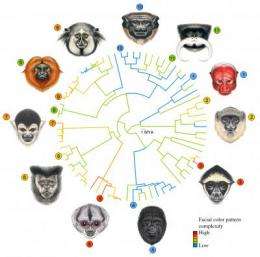
Faces of adult male primates from Central and South America. Warmer colors indicate higher complexity in facial color patterns. Species shown are: (1) Cacajao calvus, (2) Callicebus hoffmansi, (3) Ateles belzebuth, (4) Alouatta caraya, (5) Aotus trivirgatus, (6) Cebus nigritus, (7) Saimiri boliviensis, (8) Leontopithecus rosalia, (9) Callithrix kuhli, (10) Saguinus martinsi, and (11) Saguinus imperator. Credit: Stephen Nash
Why are the faces of primates so dramatically different from one another?
UCLA biologists working as "evolutionary detectives" studied the faces of 129 adult male primates from Central and South America, and they offer some answers in research published today, Jan. 11, in the early online edition of the journal Proceedings of the Royal Society B. The faces they studied evolved over at least 24 million years, they report.
"If you look at New World primates, you're immediately struck by the rich diversity of faces," said Michael Alfaro, a UCLA associate professor of ecology and evolutionary biology and the senior author of the study. "You see bright red faces, moustaches, hair tufts and much more. There are unanswered questions about how faces evolve and what factors explain the evolution of facial features. We're very visually oriented, and we get a lot of information from the face."
Some of the primate species studied are solitary, while others live in groups that can include dozens or even hundreds of others.
The life scientists divided each face into 14 regions; coded the color of each part, including the hair and skin; studied the patterns and anatomy of the faces; and gave each a "facial complexity" score. They studied how the complexity of primate faces evolved over time and examined the primates' social systems. To assess how facial colors are related to physical environments, they analyzed environmental variables, using the longitude and latitude of primates' habitats as a proxy for sun exposure and temperature. They also used statistical methods to analyze the evolutionary history of the primate groups and when they diverged from one another.
"We found very strong support for the idea that as species live in larger groups, their faces become more simple, more plain," said lead author Sharlene Santana, a UCLA postdoctoral scholar in ecology and evolutionary biology and a postdoctoral fellow with UCLA's Institute for Society and Genetics. "We think that is related to their ability to communicate using facial expressions. A face that is more plain could allow the primate to convey expressions more easily.
"Humans have pretty bare faces, which may allow us to see facial expressions more easily than if, for example, we had many colors in our faces."
The researchers' finding that faces are more simple in larger groups came as a surprise.
"Initially, we thought it might be the opposite," Santana said. "You might expect that in larger groups, faces would vary more and have more complex parts that would allow one individual to identify any member of that group. That is not what we found. Species that live in larger groups live in closer proximity to one another and tend to use facial expressions more than species in smaller groups that are more spread out. Being in closer proximity puts a stronger pressure on using facial expressions."
"This finding suggests that facial expressions are increasingly important in large groups," said co-author Jessica Lynch Alfaro, associate director of the UCLA Institute for Society and Genetics. "If you're highly social, then facial expressions matter more than having a highly complex pattern on your face."
The evolutionary biologists also found that when primates live in environment with more species that are closely related, their faces are more complex, regardless of their group size. This finding is consistent with their need to recognize individuals of other closely related species that live in the same habitat to avoid interbreeding, Santana said.
Santana, Lynch Alfaro and Alfaro present the first quantitative evidence linking social behavior to the evolution of facial diversity and complexity in primates, and they also show that ecology controls aspects of facial patterns.
As species live closer to the equator, the skin and hair around their eyes get darker, the biologists report. They also found that regions of the face around the nose and mouth get darker when species live in humid environments and denser forests and that facial hair gets longer as species live farther from the equator and the climate gets colder, which may be related to regulating body temperature.
"This is a good start toward understanding facial diversity," Alfaro said. "There was not a good idea before about what aspects of faces were shaped by which evolutionary pressure. Sharlene [Santana] has been able to say what social complexity, social behavior and ecology are doing to faces."
In the future, Santana, Lynch Alfaro and Alfaro may use computer facial-recognition software to help quantify the faces in a more sophisticated way. They also plan to study the faces of carnivores, including big cats.
Previous studies, they noted, have found that primate species with moustaches and beards (such as No. 11 and No. 9 in the accompanying image) tend to look poker-faced; they don't move their faces much when they communicate, compared with other species (such as No. 4).
Alfaro praised Santana's ability to answer some of these difficult evolutionary questions.
"Sharlene has tested ideas that have been virtually impossible to test before," he said. "She has found a clever way to implicate the degree of sociality as contributing to the diversity of faces. Social behavior explains some aspects of facial diversity."
Santana also devised a way to test a theory that has been in the biological literature for decades but had never been tested before. As a lineage diverges and species accumulate, a series of changes in facial coloration and body coloration emerges. The theory she was able to test suggests that once a species evolves to have a certain color, such as hair color, the change is irreversible and it cannot evolve back to a previous color in its lineage. Santana found this theory to be wrong.
"The idea in biology that evolutionary change is irreversible is rejected very strongly by our data," Alfaro said.
Lessons for human faces?
Does the study have implications for the evolution of human faces?
The findings do suggest, Alfaro said, that an important factor in shaping human faces is the premium on making unambiguous facial expressions.
"Humans don't have all these elaborate facial ornamentations, but we do have the ability to communicate visually with facial expressions," Alfaro said. "Does reduced coloration complexity create a blank palate for visual expressions that can be conveyed more easily? That is an idea we are testing."
More information: http://rspb.royals … pb.2011.2326
Provided by University of California - Los Angeles
-
Here's looking at you, fellow!
Mar 02, 2009 |
not rated yet |
0
-
Infants' hemodynamic responses to happy and angry facial expressions
Nov 05, 2010 |
not rated yet |
0
-
Expressionless faces provide clues on how we read emotions
Apr 15, 2010 |
not rated yet |
0
-
Facial recognition at first glance
Jul 01, 2010 |
not rated yet |
0
-
Perception of facial expressions differs across cultures
Sep 01, 2011 |
not rated yet |
0
-
Stars containing dark matter should look different from other stars
Feb 20, 2012 |
4.5 / 5 (17) |
11
-
Physicists discover evidence of rare hypernucleus, a component of strange matter
Feb 17, 2012 |
4.7 / 5 (38) |
22
-
Fast photon control brings quantum photonic technologies closer
Feb 13, 2012 |
5 / 5 (8) |
1
-
Engineers build first sub-10-nm carbon nanotube transistor
Feb 01, 2012 |
4.9 / 5 (36) |
32
-
Something old, something new: Evolution and the structural divergence of duplicate genes
Jan 31, 2012 |
4.6 / 5 (7) |
1
-
Eye biology videos
4 hours ago
-
Flowering Plant Revived After 30,000 Years in Permafrost
Feb 21, 2012
-
Toba volcano eruptions - 1.000 - 10,000 breeding pairsunb
Feb 20, 2012
-
How is a specific gene removed from DNA
Feb 20, 2012
-
Reproduction and Human evolution
Feb 19, 2012
-
Viruses: Living or Non-living organisms
Feb 19, 2012
- More from Physics Forums - Biology
More news stories
Surprising diversity at a synapse hints at complex diversity of neural circuitry
A new study reveals a dazzling degree of biological diversity in an unexpected place a single neural connection in the body wall of flies.
11 hours ago |
5 / 5 (4) |
0
|
Men might not 'become extinct' after all: Theory of the 'rotting' Y chromosome dealt a fatal blow
If you were to discover that a fundamental component of human biology has survived virtually intact for the past 25 million years, you'd be quite confident in saying that it is here to stay.
14 hours ago |
5 / 5 (6) |
1
|
New family of legless amphibians found in India
Since before the age of dinosaurs it has burrowed unbothered beneath the monsoon-soaked soils of remote northeast India - unknown to science and mistaken by villagers as a deadly, miniature snake.
21 hours ago |
5 / 5 (9) |
3
Climate change affects bird migration timing in North America
Bird migration timing across North America has been affected by climate change, according to a study published Feb. 22 in the open access journal PLoS ONE.
10 hours ago |
4.5 / 5 (2) |
2
New iridescent lizard species found in Cambodia
A new species of lizard with striking iridescent rainbow skin, a long tail and very short legs has been discovered in the rainforest in northeast Cambodia, conservationists announced Wednesday.
10 hours ago |
not rated yet |
0
Researchers build first physical 'metatronic' circuit
(PhysOrg.com) -- The technological world of the 21st century owes a tremendous amount to advances in electrical engineering, specifically, the ability to finely control the flow of electrical charges using ...
Spitzer finds solid buckyballs in space
(PhysOrg.com) -- Astronomers using data from NASA's Spitzer Space Telescope have, for the first time, discovered buckyballs in a solid form in space. Prior to this discovery, the microscopic carbon spheres ...
Faster than light neutrinos? More like faulty wiring
You can shelf your designs for a warp drive engine (for now) and put the DeLorean back in the garage; it turns out neutrinos may not have broken any cosmic speed limits after all.
Physicists surprised by disappearing and reappearing superconductivity in iron selenium chalcogenides
Superconductivity is a rare physical state in which matter is able to conduct electricity -- maintain a flow of electrons -- without any resistance. This phenomenon can only be found in certain materials at low temperatures, ...
Stanford research team cracks animated NuCaptcha
(PhysOrg.com) -- The research team from Stanford University, led by Elie Bursztein, that previously had cracked regular CAPTCHAs and then audio CAPTCHAs, now has also successfully cracked the animated version called NuCapt ...
Going up: Japan builder eyes space elevator
A Japanese construction firm claimed Wednesday it could execute an out-of-this-world plan to put tourists in space within 40 years by building an elevator that stretches a quarter of the way to the moon.
Jan 11, 2012
Rank: 3.7 / 5 (3)
I suggest confirmation of this with some rigorous analysis might provide additional evidence for the theory laid out in this article.
From personal experience, I used to have a lot of facial hair. After shaving it off, I felt much less capable of being dishonest, simply because I figured other people would know.
I have a lot of facial tells. One of the reasons I am a poor poker player.
Jan 11, 2012
Rank: 1 / 5 (1)
Jan 11, 2012
Rank: 2.5 / 5 (2)
"ASDs are hypothesized as one of many adaptive human cognitive variations that have been maintained in modern populations via genetic and epigenetic mechanisms. Introgression from "archaic" hominids (adapted for less demanding social environments) is conjectured as the source of initial intraspecific heterogeneity because strict inclusive fitness does not adequately model the evolution of distinct, copy-number sensitive phenotypes within a freely reproducing population."
goo.gl/aloZI
Jan 12, 2012
Rank: 1.3 / 5 (15)
The evolutionary assumptions are misleading the researchers into believing in a slow rate of change whereas the changes really occur at a very rapid rate. Go read up on the normal "surprises" scientists have when they come upon changes in species in isolated places.
Jan 12, 2012
Rank: 4.4 / 5 (7)
Jan 12, 2012
Rank: 4.6 / 5 (9)
No, some became fruit bats. A few still look a LOT like rodents. Primates stopped being something that wasn't a primate millions, not thousands, of years ago.
This isn't going to change just because you keep shoveling shit Kevin. If you had some evidence you would post it and you never do.
Except that some did change into fruit bats and this has been pointed out to you before. So you are lying again.
Not assumptions. It is what the evidence shows.>>
Jan 12, 2012
Rank: 4.6 / 5 (10)
Rapid change, not in a few thousand years but in many thousands, is not surprising to anyone in science when you are talking about isolated species. Its called genetic drift. You should read about it.
You should also read Genesis some day. You would find that it is completely wrong on so very much and even contradicts itself. The first two chapters contradict.
Goodbye Kevin. So boring to see you run away yet again. What is it, more than 90% of the time? Even you don't think you can convince anyone.
gmurphy, you are a vile heretic. The Giant Invisible Orbiting Aardvark created all that is. The SM is a mere upstart that even Bob, Holy is his Pipe, laughs at, and Bob can't even get out of the fifties much less create an entire Universe.
Ethelred
Jan 12, 2012
Rank: not rated yet
Jan 18, 2012
Rank: 5 / 5 (2)
Jan 22, 2012
Rank: 3 / 5 (2)