Evolutionary psychologists find macaques more likely influenced by friends than family
January 12, 2012 by Bob Yirka
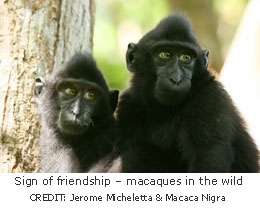
(PhysOrg.com) -- In order to better understand human relationships, researchers who study such things often turn to other primates for the simple reason that they are more accessible, being locked up in zoos and such. Thus, PhD student Jerome Micheletta, at the University of Portsmith in the UK, found himself studying the crested macaque in the Marwell Wildlife Zoological Park. It was while doing so that he discovered that the macaques tended to follow the gaze of a friend more quickly than they did others, such as family members. Micheletta along with Dr. Dr Bridget Waller have published their findings on this research in the journal Animal Behavior.
When macaques are together, they tend to pair up with friends; other macaques that they spend more time with than others in the group. As part of their “friendship” pairs groom one another and pick off fleas, etc. And macaques, like people and many other animals, also note when other members of their group turn to look at something, and then turn to look as well to see what’s up. It is thought that such gaze following is a natural form of self-preservation. After all, if a predator has suddenly appeared behind you, and someone you are interacting with suddenly looks and sees them, it makes a lot of sense to turn and have a look yourself.
But what the two found surprising was the time lag between noting a change in gaze, and then in turning to look in response, with the macaques. They found that when it was a friend doing the gazing, there was little to no lag at all. But when it was anybody else, it took slightly longer, regardless of whether it was family or a group leader.
Micheletta and Waller don’t suggest they know for sure why this is, but do theorize that it might be because the macaques view their friends more importantly than they do others in the group, or that because of their bond, they look forward to sharing in whatever the other has found. Or, it also seems plausible that they simply trust their friends more, and thus don’t hesitate to turn and look when they see their friend has found something of interest.
The two researchers also hint that such behavior might shed some light on human relationships as well, but as yet, haven’t undertaken a study to find out if people would react the same way, and if they do, what it might mean.
More information: Press release
© 2011 PhysOrg.com
-
Study shows Facebook friend relationships due mostly to similarities between people
Dec 20, 2011 |
not rated yet |
0
-
For macaques, male bonding is a political move
Nov 18, 2010 |
not rated yet |
0
-
Rhesus macaque moms 'go gaga' for baby, too
Oct 08, 2009 |
not rated yet |
0
-
Researcher uses card trick to reveal unconscious knowledge
Nov 17, 2011 |
not rated yet |
0
-
Baboons prefer dining with friends
Jul 06, 2011 |
not rated yet |
0
-
Stars containing dark matter should look different from other stars
Feb 20, 2012 |
4.5 / 5 (17) |
11
-
Physicists discover evidence of rare hypernucleus, a component of strange matter
Feb 17, 2012 |
4.7 / 5 (38) |
22
-
Fast photon control brings quantum photonic technologies closer
Feb 13, 2012 |
5 / 5 (8) |
1
-
Engineers build first sub-10-nm carbon nanotube transistor
Feb 01, 2012 |
4.9 / 5 (36) |
32
-
Something old, something new: Evolution and the structural divergence of duplicate genes
Jan 31, 2012 |
4.6 / 5 (7) |
1
-
Eye biology videos
4 hours ago
-
Flowering Plant Revived After 30,000 Years in Permafrost
Feb 21, 2012
-
Toba volcano eruptions - 1.000 - 10,000 breeding pairsunb
Feb 20, 2012
-
How is a specific gene removed from DNA
Feb 20, 2012
-
Reproduction and Human evolution
Feb 19, 2012
-
Viruses: Living or Non-living organisms
Feb 19, 2012
- More from Physics Forums - Biology
More news stories
Surprising diversity at a synapse hints at complex diversity of neural circuitry
A new study reveals a dazzling degree of biological diversity in an unexpected place a single neural connection in the body wall of flies.
11 hours ago |
5 / 5 (4) |
0
|
Men might not 'become extinct' after all: Theory of the 'rotting' Y chromosome dealt a fatal blow
If you were to discover that a fundamental component of human biology has survived virtually intact for the past 25 million years, you'd be quite confident in saying that it is here to stay.
14 hours ago |
5 / 5 (6) |
1
|
New family of legless amphibians found in India
Since before the age of dinosaurs it has burrowed unbothered beneath the monsoon-soaked soils of remote northeast India - unknown to science and mistaken by villagers as a deadly, miniature snake.
21 hours ago |
5 / 5 (9) |
3
Climate change affects bird migration timing in North America
Bird migration timing across North America has been affected by climate change, according to a study published Feb. 22 in the open access journal PLoS ONE.
10 hours ago |
4.5 / 5 (2) |
2
New iridescent lizard species found in Cambodia
A new species of lizard with striking iridescent rainbow skin, a long tail and very short legs has been discovered in the rainforest in northeast Cambodia, conservationists announced Wednesday.
10 hours ago |
not rated yet |
0
Researchers build first physical 'metatronic' circuit
(PhysOrg.com) -- The technological world of the 21st century owes a tremendous amount to advances in electrical engineering, specifically, the ability to finely control the flow of electrical charges using ...
Spitzer finds solid buckyballs in space
(PhysOrg.com) -- Astronomers using data from NASA's Spitzer Space Telescope have, for the first time, discovered buckyballs in a solid form in space. Prior to this discovery, the microscopic carbon spheres ...
Faster than light neutrinos? More like faulty wiring
You can shelf your designs for a warp drive engine (for now) and put the DeLorean back in the garage; it turns out neutrinos may not have broken any cosmic speed limits after all.
Physicists surprised by disappearing and reappearing superconductivity in iron selenium chalcogenides
Superconductivity is a rare physical state in which matter is able to conduct electricity -- maintain a flow of electrons -- without any resistance. This phenomenon can only be found in certain materials at low temperatures, ...
Stanford research team cracks animated NuCaptcha
(PhysOrg.com) -- The research team from Stanford University, led by Elie Bursztein, that previously had cracked regular CAPTCHAs and then audio CAPTCHAs, now has also successfully cracked the animated version called NuCapt ...
Going up: Japan builder eyes space elevator
A Japanese construction firm claimed Wednesday it could execute an out-of-this-world plan to put tourists in space within 40 years by building an elevator that stretches a quarter of the way to the moon.
Jan 12, 2012
Rank: not rated yet
I think most animals that practice gaze-tracking, whether tracking like species, or different species, have that situational awareness of their local environment by staying cued in to other animals in the vicinity.
In short, it probably comes down to how much of a ruckus you make, whether it be intense staring, or vocalizations.
Jan 12, 2012
Rank: not rated yet
http://www.youtub...embedded