'Extinct' monkey rediscovered in Borneo by new expedition
January 20, 2012
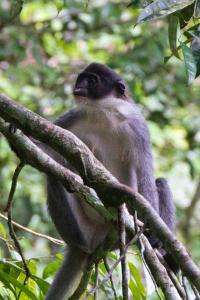
This is a Miller's Grizzled Langur. Credit: Eric Fell
An international team of scientists has found one of the rarest and least known primates in Borneo, Miller's Grizzled Langur, a species which was believed to be extinct or on the verge of extinction. The team's findings, published in the American Journal of Primatology, confirms the continued existence of this endangered monkey and reveals that it lives in an area where it was previously not known to exist.
Miller's Grizzled Langur (Presbytis hosei canicrus) is part of the small primate genus Presbytis, found across Borneo, Sumatra, Java and the Thai-Malay Peninsula. In Borneo, P.h. canicrus is only found in a small corner of the county's north east and its habitat has suffered from fires, human encroachment and conversion of land for agriculture and mining.
The team's expedition took to them to Wehea Forest in East Kalimantan, Borneo, a large 38,000 ha area of mostly undisturbed rainforest. Wehea contains at least nine known species of non-human primate, including the Bornean orangutan and gibbon.
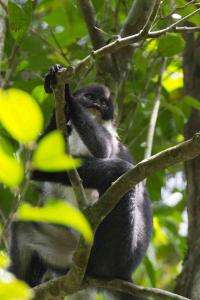
This is a Miller's Grizzled Langur. Credit: Eric Fell
"Discovery of P.h canicrus was a surprise since Wehea Forest lies outside of this monkey's known range. Future research will focus on estimating the population density for P.h. canicrus in Wehea and the surrounding forest," said Brent Loken, from Simon Fraser University Canada. "Concern that the species may have gone extinct was first raised in 2004, and a search for the monkey during another expedition in 2008 supported the assertion that the situation was dire."By conducting observations at mineral licks where animals congregate and setting up camera traps in several locations, the expedition confirmed that P. h canicrus continues to survive in areas west of its previously recorded geographic range. The resulting photos provide the first solid evidence demonstrating that its geographic range extends further than previously thought.
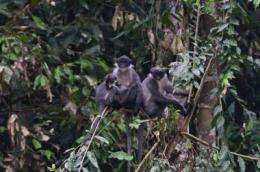
This is a Miller's Grizzled Langur. Credit: Eric Fell
"It was a challenge to confirm our finding as there are so few pictures of this monkey available for study," said Loken. "The only description of Miller's Grizzled Langur came from museum specimens. Our photographs from Wehea are some of the only pictures that we have of this monkey.""East Kalimantan can be a challenging place to conduct research, given the remoteness of many remaining forested areas, so it isn't surprising that so little is known about this primate," said Dr. Stephanie Spehar, Assistant Professor of Anthropology at University of Wisconsin Oshkosh. "We are very grateful to our local partners. This discovery represents the hard work, dedication, and collaboration of Western and Indonesian scientists, students, NGOs, as well as local communities and government."
"While our finding confirms the monkey still exists in East Kalimantan, there is a good chance that it remains one of the world's most endangered primates," concluded Loken. "I believe it is a race against time to protect many species in Borneo. It is difficult to adopt conservation strategies to protect species when we don't even know the extent of where they live. We need more scientists in the field working on understudied species such as Miller's Grizzled Langur, clouded leopards and sun bears."
-
Saving the wild orchids of Borneo
Jul 17, 2008 |
not rated yet |
0
-
First images of newly discovered primate
Jan 10, 2012 |
not rated yet |
0
-
Monkey species discovery overshadowed by threat
Feb 23, 2007 |
not rated yet |
0
-
Scientists discover new monkey species in Amazon
Aug 26, 2011 |
not rated yet |
0
-
Sumatran Rhino Seen in Borneo Jungles
Sep 09, 2006 |
not rated yet |
0
-
Stars containing dark matter should look different from other stars
Feb 20, 2012 |
4.5 / 5 (17) |
11
-
Physicists discover evidence of rare hypernucleus, a component of strange matter
Feb 17, 2012 |
4.7 / 5 (38) |
22
-
Fast photon control brings quantum photonic technologies closer
Feb 13, 2012 |
5 / 5 (8) |
1
-
Engineers build first sub-10-nm carbon nanotube transistor
Feb 01, 2012 |
4.9 / 5 (36) |
32
-
Something old, something new: Evolution and the structural divergence of duplicate genes
Jan 31, 2012 |
4.6 / 5 (7) |
1
-
Eye biology videos
4 hours ago
-
Flowering Plant Revived After 30,000 Years in Permafrost
Feb 21, 2012
-
Toba volcano eruptions - 1.000 - 10,000 breeding pairsunb
Feb 20, 2012
-
How is a specific gene removed from DNA
Feb 20, 2012
-
Reproduction and Human evolution
Feb 19, 2012
-
Viruses: Living or Non-living organisms
Feb 19, 2012
- More from Physics Forums - Biology
More news stories
Surprising diversity at a synapse hints at complex diversity of neural circuitry
A new study reveals a dazzling degree of biological diversity in an unexpected place a single neural connection in the body wall of flies.
11 hours ago |
5 / 5 (4) |
0
|
Men might not 'become extinct' after all: Theory of the 'rotting' Y chromosome dealt a fatal blow
If you were to discover that a fundamental component of human biology has survived virtually intact for the past 25 million years, you'd be quite confident in saying that it is here to stay.
14 hours ago |
5 / 5 (6) |
1
|
New family of legless amphibians found in India
Since before the age of dinosaurs it has burrowed unbothered beneath the monsoon-soaked soils of remote northeast India - unknown to science and mistaken by villagers as a deadly, miniature snake.
21 hours ago |
5 / 5 (9) |
3
Climate change affects bird migration timing in North America
Bird migration timing across North America has been affected by climate change, according to a study published Feb. 22 in the open access journal PLoS ONE.
10 hours ago |
4.5 / 5 (2) |
2
New iridescent lizard species found in Cambodia
A new species of lizard with striking iridescent rainbow skin, a long tail and very short legs has been discovered in the rainforest in northeast Cambodia, conservationists announced Wednesday.
10 hours ago |
not rated yet |
0
Researchers build first physical 'metatronic' circuit
(PhysOrg.com) -- The technological world of the 21st century owes a tremendous amount to advances in electrical engineering, specifically, the ability to finely control the flow of electrical charges using ...
Spitzer finds solid buckyballs in space
(PhysOrg.com) -- Astronomers using data from NASA's Spitzer Space Telescope have, for the first time, discovered buckyballs in a solid form in space. Prior to this discovery, the microscopic carbon spheres ...
Faster than light neutrinos? More like faulty wiring
You can shelf your designs for a warp drive engine (for now) and put the DeLorean back in the garage; it turns out neutrinos may not have broken any cosmic speed limits after all.
Physicists surprised by disappearing and reappearing superconductivity in iron selenium chalcogenides
Superconductivity is a rare physical state in which matter is able to conduct electricity -- maintain a flow of electrons -- without any resistance. This phenomenon can only be found in certain materials at low temperatures, ...
Stanford research team cracks animated NuCaptcha
(PhysOrg.com) -- The research team from Stanford University, led by Elie Bursztein, that previously had cracked regular CAPTCHAs and then audio CAPTCHAs, now has also successfully cracked the animated version called NuCapt ...
Going up: Japan builder eyes space elevator
A Japanese construction firm claimed Wednesday it could execute an out-of-this-world plan to put tourists in space within 40 years by building an elevator that stretches a quarter of the way to the moon.

