Astronomers find a dark matter galaxy far, far away
January 18, 2012
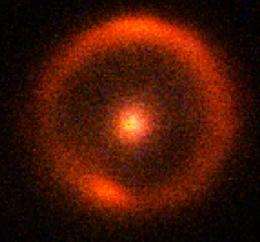
At the center of this infrared image is a massive red galaxy, 9.8 billion light-years from Earth, which acts like a cosmic magnifying glass, distorting the light from an even more distant galaxy, 17.3 billion light-years away. The result is a spectacular Einstein ring image of the background galaxy. The observations were made with the 10-meter Keck-11 Telescope on Mauna Kea, Hawaii. Image: David Lagattuta/W. M. Keck Observatory
(PhysOrg.com) -- A faint satellite galaxy 10 billion light years from Earth is the lowest-mass object ever detected at such a distance, says University of California, Davis, physics professor Chris Fassnacht, who aided in the satellites discovery.
The find, described in a paper published online today (Jan. 18) in the journal Nature, could help astronomers find similar objects and confirm or reject theories about the structure of the cosmos.
Theory predicts that galaxies should be surrounded by halos of smaller, satellite blobs of mass, according to Fassnacht. Astronomers have detected such satellites around our own galaxy, the Milky Way, and nearby.
But they had not previously detected the predicted satellites of more distant galaxies.
Because most of the mass of galaxies is made up, not of stars, but of dark matter, which does not absorb or emit light, these distant objects may be very faint or even completely dark.
The team looked for faint or dark satellites of distant galaxies using a method called gravitational lensing. Using the Keck II telescope at the W.M. Keck Observatory on Mauna Kea, Hawaii, with adaptive optics, they found two galaxies aligned with each other, as viewed from Earth.
The nearer objects gravitational field deflects the light from the more distant object as the light passes through or near the other objects gravitational field, creating a distorted image as if passed through a lens. By analyzing these distorted images, the researchers could determine if there were any satellite galaxies clustered around the lens galaxy.
Adaptive optics make constant, tiny adjustments to the telescope mirror to compensate for the effects of the Earths atmosphere. As a result, the Keck telescopes can achieve higher resolution than the Hubble Space Telescope.
The technique can now be applied to many more galaxies, Fassnacht said. As we collect more objects, we can do more precise tests of our simulations and make predictions about the structure of the universe, he said.
First author Simona Vegetti, a postdoctoral researcher at the Massachusetts Institute of Technology, said: Now we have one dark satellite, but suppose that we dont find enough of them then we will have to change the properties of dark matter.
Or, we might find as many satellites as we see in the simulations, and that will tell us that dark matter has the properties we think it has.
Fassnacht and Vegetti worked with Leon Koopmans of the University of Groningen, Netherlands; David Lagattuta, now at the Swinburne University of Technology, Australia; Matthew Auger, UC Santa Barbara; and John McKean of the Netherlands Foundation for Research in Astronomy. Lagattuta and Auger are former graduate students in Fassnachts lab, and McKean was a postdoctoral researcher at UC Davis.
More information: http://www.nature. … re10669.html
-
Mapping dark matter from galactic ripples
Jan 09, 2012 |
not rated yet |
0
-
Andromeda dwarf galaxies help unravel the mysteries of dark matter
Nov 08, 2011 |
not rated yet |
0
-
Nature's best magnifying glass views eary spiral galaxy
May 26, 2011 |
not rated yet |
0
-
Invisible Milky Way Satellite Uncovered With Help from NERSC
Mar 24, 2011 |
not rated yet |
0
-
Trick of Nature Allows Hubble and Keck to Find Tiny Galaxy
Oct 05, 2007 |
not rated yet |
0
-
Stars containing dark matter should look different from other stars
Feb 20, 2012 |
4.5 / 5 (17) |
11
-
Physicists discover evidence of rare hypernucleus, a component of strange matter
Feb 17, 2012 |
4.7 / 5 (38) |
22
-
Fast photon control brings quantum photonic technologies closer
Feb 13, 2012 |
5 / 5 (8) |
1
-
Engineers build first sub-10-nm carbon nanotube transistor
Feb 01, 2012 |
4.9 / 5 (36) |
32
-
Something old, something new: Evolution and the structural divergence of duplicate genes
Jan 31, 2012 |
4.6 / 5 (7) |
1
-
Calculating the magnitude
2 hours ago
-
What is this spectrum I took?
13 hours ago
-
Orientation of Space
13 hours ago
-
Geologically Active Moon Now: NASA
20 hours ago
-
advice on building a science fair telescope
Feb 22, 2012
-
Rise of the Sun
Feb 22, 2012
- More from Physics Forums - General Astronomy
More news stories
Spitzer finds solid buckyballs in space
(PhysOrg.com) -- Astronomers using data from NASA's Spitzer Space Telescope have, for the first time, discovered buckyballs in a solid form in space. Prior to this discovery, the microscopic carbon spheres ...
14 hours ago |
4.7 / 5 (12) |
8
|
Going up: Japan builder eyes space elevator
A Japanese construction firm claimed Wednesday it could execute an out-of-this-world plan to put tourists in space within 40 years by building an elevator that stretches a quarter of the way to the moon.
Space & Earth / Space Exploration
21 hours ago |
3.5 / 5 (13) |
26
ENASA satellite finds Earth's clouds are getting lower
(PhysOrg.com) -- Earth's clouds got a little lower -- about one percent on average -- during the first decade of this century, finds a new NASA-funded university study based on NASA satellite data. The results ...
Space & Earth / Earth Sciences
18 hours ago |
5 / 5 (8) |
13
|
Fresh scandal embroils US climate science debate
A fresh scandal over climate change has erupted in the United States after leaked documents appeared to show a right-wing funded campaign to influence how climate science is taught in schools.
11 hours ago |
4.1 / 5 (9) |
8
World's oceans get an acid bath
Among the repercussions of global climate change, the effect of ocean acidification on marine life is one of the least-understood variables.
18 hours ago |
4.3 / 5 (6) |
4
|
Researchers build first physical 'metatronic' circuit
(PhysOrg.com) -- The technological world of the 21st century owes a tremendous amount to advances in electrical engineering, specifically, the ability to finely control the flow of electrical charges using ...
Faster than light neutrinos? More like faulty wiring
You can shelf your designs for a warp drive engine (for now) and put the DeLorean back in the garage; it turns out neutrinos may not have broken any cosmic speed limits after all.
Physicists surprised by disappearing and reappearing superconductivity in iron selenium chalcogenides
Superconductivity is a rare physical state in which matter is able to conduct electricity -- maintain a flow of electrons -- without any resistance. This phenomenon can only be found in certain materials at low temperatures, ...
Stanford research team cracks animated NuCaptcha
(PhysOrg.com) -- The research team from Stanford University, led by Elie Bursztein, that previously had cracked regular CAPTCHAs and then audio CAPTCHAs, now has also successfully cracked the animated version called NuCapt ...
Flesh-eating bacteria inspire superglue
(PhysOrg.com) -- A bio-inspired superglue has been developed by Oxford University researchers that cant be matched for sticking molecules together and not letting go.
Scientists create potent molecules aimed at treating muscular dystrophy
While RNA is an appealing drug target, small molecules that can actually affect its function have rarely been found. But now scientists from the Florida campus of The Scripps Research Institute have for the first time designed ...
Jan 18, 2012
Rank: 1 / 5 (10)
From the report: "Because it is so far and hard to see, astronomers can't be sure if the newly discovered galaxy really is made almost exclusively of dark matter, or if it just contains stars that are too dim to be visible at this distance."
So this entire article may be so much bunk. Nice....
Seems to make much more sense for this to be a massive black hole, flung off into space during a galactic collision, or just a faint galaxy, rather than unproven dark matter. Occams Razor would favor a simpler explanation.
Jan 18, 2012
Rank: 4.1 / 5 (7)
It would be very easy to show the difference between a point gravity source like a black hole, and one with a small but discernible radius.
The authors are pointing out that they cannot tell how luminous it is (or even if its luminous at all), just that it has sufficient mass to act as a gravitational lens. Hence their fudging about its nature.
Jan 19, 2012
Rank: 2.8 / 5 (6)
Jan 19, 2012
Rank: 3 / 5 (3)
Jan 19, 2012
Rank: not rated yet
Jan 20, 2012
Rank: 3 / 5 (2)
1. How come we can see 17 bly away if the Universe is only 13.7 by old... And I got an answer, the Universe is that old, but observable Universe is bigger.
Fair enough, I researched observable Universe and I discovered that from one end to the other of the bubble should be around 93 bly ... But then I got to my second question...
2. Because we can only see so far in the Universe from us to an edge of the Universe is about 46 bly... But we can't see that far, so why do scientists put our galaxy in the centre of the Universe? How can we be sure of our position if we can just see about 17 bly away?
Because of the discrepancy between observable Universe and actual age I came to the conclusion that there is something moving faster than light in the Universe and that is the Universe's expansion.. I would appreciate if someone could answer my questions...
Jan 25, 2012
Rank: not rated yet
Could you show us a link for this? I'd be curious as who is saying this.
A "centre" implies a non-inflationary "big bang", but if you go by the "inflation theory" there is no "centre" due to the fact galactic density is observed to be almost exactly the same no matter what direction the universe is observed through the most powerful telescopes. We had this discussion recently in one of Astronomy Club meetings.
Maybe the final answer can be found out there on a "sliderule".
Jan 25, 2012
Rank: not rated yet
However, after the Hubble telescope came online, "galactic size & density" were not observed to be in comport with a "big bang", so "inflation" became the new catchphrase to explain the shortcomings of the "big bang", which is the "galactic density" & "size" dilemna.
With "inflation" you get an explanation of why the universe is expanding without doing away with the "big bang", the two theories standing alone negate one another, but melded together becomes an intellectual concept to in comport with Hubble Ultra-DeepField observations...this is what we discussed in our Astronomy club...seems reasonable.