Genetic analysis shows tortoise species thought to be extinct for 150 years still lives
January 9, 2012
Tortoise species thought to be extinct still lives, genetic analysis reveals

Enlarge

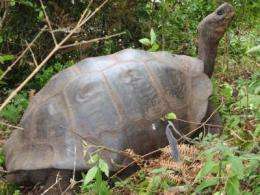
G. Becky tortoises are native to Isabela Island in the Galapagos chain and have more domed shape shell. Credit: Courtesy Yale University

Dozens of giant tortoises of a species believed extinct for 150 years may still be living at a remote location in the Galapagos Islands, a genetic analysis conducted by Yale University researchers reveals.

The analysis, published Jan. 9 in the journal , suggests that direct descendants of at least 38 purebred individuals of Chelonoidis elephantopus live on the volcanic slopes of the northern shore of Isabela Island — 200 miles from their ancestral home of Floreana Island, where they disappeared after being hunted by whalers.

"This is not just an academic exercise," said Gisella Caccone, senior research scientist in the Department of Ecology and Evolutionary Biology and senior author of the paper. "If we can find these individuals, we can restore them to their island of origin. This is important as these animals are keystone species playing a crucial role in maintaining the ecological integrity of the island communities."

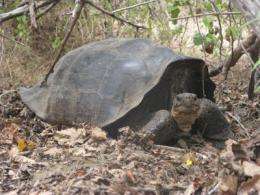
On his historic voyage to the Galapagos in 1835, Charles Darwin observed that the shells of tortoises living on different islands of the chain had different shapes – one of the observations that inspired his theory of natural selection. For instance, the shells of C. elephantopus on Floreana were saddle-shaped while tortoises on other islands had domed-shaped shells.
Tortoise species thought to be extinct still lives, genetic analysis reveals
Enlarge

This tortoise is a hybrid of G. Becky and C. elephantopus, a species native to Floreana Island some 200 miles away and thought to be extinct. Genetic analysis of tortoise population on Isabela Island suggests purebred individuals of C. elephantopus must still be alive on Isabela. Credit: Courtesy of Yale University

On Floreana, however, the tortoises disappeared because of hunting by whalers and workers at a heating oil factory that had been established on the island.

A team of Yale researchers visiting Volcano Wolf on the northern tip of Isabela Island in 2008 took blood samples from more than 1600 tortoises and compared them to a genetic database of living and extinct tortoise species. An analysis detected the genetic signatures of C. elephantopus in 84 Volcano Wolf tortoises, meaning one of their parents was a purebred member of the missing species. In 30 cases breeding had taken place within the last 15 years. Since the lifespan of tortoises can exceed 100 years, there is a high probability that many purebreds are still alive, note the researchers.

"To our knowledge, this is the first report of the rediscovery of a species by way of tracking the genetic footprints left in the genomes of its hybrid offspring," said former Yale postdoctoral researcher Ryan Garrick, now assistant professor at the University of Mississipi and first author of the paper.

Intensive breeding of hybrids might allow scientists to resuscitate the C. elephantopus even if sufficient numbers of purebred tortoises can not be found, Garrick said.

The team doubts that the tortoises reached Volcano Wolf on their own and theorized the were transported as food from Floreana, but were either thrown overboard by whalers or left on shore of Isabela.

More information: Garrick et al.: “Genetic rediscovery of an ‘extinct’ Galápagos giant tortoise species.” Current Biology, January 10, 2012, print issue

Provided by Yale University (news : web)

4.6 /5 (11 votes)  

Filter


Move the slider to adjust rank threshold, so that you can hide some of the comments.


Display comments: newest first

NeutronicallyRepulsive
Jan 10, 2012

Rank: 5 / 5 (4)
Don't forget to add, that these are probably the most delicious animals in existence. As was noted by people who discovered them, before they ate them to (as now was found out - near) extinction. Hopefully this time it will be time to properly label them, and actually bring them back or let them survive without eating them.
deepsand
Jan 10, 2012

Rank: 5 / 5 (3)
Given the continued active taking and trading of various bush meats and threatened aquatic life forms, I would not here hold out much hope for man's best behavior.
Rank 4.6 /5 (11 votes)
Relevant PhysicsForums posts
  • Eye biology videos
    created4 hours ago
  • Flowering Plant Revived After 30,000 Years in Permafrost
    createdFeb 21, 2012
  • Toba volcano eruptions - 1.000 - 10,000 breeding pairsunb
    createdFeb 20, 2012
  • How is a specific gene removed from DNA
    createdFeb 20, 2012
  • Reproduction and Human evolution
    createdFeb 19, 2012
  • Viruses: Living or Non-living organisms
    createdFeb 19, 2012
  • More from Physics Forums - Biology

More news stories

Surprising diversity at a synapse hints at complex diversity of neural circuitry

A new study reveals a dazzling degree of biological diversity in an unexpected place – a single neural connection in the body wall of flies.

Biology / Other

created 10 hours ago | popularity 5 / 5 (4) | comments 0 | with audio podcast

Men might not 'become extinct' after all: Theory of the 'rotting' Y chromosome dealt a fatal blow

If you were to discover that a fundamental component of human biology has survived virtually intact for the past 25 million years, you'd be quite confident in saying that it is here to stay.

Biology / Biotechnology

created 13 hours ago | popularity 5 / 5 (6) | comments 1 | with audio podcast

New family of legless amphibians found in India

Since before the age of dinosaurs it has burrowed unbothered beneath the monsoon-soaked soils of remote northeast India - unknown to science and mistaken by villagers as a deadly, miniature snake.

Biology / Plants & Animals

created 21 hours ago | popularity 5 / 5 (8) | comments 3

Climate change affects bird migration timing in North America

Bird migration timing across North America has been affected by climate change, according to a study published Feb. 22 in the open access journal PLoS ONE.

Biology / Ecology

created 9 hours ago | popularity 4.5 / 5 (2) | comments 2

New iridescent lizard species found in Cambodia

A new species of lizard with striking iridescent rainbow skin, a long tail and very short legs has been discovered in the rainforest in northeast Cambodia, conservationists announced Wednesday.

Biology / Plants & Animals

created 10 hours ago | popularity not rated yet | comments 0


Researchers build first physical 'metatronic' circuit

(PhysOrg.com) -- The technological world of the 21st century owes a tremendous amount to advances in electrical engineering, specifically, the ability to finely control the flow of electrical charges using ...

Spitzer finds solid buckyballs in space

(PhysOrg.com) -- Astronomers using data from NASA's Spitzer Space Telescope have, for the first time, discovered buckyballs in a solid form in space. Prior to this discovery, the microscopic carbon spheres ...

Faster than light neutrinos? More like faulty wiring

You can shelf your designs for a warp drive engine (for now) and put the DeLorean back in the garage; it turns out neutrinos may not have broken any cosmic speed limits after all.

Physicists surprised by disappearing and reappearing superconductivity in iron selenium chalcogenides

Superconductivity is a rare physical state in which matter is able to conduct electricity -- maintain a flow of electrons -- without any resistance. This phenomenon can only be found in certain materials at low temperatures, ...

CT colonography shown to be comparable to standard colonoscopy

Computerized tomographic (CT) colonography (CTC), also known as virtual colonoscopy, is comparable to standard colonoscopy in its ability to accurately detect cancer and precancerous polyps in people ages 65 and older, according ...

Stanford research team cracks animated NuCaptcha

(PhysOrg.com) -- The research team from Stanford University, led by Elie Bursztein, that previously had cracked regular CAPTCHAs and then audio CAPTCHAs, now has also successfully cracked the animated version called NuCapt ...