Graphene: Supermaterial goes superpermeable
January 26, 2012
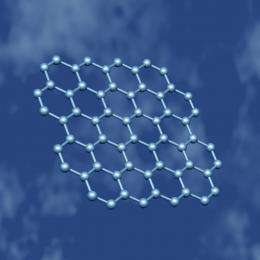
Artistic impression of graphene molecules. Image: University of Manchester
Graphene is one of the wonders of the science world, with the potential to create foldaway mobile phones, wallpaper-thin lighting panels and the next generation of aircraft. The new finding at the University of Manchester gives graphene's potential a most surprising dimension graphene can also be used for distilling alcohol.
In a report published in Science, a team led by Professor Sir Andre Geim shows that graphene-based membranes are impermeable to all gases and liquids (vacuum-tight). However, water evaporates through them as quickly as if the membranes were not there at all.
This newly-found property can now be added to the already long list of superlatives describing graphene. It is the thinnest known material in the universe and the strongest ever measured. It conducts electricity and heat better than any other material. It is the stiffest one too and, at the same time, it is the most ductile. Demonstrating its remarkable properties won University of Manchester academics the Nobel Prize in Physics in 2010.
Now the University of Manchester scientists have studied membranes from a chemical derivative of graphene called graphene oxide. Graphene oxide is the same graphene sheet but it is randomly covered with other molecules such as hydroxyl groups OH-. Graphene oxide sheets stack on top of each other and form a laminate.
The researchers prepared such laminates that were hundreds times thinner than a human hair but remained strong, flexible and were easy to handle.
When a metal container was sealed with such a film, even the most sensitive equipment was unable to detect air or any other gas, including helium, to leak through.
It came as a complete surprise that, when the researchers tried the same with ordinary water, they found that it evaporates without noticing the graphene seal. Water molecules diffused through the graphene-oxide membranes with such a great speed that the evaporation rate was the same independently whether the container was sealed or completely open.
Dr Rahul Nair, who was leading the experimental work, offers the following explanation: "Graphene oxide sheets arrange in such a way that between them there is room for exactly one layer of water molecules. They arrange themselves in one molecule thick sheets of ice which slide along the graphene surface with practically no friction.
"If another atom or molecule tries the same trick, it finds that graphene capillaries either shrink in low humidity or get clogged with water molecules."
"Helium gas is hard to stop. It slowly leaks even through a millimetre -thick window glass but our ultra-thin films completely block it. At the same time, water evaporates through them unimpeded. Materials cannot behave any stranger," comments Professor Geim. "You cannot help wondering what else graphene has in store for us".
"This unique property can be used in situations where one needs to remove water from a mixture or a container, while keeping in all the other ingredients", says Dr Irina Grigorieva who also participated in the research.
"Just for a laugh, we sealed a bottle of vodka with our membranes and found that the distilled solution became stronger and stronger with time. Neither of us drinks vodka but it was great fun to do the experiment", adds Dr Nair.
The Manchester researchers report this experiment in their Science paper, too, but they say they do not envisage use of graphene in distilleries, nor offer any immediate ideas for applications.
However, Professor Geim adds 'The properties are so unusual that it is hard to imagine that they cannot find some use in the design of filtration, separation or barrier membranes and for selective removal of water'.
More information: The paper, Unimpeded Permeation of Water Through Helium-LeakTight Graphene-Based Membranes, by R. Nair, H. Wu, P. Jayaram, V. Grigorieva and A. Geim, is published in Science on January 26, 2012.
-
Graphene's 'Big Mac' creates next generation of chips
Oct 09, 2011 |
not rated yet |
0
-
Graphene reveals its magnetic personality
Jan 08, 2012 |
not rated yet |
0
-
Bilayer graphene is another step toward graphene electronics
Aug 11, 2011 |
not rated yet |
0
-
Researchers Discover New Properties of World's Thinnest Material
Jun 14, 2010 |
not rated yet |
0
-
Graphene pioneers follow in Nobel footsteps
Sep 02, 2008 |
not rated yet |
0
-
Stars containing dark matter should look different from other stars
Feb 20, 2012 |
4.5 / 5 (17) |
11
-
Physicists discover evidence of rare hypernucleus, a component of strange matter
Feb 17, 2012 |
4.7 / 5 (38) |
22
-
Fast photon control brings quantum photonic technologies closer
Feb 13, 2012 |
5 / 5 (8) |
1
-
Engineers build first sub-10-nm carbon nanotube transistor
Feb 01, 2012 |
4.9 / 5 (36) |
32
-
Something old, something new: Evolution and the structural divergence of duplicate genes
Jan 31, 2012 |
4.6 / 5 (7) |
1
-
Specific heat of Al
Feb 21, 2012
-
Strongest steel?
Feb 19, 2012
-
stabilizing Zirconia
Feb 18, 2012
-
How to calculate strength of welds (welded joints)?
Feb 17, 2012
-
Polycarbonate fracture toughness????
Feb 16, 2012
-
FTIR:What is the proper instrument for liquid samples?
Feb 15, 2012
- More from Physics Forums - Materials & Chemical Engineering
More news stories
Researchers discover how different nanomaterial surfaces affect proteins
A new study led by nanotechnology and biotechnology experts at Rensselaer Polytechnic Institute is providing important details on how proteins in our bodies interact with nanomaterials. In their new study, published in the ...
Nanotechnology / Bio & Medicine
7 hours ago |
5 / 5 (2) |
1
|
New nanotechnology converts heat into power when it's needed most
Never get stranded with a dead cell phone again. A promising new technology called Power Felt, a thermoelectric device that converts body heat into an electrical current, soon could create enough juice to make another call ...
14 hours ago |
4 / 5 (8) |
6
|
Graphene is thinnest known anti-corrosion coating
New research has established the "miracle material" called graphene as the world's thinnest known coating for protecting metals against corrosion. Their study on this potential new use of graphene appears ...
Nanotechnology / Nanomaterials
10 hours ago |
4.6 / 5 (7) |
2
|
New technique produces free-standing piezoelectric ferroelectric nanostructures from PZT material
(PhysOrg.com) -- Researchers have developed a soft template infiltration technique for fabricating free-standing piezoelectrically active ferroelectric nanotubes and other nanostructures from PZT ...
14 hours ago |
5 / 5 (5) |
4
|
A new twist on nanowires
Nanowires — microscopic fibers that can be “grown” in the lab — are a hot research topic today, with a variety of potential applications including light-emitting diodes (LEDs) and sensors. ...
16 hours ago |
4.8 / 5 (4) |
0
|
Researchers build first physical 'metatronic' circuit
(PhysOrg.com) -- The technological world of the 21st century owes a tremendous amount to advances in electrical engineering, specifically, the ability to finely control the flow of electrical charges using ...
Faster than light neutrinos? More like faulty wiring
You can shelf your designs for a warp drive engine (for now) and put the DeLorean back in the garage; it turns out neutrinos may not have broken any cosmic speed limits after all.
Spitzer finds solid buckyballs in space
(PhysOrg.com) -- Astronomers using data from NASA's Spitzer Space Telescope have, for the first time, discovered buckyballs in a solid form in space. Prior to this discovery, the microscopic carbon spheres ...
Physicists surprised by disappearing and reappearing superconductivity in iron selenium chalcogenides
Superconductivity is a rare physical state in which matter is able to conduct electricity -- maintain a flow of electrons -- without any resistance. This phenomenon can only be found in certain materials at low temperatures, ...
Scientists create potent molecules aimed at treating muscular dystrophy
While RNA is an appealing drug target, small molecules that can actually affect its function have rarely been found. But now scientists from the Florida campus of The Scripps Research Institute have for the first time designed ...
Stanford research team cracks animated NuCaptcha
(PhysOrg.com) -- The research team from Stanford University, led by Elie Bursztein, that previously had cracked regular CAPTCHAs and then audio CAPTCHAs, now has also successfully cracked the animated version called NuCapt ...
Jan 26, 2012
Rank: 4.8 / 5 (13)
Jan 26, 2012
Rank: not rated yet
Jan 26, 2012
Rank: 5 / 5 (4)
Jan 26, 2012
Rank: 1 / 5 (10)
Jan 26, 2012
Rank: 1 / 5 (9)
Jan 26, 2012
Rank: not rated yet
Jan 26, 2012
Rank: 5 / 5 (9)
2. Pipe the resultant low-pressure water vapor through a condensing coil located in the concentrator's own shadow.
3. Wait until your glass dribbles full... and drink.
Jan 26, 2012
Rank: 2.5 / 5 (2)
Suck the air out of the container, which would cause the water in the target substance to vaporize, and this would theoretically cross the graphene barrier, resulting in an ultra-dry container, I think.
I dont know, maybe we're thinking backwards.
Maybe its more useful if you need to get water INTO something, without letting air or other materials out.
It could be useful in instrumentation for measuring air samples or something, where you might want to remove the water vapor from the sample without changing anything else about the sample's composition.
Could be useful for removing humidity from sensitive work spaces, such as for electronics or nanotechnology manufacture.
I don't know, talk to somebody in food preservation and processing. I'm sure some industry chef or chemist could find a use for this in foods preperation.
Jan 26, 2012
Rank: 5 / 5 (3)
Jan 26, 2012
Rank: 5 / 5 (3)
I think you mean 'condensing it down for the less enlightened'
Jan 26, 2012
Rank: 5 / 5 (2)
Brandy is currently produced by heating wine, this causes many changes to the flavours in the wine. However, if the wine could be concentrated by removing most of the water, the flavour of the concentrated wine would be enhanced rather than changed.
Jan 26, 2012
Rank: 5 / 5 (1)
For food it sounds good to dehydrate food without losing flavour.
Jan 27, 2012
Rank: 5 / 5 (3)
Hydrogen storage is still somewhat of a problem as it tends to leak and/or make substances brittle.
If this form of graphene could block hydrogen then that would be great.
Jan 27, 2012
Rank: 5 / 5 (3)
It is done so for traditional reasons, if at all. Vacuum distillation works just as well by lowering the boiling point of water to room temperature.
The real difficulty in the process is that you remove the alcohol with the water, so the resulting vapors have to be distilled a second time and the alcohol returned to the wine. It's a costly process, and would work much better if they could just leave the wine in an aging vat covered with graphene, and then wait for the water to come out.
It also means that home distilling can now be accomplished with a glass bottle and a hand pump. You take two bottles, connect them with a hose, put a graphene film in between and pump the air out of the other. Water moves in to fill the void.
Jan 27, 2012
Rank: 1 / 5 (1)
Jan 27, 2012
Rank: not rated yet
Concentrating all that non-water stuff to a brew is not a good idea. A still enables the lighter alcohols to be removed, and the heavier alcohols to stay behind.
Jan 27, 2012
Rank: 4.5 / 5 (2)
Jan 28, 2012
Rank: 1 / 5 (1)
Jan 28, 2012
Rank: not rated yet
Jan 31, 2012
Rank: not rated yet
The way the scouting movement does this is: Take a bucket. If possible, put it in sunshine. Pour an inch or two of dirty water at the bottom. Place an upright, empty drinking glass at the center of the bottom. Cover the bucket's opening with a plastic sheet or film, fixed around the bucket's opening, not stretched too taut. Put a pebble on the plastic sheet, just above the glass.
The water inside evaporates and condenses on all inner surfaces. The water that condenses on the plastic sheet runs downward to the sheet's lowest spot, the pebble spot, and drips into the glass.
If you ever get lost in the wilderness and this saves your life, please remember to send me a reward of $100,000, or whatever you think your life is worth.