Guinness World Record: DESY's X-ray laser FLASH shoots fastest movie
January 25, 2012
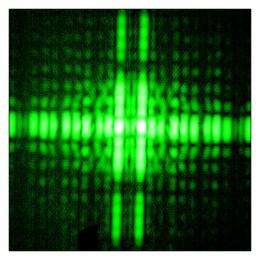
Main part of the Brandenburg Gate hologram. Credit: Stefan Eisebitt/HZB.
It's official: The world's fastest movie was shot by DESY's X-ray laser FLASH in Hamburg, Germany.
In its 2012 edition, the famous Guinness Book of World Records lists an interval of a mere 50 femtoseconds between two frames for FLASH. A femtosecond is a quadrillionth of a second, meaning that the two images are separated by just 0.000 000 000 000 05 seconds this is 800 billion times faster than a feature film. On Thursday, Professor Stefan Eisebitt from Technische Universität Berlin and the Helmholtz Zentrum Berlin will present the record slow motion at the DESY light sources users meeting. As the film motif for the demonstration of the technique his group chose a micro model of the Brandenburg Gate, spanning only a few micrometers.
The specialised light sources at DESY offer scientists unique insights into the world of atoms and molecules and attracted more than 2500 guest users in 2011 alone. More than 600 participants registered for the three-day users meeting organised jointly by DESY and the European XFEL.

Optical lasers are used to synchronize free-electron lasers. Photo: Greg Hren/Research Laboratory of Electronics at MIT
The novel X-ray lasers will offer high speed films of ultrafast molecular processes and chemical reactions for a better understanding of these processes, emphasises DESY's director of research Professor Edgar Weckert. At FLASH, Eisebitt and his team demonstrated the fastest imaging sequence so far. For this purpose, the scientists split the X-ray laser beam into two flashes and sent one of them via a detour of only 0.015 millimetres, making it arrive 50 femtoseconds later than the first one. Since no detector can be read out so fast, the scientists stored both images as superimposed holograms, allowing the subsequent reconstruction of the single images.With these experiments, the scientists showed that this record slow motion is achievable. However, they did not only take the worlds fastest but probably also the shortest film with just two images. Thus, additional development work is necessary for the use of this method in practice. The long-term goal is to track the movements of molecules and nano structures in realtime, Eisebitt said. His team also presented their work in the journal Nature Photonics.
More information: DOI: 10.1038/NPHOTON.2010.287
Provided by DESY
-
Fastest movie in the world recorded: Scientists develop a method to film nanostructures
Jan 12, 2011 |
not rated yet |
0
-
Scientists study processes using high-intensity ultrashort X-ray pulses
Feb 03, 2011 |
not rated yet |
0
-
World's best metronome enables slow-motion pictures of atoms and molecules
Jan 17, 2012 |
not rated yet |
0
-
European XFEL Project Shines a New Light for Research
Oct 11, 2007 |
not rated yet |
0
-
FLASH Imaging Redux: Nano-Cinema is Born
Jul 08, 2008 |
not rated yet |
0
-
Stars containing dark matter should look different from other stars
Feb 20, 2012 |
4.5 / 5 (17) |
11
-
Physicists discover evidence of rare hypernucleus, a component of strange matter
Feb 17, 2012 |
4.7 / 5 (38) |
22
-
Fast photon control brings quantum photonic technologies closer
Feb 13, 2012 |
5 / 5 (8) |
1
-
Engineers build first sub-10-nm carbon nanotube transistor
Feb 01, 2012 |
4.9 / 5 (36) |
32
-
Something old, something new: Evolution and the structural divergence of duplicate genes
Jan 31, 2012 |
4.6 / 5 (7) |
1
-
linear wave equation vs. linear system
1 hour ago
-
adhesive force and surface tension
1 hour ago
-
Newbie here.
3 hours ago
-
Rainbows in space?
3 hours ago
-
taking mechanical physics next fall
5 hours ago
-
Help: maximum force of an object when given impulse and time on a graph
8 hours ago
- More from Physics Forums - General Physics
More news stories
Researchers build first physical 'metatronic' circuit
(PhysOrg.com) -- The technological world of the 21st century owes a tremendous amount to advances in electrical engineering, specifically, the ability to finely control the flow of electrical charges using ...
10 hours ago |
4.7 / 5 (17) |
5
|
Faster than light neutrinos? More like faulty wiring
You can shelf your designs for a warp drive engine (for now) and put the DeLorean back in the garage; it turns out neutrinos may not have broken any cosmic speed limits after all.
9 hours ago |
4.2 / 5 (22) |
23
|
Physicists surprised by disappearing and reappearing superconductivity in iron selenium chalcogenides
Superconductivity is a rare physical state in which matter is able to conduct electricity -- maintain a flow of electrons -- without any resistance. This phenomenon can only be found in certain materials at low temperatures, ...
13 hours ago |
5 / 5 (5) |
2
|
Less is more: Study of tiny droplets could have big impact on industrial applications
(PhysOrg.com) -- Under a microscope, a tiny droplet slides between two fine hairs like a roller coaster on a set of rails until poof it suddenly spreads along them, a droplet no more.
10 hours ago |
3.7 / 5 (3) |
0
|
Study reveals switching mechanism in promising computer memory device
(PhysOrg.com) -- Sometimes knowing that a new technology works is not enough. You also must know why it works to get marketplace acceptance. New information from the National Institute of Standards and Technology ...
17 hours ago |
4 / 5 (4) |
0
|
Spitzer finds solid buckyballs in space
(PhysOrg.com) -- Astronomers using data from NASA's Spitzer Space Telescope have, for the first time, discovered buckyballs in a solid form in space. Prior to this discovery, the microscopic carbon spheres ...
Stanford research team cracks animated NuCaptcha
(PhysOrg.com) -- The research team from Stanford University, led by Elie Bursztein, that previously had cracked regular CAPTCHAs and then audio CAPTCHAs, now has also successfully cracked the animated version called NuCapt ...
CT colonography shown to be comparable to standard colonoscopy
Computerized tomographic (CT) colonography (CTC), also known as virtual colonoscopy, is comparable to standard colonoscopy in its ability to accurately detect cancer and precancerous polyps in people ages 65 and older, according ...
Going up: Japan builder eyes space elevator
A Japanese construction firm claimed Wednesday it could execute an out-of-this-world plan to put tourists in space within 40 years by building an elevator that stretches a quarter of the way to the moon.
Scientists create potent molecules aimed at treating muscular dystrophy
While RNA is an appealing drug target, small molecules that can actually affect its function have rarely been found. But now scientists from the Florida campus of The Scripps Research Institute have for the first time designed ...
Flesh-eating bacteria inspire superglue
(PhysOrg.com) -- A bio-inspired superglue has been developed by Oxford University researchers that cant be matched for sticking molecules together and not letting go.
