Hacking the SEM: Crystal phase detection for nanoscale samples
January 25, 2012
Hacking the SEM: Crystal phase detection for nanoscale samples

Enlarge

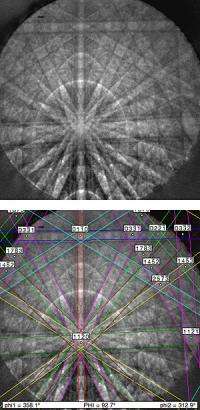
Top: Transmission electron diffraction pattern from from a segment of an indium gallium nitride (InGaN) nanowire about 50 nanometers in diameter taken with an SEM using the new NIST technique clearly shows a unique pattern associated with crystal diffraction. Bottom: Same pattern but with an overlay showing the crystallographic indexing associated with the atomic structure of the material. Credit: Geiss/NIST

(PhysOrg.com) -- Custom modifications of equipment are an honored tradition of the research lab. In a recent paper, two materials scientists at the National Institute of Standards and Technology describe how a relatively simple mod of a standard scanning electron microscope (SEM) enables a roughly 10-fold improvement in its ability to measure the crystal structure of nanoparticles and extremely thin films. By altering the sample position, they are able to determine crystal structure of particles as small as 10 nanometers. The technique, they say, should be applicable to a wide range of work, from crime scene forensics to environmental monitoring to process control in nanomanufacturing.

The technique is a new way of doing with an SEM. In standard SEM-based electron diffraction, the researcher analyses patterns that are formed by electrons that bounce back after striking atoms in the sample. If the sample is a , with a regular pattern to the arrangement of atoms, these diffracted electrons form a pattern of lines that reveals the particular or "phase" and orientation of the material.

The information, say NIST's Robert Keller and Roy Geiss, can be critical. "A common example is , which can exist in a couple of different crystal phases. That difference significantly affects how the material behaves chemically, how reactive it is. You need to add crystallographic identification to the to completely characterize the material."

SEMs often are outfitted with an instrument for just this task, a device called an EBSD (electron back-scatter diffraction) detector. The problem, they say, is that below a certain size, the usual setup just doesn't work. "You can determine the crystal structure of an isolated particle down to a size of about 100 to 120 nanometers, but below that the crystals are so small that you're getting information about the sample holder instead." A somewhat more exotic instrument, the transmission electron microscope (TEM), does much better, they say, but samples below about 50 nanometers in size show very limited diffraction patterns because the higher-powered electron beam of the TEM just blasts through them.

The novel tweak developed by Keller and Geiss combines a little of each. They moved the SEM sample holder closer to the beam source and adjust the angles so that instead of imaging electrons bouncing back from the sample, the "EBSD" detector is actually seeing electrons that scatter forward through the sample in a manner similar to a TEM. (They also came up with a unique method of holding samples to make this work.)

They have shown that their technique produces reliable crystal phase information for as small as 10 nanometers across, as well as for single crystalline grains as small as 15 nanometers in an ultrathin film.

Electron diffraction in an SEM, says Keller, "in general represents the only approach capable of measuring the atomic structure, defect content, or crystallographic phase of single nanoparticles. This is a critical need in cases of extremely limited sampling of unknown particles. This work pushes electron diffraction to a new frontier by providing spatial resolution that rivals that possible in a TEM, and makes it available to anyone with an SEM. And that's an ubiquitous tool in virtually all fields that require characterization of solids."

Typical applications, the researchers say, include pinpointing ammunition sources from gunshot residue at crime scenes; determining the processing history of confiscated drugs; accurate characterization of nanoparticles for health, safety and environmental impact studies; and optimizing grain structure in high-performance electronics based on and process and quality control in nanomanufacturing.

More information: R.R. Keller and R.H. Geiss. Transmission EBSD from 10 nm domains in a scanning electron microscope. Journal of Microscopy, 2011. doi: 10.1111/j.1365-2818.2011.03566.x . Scheduled to appear in the March 2012 issue.

Provided by National Institute of Standards and Technology (news : web)


Rank 5 /5 (2 votes)
Related Stories
Relevant PhysicsForums posts
  • Newbie here.
    created1 hour ago
  • Rainbows in space?
    created1 hour ago
  • taking mechanical physics next fall
    created2 hours ago
  • Help: maximum force of an object when given impulse and time on a graph
    created5 hours ago
  • Impulse, momentum, and force during motion around a circle
    created8 hours ago
  • Help needed to find the best fit to an angular distribution
    created8 hours ago
  • More from Physics Forums - General Physics

More news stories

Researchers build first physical 'metatronic' circuit

(PhysOrg.com) -- The technological world of the 21st century owes a tremendous amount to advances in electrical engineering, specifically, the ability to finely control the flow of electrical charges using ...

Physics / General Physics

created 7 hours ago | popularity 4.7 / 5 (15) | comments 5 | with audio podcast

Faster than light neutrinos? More like faulty wiring

You can shelf your designs for a warp drive engine (for now) and put the DeLorean back in the garage; it turns out neutrinos may not have broken any cosmic speed limits after all.

Physics / General Physics

created 6 hours ago | popularity 4.3 / 5 (19) | comments 20 | with audio podcast

Physicists surprised by disappearing and reappearing superconductivity in iron selenium chalcogenides

Superconductivity is a rare physical state in which matter is able to conduct electricity -- maintain a flow of electrons -- without any resistance. This phenomenon can only be found in certain materials at low temperatures, ...

Physics / Superconductivity

created 10 hours ago | popularity 5 / 5 (4) | comments 1 | with audio podcast

Less is more: Study of tiny droplets could have big impact on industrial applications

(PhysOrg.com) -- Under a microscope, a tiny droplet slides between two fine hairs like a roller coaster on a set of rails until — poof — it suddenly spreads along them, a droplet no more.

Physics / General Physics

created 7 hours ago | popularity 3 / 5 (2) | comments 0 | with audio podcast

Study reveals switching mechanism in promising computer memory device

(PhysOrg.com) -- Sometimes knowing that a new technology works is not enough. You also must know why it works to get marketplace acceptance. New information from the National Institute of Standards and Technology ...

Physics / General Physics

created 14 hours ago | popularity 4 / 5 (4) | comments 0 | with audio podcast


Spitzer finds solid buckyballs in space

(PhysOrg.com) -- Astronomers using data from NASA's Spitzer Space Telescope have, for the first time, discovered buckyballs in a solid form in space. Prior to this discovery, the microscopic carbon spheres ...

Scientists create potent molecules aimed at treating muscular dystrophy

While RNA is an appealing drug target, small molecules that can actually affect its function have rarely been found. But now scientists from the Florida campus of The Scripps Research Institute have for the first time designed ...

Stanford research team cracks animated NuCaptcha

(PhysOrg.com) -- The research team from Stanford University, led by Elie Bursztein, that previously had cracked regular CAPTCHAs and then audio CAPTCHAs, now has also successfully cracked the animated version called NuCapt ...

Surprising diversity at a synapse hints at complex diversity of neural circuitry

A new study reveals a dazzling degree of biological diversity in an unexpected place – a single neural connection in the body wall of flies.

Flesh-eating bacteria inspire superglue

(PhysOrg.com) -- A bio-inspired superglue has been developed by Oxford University researchers that can’t be matched for sticking molecules together and not letting go.

Researchers discover how different nanomaterial surfaces affect proteins

A new study led by nanotechnology and biotechnology experts at Rensselaer Polytechnic Institute is providing important details on how proteins in our bodies interact with nanomaterials. In their new study, published in the ...