The Helix Nebula in new colors
January 19, 2012
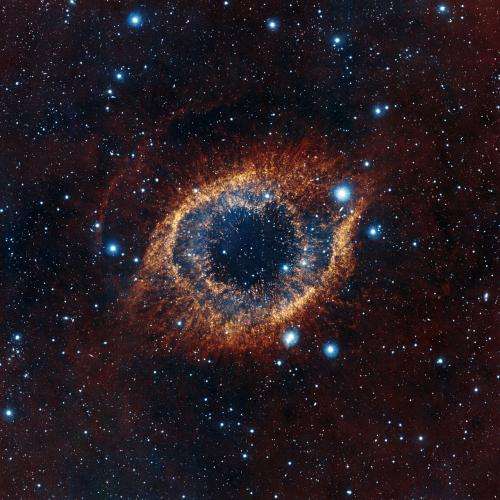
ESO's Visible and Infrared Survey Telescope for Astronomy (VISTA) has captured this unusual view of the Helix Nebula (NGC 7293), a planetary nebula located 700 light-years away. The coloured picture was created from images taken through Y, J and K infrared filters. While bringing to light a rich background of stars and galaxies, the telescope's infrared vision also reveals strands of cold nebular gas that are mostly obscured in visible images of the Helix. Credit: ESO/VISTA/J. Emerson. Acknowledgment: Cambridge Astronomical Survey Unit
(PhysOrg.com) -- ESO's VISTA telescope, at the Paranal Observatory in Chile, has captured a striking new image of the Helix Nebula. This picture, taken in infrared light, reveals strands of cold nebular gas that are invisible in images taken in visible light, as well as bringing to light a rich background of stars and galaxies.
The Helix Nebula is one of the closest and most remarkable examples of a planetary nebula. It lies in the constellation of Aquarius (The Water Bearer), about 700 light-years away from Earth. This strange object formed when a star like the Sun was in the final stages of its life. Unable to hold onto its outer layers, the star slowly shed shells of gas that became the nebula. It is evolving to become a white dwarf star and appears as the tiny blue dot seen at the centre of the image.
The nebula itself is a complex object composed of dust, ionised material as well as molecular gas, arrayed in a beautiful and intricate flower-like pattern and glowing in the fierce glare of ultraviolet light from the central hot star.
This video is not supported by your browser at this time.
This video compares a new view of the Helix Nebula acquired with the VISTA telescope in infrared light with the more familiar view in visible light from the MPG/ESO 2.2-metre telescope at ESO's La Silla Observatory. The infrared vision of VISTA reveals strands of cold nebular gas that are mostly obscured in visible light images of the Helix. Credit: ESO/VISTA/J. Emerson. Acknowledgment: Cambridge Astronomical Survey Unit
The main ring of the Helix is about two light-years across, roughly half the distance between the Sun and the nearest star. However, material from the nebula spreads out from the star to at least four light-years. This is particularly clear in this infrared view since red molecular gas can be seen across much of the image.While hard to see visually, the glow from the thinly spread gas is easily captured by VISTA's special detectors, which are very sensitive to infrared light. The 4.1-metre telescope is also able to detect an impressive array of background stars and galaxies.
The powerful vision of ESO's VISTA telescope also reveals fine structure in the nebula's rings. The infrared light picks out how the cooler, molecular gas is organised. The material clumps into filaments that radiate out from the centre and the whole view resembles a celestial firework display.
Even though they look tiny, these strands of molecular hydrogen, known as cometary knots, are about the size of our Solar System. The molecules in them are able to survive the high-energy radiation that emanates from the dying star precisely because they clump into these knots, which in turn are shielded by dust and molecular gas. It is currently unclear how the cometary knots may have originated.
-
Into the eye of the helix
Feb 25, 2009 |
not rated yet |
0
-
Scientists discovers 'firework' display in Helix Nebula
Jul 20, 2009 |
not rated yet |
0
-
A cosmic inkblot test
Aug 11, 2011 |
not rated yet |
0
-
The Last Confessions of a Dying Star
Mar 04, 2008 |
not rated yet |
0
-
VISTA stares deeply into the blue lagoon
Jan 05, 2011 |
not rated yet |
0
-
Stars containing dark matter should look different from other stars
Feb 20, 2012 |
4.5 / 5 (17) |
11
-
Physicists discover evidence of rare hypernucleus, a component of strange matter
Feb 17, 2012 |
4.7 / 5 (38) |
22
-
Fast photon control brings quantum photonic technologies closer
Feb 13, 2012 |
5 / 5 (8) |
1
-
Engineers build first sub-10-nm carbon nanotube transistor
Feb 01, 2012 |
4.9 / 5 (36) |
32
-
Something old, something new: Evolution and the structural divergence of duplicate genes
Jan 31, 2012 |
4.6 / 5 (7) |
1
-
What is this spectrum I took?
9 hours ago
-
Orientation of Space
9 hours ago
-
Geologically Active Moon Now: NASA
16 hours ago
-
advice on building a science fair telescope
22 hours ago
-
Rise of the Sun
22 hours ago
-
Uncertainty of planetary orbital period
Feb 19, 2012
- More from Physics Forums - General Astronomy
More news stories
Spitzer finds solid buckyballs in space
(PhysOrg.com) -- Astronomers using data from NASA's Spitzer Space Telescope have, for the first time, discovered buckyballs in a solid form in space. Prior to this discovery, the microscopic carbon spheres ...
11 hours ago |
4.7 / 5 (12) |
6
|
Going up: Japan builder eyes space elevator
A Japanese construction firm claimed Wednesday it could execute an out-of-this-world plan to put tourists in space within 40 years by building an elevator that stretches a quarter of the way to the moon.
Space & Earth / Space Exploration
18 hours ago |
3.5 / 5 (13) |
24
ENASA satellite finds Earth's clouds are getting lower
(PhysOrg.com) -- Earth's clouds got a little lower -- about one percent on average -- during the first decade of this century, finds a new NASA-funded university study based on NASA satellite data. The results ...
Space & Earth / Earth Sciences
15 hours ago |
5 / 5 (8) |
9
|
Fresh scandal embroils US climate science debate
A fresh scandal over climate change has erupted in the United States after leaked documents appeared to show a right-wing funded campaign to influence how climate science is taught in schools.
7 hours ago |
4.4 / 5 (7) |
6
World's oceans get an acid bath
Among the repercussions of global climate change, the effect of ocean acidification on marine life is one of the least-understood variables.
14 hours ago |
4.3 / 5 (6) |
4
|
Researchers build first physical 'metatronic' circuit
(PhysOrg.com) -- The technological world of the 21st century owes a tremendous amount to advances in electrical engineering, specifically, the ability to finely control the flow of electrical charges using ...
Faster than light neutrinos? More like faulty wiring
You can shelf your designs for a warp drive engine (for now) and put the DeLorean back in the garage; it turns out neutrinos may not have broken any cosmic speed limits after all.
Physicists surprised by disappearing and reappearing superconductivity in iron selenium chalcogenides
Superconductivity is a rare physical state in which matter is able to conduct electricity -- maintain a flow of electrons -- without any resistance. This phenomenon can only be found in certain materials at low temperatures, ...
Scientists create potent molecules aimed at treating muscular dystrophy
While RNA is an appealing drug target, small molecules that can actually affect its function have rarely been found. But now scientists from the Florida campus of The Scripps Research Institute have for the first time designed ...
Stanford research team cracks animated NuCaptcha
(PhysOrg.com) -- The research team from Stanford University, led by Elie Bursztein, that previously had cracked regular CAPTCHAs and then audio CAPTCHAs, now has also successfully cracked the animated version called NuCapt ...
Less is more: Study of tiny droplets could have big impact on industrial applications
(PhysOrg.com) -- Under a microscope, a tiny droplet slides between two fine hairs like a roller coaster on a set of rails until poof it suddenly spreads along them, a droplet no more.