IBM scientists create the smallest 3D map of planet Earth
January 18, 2012 by Steve Hamm
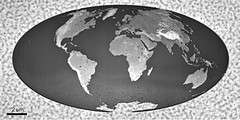
The map, produced on a tiny sliver of polymer, measures just 22 by 11 micrometers. To put that into perspective, 1000 copies of the map could fit within a single grain of salt.
An achievement made last year by IBM scientists cant really compare with the largest collection of Charlies Angels memorabilia (5,569 items), the most body piercings in one session (3,900) or the longest cucumber (47 inches), all Guinness World Records, but IBMs nanotech experts have attained a Guinness record of their own. Their feat: creating the smallest 3D map of Earth.
The map, produced on a tiny sliver of polymer, measures just 22 by 11 micrometers. To put that into perspective, 1000 copies of the map could fit within a single grain of salt.
The Guinness World Record organization recognized the handiwork of IBM scientists in Zurich, Switzerland, and Almaden, Calif., in its new book, Guinness World Records 2012. (Officially they are no longer called the Guinness Book of World Records.)
Unlike many other Guinness participants, the scientists werent motivated by a desire for 15 minutes of pop-culture fame. Rather, they created their tiny map to demonstrate a breakthrough in the miniaturization of complex structures. They expect their techniques to open new prospects for developing nanoscale objects in a variety of fields including electronics, medicine, life sciences and opto-electronics.
.
How did the IBMers do it? They used a tiny silicon tip with a sharp point 100,000 times smaller than a sharpened pencil to create the miniature patterns. The etching technique is very similar to how the ancient Egyptians used chisels on stone to create drawings and hieroglyphics.
Since some members of the IBM team are avid mountaineers, they also created a 25-nanometer-high 3D replica of the Matterhorn.
True, neither the tiny Matterhorn nor the tiny Earth map compare for sheer weirdness with the record for the greatest distance traveled with a pool cue balanced on the chin (5,472 ft 9 in), but, heck, theyre pretty darn cool.
Provided by IBM
-
Sharpest microscope tip lands researchers in Guinness Book of World Records
Mar 01, 2011 |
not rated yet |
0
-
It's true! Scientists HAVE written the world's smallest periodic table
Oct 05, 2011 |
not rated yet |
0
-
A close-up look at the world's smallest book
Mar 25, 2011 |
not rated yet |
0
-
IBM demonstrates nonoscale 3D patterning technique (w/ Video)
Apr 23, 2010 |
not rated yet |
0
-
Aussie croc named biggest in captivity
Sep 15, 2011 |
not rated yet |
0
-
Stars containing dark matter should look different from other stars
Feb 20, 2012 |
4.5 / 5 (17) |
11
-
Physicists discover evidence of rare hypernucleus, a component of strange matter
Feb 17, 2012 |
4.7 / 5 (38) |
22
-
Fast photon control brings quantum photonic technologies closer
Feb 13, 2012 |
5 / 5 (8) |
1
-
Engineers build first sub-10-nm carbon nanotube transistor
Feb 01, 2012 |
4.9 / 5 (36) |
32
-
Something old, something new: Evolution and the structural divergence of duplicate genes
Jan 31, 2012 |
4.6 / 5 (7) |
1
-
taking mechanical physics next fall
1 hour ago
-
Help: maximum force of an object when given impulse and time on a graph
4 hours ago
-
Impulse, momentum, and force during motion around a circle
6 hours ago
-
Help needed to find the best fit to an angular distribution
7 hours ago
-
What is centripetal force
10 hours ago
-
Magnetic Reynolds Number
11 hours ago
- More from Physics Forums - General Physics
More news stories
Researchers discover how different nanomaterial surfaces affect proteins
A new study led by nanotechnology and biotechnology experts at Rensselaer Polytechnic Institute is providing important details on how proteins in our bodies interact with nanomaterials. In their new study, published in the ...
Nanotechnology / Bio & Medicine
7 hours ago |
5 / 5 (2) |
1
|
New nanotechnology converts heat into power when it's needed most
Never get stranded with a dead cell phone again. A promising new technology called Power Felt, a thermoelectric device that converts body heat into an electrical current, soon could create enough juice to make another call ...
13 hours ago |
4 / 5 (8) |
6
|
Graphene is thinnest known anti-corrosion coating
New research has established the "miracle material" called graphene as the world's thinnest known coating for protecting metals against corrosion. Their study on this potential new use of graphene appears ...
Nanotechnology / Nanomaterials
10 hours ago |
4.6 / 5 (7) |
2
|
New technique produces free-standing piezoelectric ferroelectric nanostructures from PZT material
(PhysOrg.com) -- Researchers have developed a soft template infiltration technique for fabricating free-standing piezoelectrically active ferroelectric nanotubes and other nanostructures from PZT ...
14 hours ago |
5 / 5 (5) |
4
|
A new twist on nanowires
Nanowires — microscopic fibers that can be “grown” in the lab — are a hot research topic today, with a variety of potential applications including light-emitting diodes (LEDs) and sensors. ...
16 hours ago |
4.8 / 5 (4) |
0
|
Researchers build first physical 'metatronic' circuit
(PhysOrg.com) -- The technological world of the 21st century owes a tremendous amount to advances in electrical engineering, specifically, the ability to finely control the flow of electrical charges using ...
Faster than light neutrinos? More like faulty wiring
You can shelf your designs for a warp drive engine (for now) and put the DeLorean back in the garage; it turns out neutrinos may not have broken any cosmic speed limits after all.
Spitzer finds solid buckyballs in space
(PhysOrg.com) -- Astronomers using data from NASA's Spitzer Space Telescope have, for the first time, discovered buckyballs in a solid form in space. Prior to this discovery, the microscopic carbon spheres ...
Physicists surprised by disappearing and reappearing superconductivity in iron selenium chalcogenides
Superconductivity is a rare physical state in which matter is able to conduct electricity -- maintain a flow of electrons -- without any resistance. This phenomenon can only be found in certain materials at low temperatures, ...
Scientists create potent molecules aimed at treating muscular dystrophy
While RNA is an appealing drug target, small molecules that can actually affect its function have rarely been found. But now scientists from the Florida campus of The Scripps Research Institute have for the first time designed ...
Stanford research team cracks animated NuCaptcha
(PhysOrg.com) -- The research team from Stanford University, led by Elie Bursztein, that previously had cracked regular CAPTCHAs and then audio CAPTCHAs, now has also successfully cracked the animated version called NuCapt ...