James Webb Space Telescope: A year of achievement and success
January 9, 2012
James Webb Space Telescope: A year of achievement and success

Enlarge

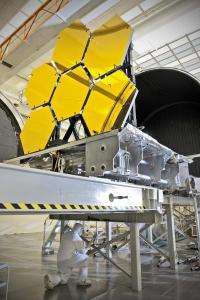
The first six flight-ready James Webb Space Telescope's primary mirror segments are prepped to begin final cryogenic testing at NASA's Marshall Space Flight Center in Huntsville, Ala. Credit: NASA/Chris Gunn

The James Webb Space Telescope marked a year of significant progress in 2011 as it continues to come together as NASA's next generation space telescope. The year brought forth a pathfinder backplane to support the large primary mirror structure, mirror cryotesting, creation of mirror support structures, several successful sunshield layer tests and the creation of an assembly station within NASA Goddard Space Flight Center's cleanroom. Achievements were also made in the areas of flight and communications software and the propulsion system.

In December, manufacturing and testing of all mirrors was completed in a final test at the X-ray and Calibration Facility at Marshall Space Flight Center, Huntsville, Ala. During these tests mirror segments were chilled to temperatures similar to those Webb will see in space, around minus 400 degrees Fahrenheit.

It was the culmination of work started in 2003. Heeding lessons learned from the , the program adopted the strategy of tackling the most difficult technical challenges first. That decision proved to be the right one. In June, all 18 flight segments, plus the secondary, tertiary and fine steering mirrors, were polished and coated yielding exquisite surfaces that will enable Webb to image the most distant galaxies.

This video is not supported by your browser at this time.

The James Webb Space Telescope will be a large infrared telescope with a 6.5-meter primary mirror. Launch is planned for 2014. The Webb Telescope will be the premier observatory of the next decade, serving thousands of astronomers worldwide. It will study every phase in the history of our universe, ranging from the first luminous glows after the Big Bang, to the formation of solar systems capable of supporting life on planets like Earth, to the evolution of our own solar system. Formerly known as the "Next Generation Space Telescope" and considered the successor to the Hubble Space Telescope, the telescope was renamed in Sept. 2002 after former NASA administrator, James Webb. Credit: NASA/Goddard Space Flight Center/SVS

Two of Webb's supporting and pathfinder structures were also completed. To assemble the flight telescope on the ground, a 139,000 pound structure will install the flight mirrors using an overhead track system supporting a robotic arm. The huge platform has been completed and assembled in the ultra-clean room used for telescope assembly at Goddard.

Also finished was the pathfinder backplane, a full-scale engineering model of the center section of the flight backplane. The backplane holds the mirror segments in place to form a single primary mirror. The full pathfinder element will consist of 12 of the 18 hexagonal cells (the center section of the primary mirror) of the telescope and contain a subset of two primary mirror segment assemblies, the secondary mirror, and the subsystem containing the tertiary and fine steering mirrors. It will demonstrate integration and test procedures that will be used on the flight telescope.

Webb's giant sunshield moved forward into a new testing phase last year, the final step before fabrication of the flight sunshield. Sunshield layer three became the first of five full-size flight-like layers stretched out in a fully simulated flight configuration. This enables engineers to make 3-D shape measurements that will tell them how the full-size sunshield layers will behave in space. Completing this test is a critical step in the sunshield's development and gives the engineers confidence and experience needed to manufacture the five flight layers.

An important sunshield deployment flight structure also completed fabrication in 2011. The space-qualified graphite composite tubes that will enable the sunshield to deploy in space have finished fabrication. The telescoping tube system was designed at Astro Aerospace, a business unit of Northrop Grumman.

Capping the year's achievements, Webb's spacecraft also moved forward. The propulsion system's 16 monopropellant rocket engine thrusters, which control momentum and station-keeping on orbit, were upgraded to accept higher heat loading from the sunshield. Propulsion engineers also completed building four flight secondary combustion augmented thrusters which maintain orbit after the launch vehicle finishes its burns. Engineers also verified the flight software responsible for ground commands and science data delivery.

Provided by NASA's Goddard Space Flight Center (news : web)

3.7 /5 (3 votes)  

Rank 3.7 /5 (3 votes)
Relevant PhysicsForums posts
  • What is this spectrum I took?
    created8 hours ago
  • Orientation of Space
    created9 hours ago
  • Geologically Active Moon Now: NASA
    created16 hours ago
  • advice on building a science fair telescope
    created21 hours ago
  • Rise of the Sun
    created22 hours ago
  • Uncertainty of planetary orbital period
    createdFeb 19, 2012
  • More from Physics Forums - General Astronomy

More news stories

Spitzer finds solid buckyballs in space

(PhysOrg.com) -- Astronomers using data from NASA's Spitzer Space Telescope have, for the first time, discovered buckyballs in a solid form in space. Prior to this discovery, the microscopic carbon spheres ...

Space & Earth / Astronomy

created 10 hours ago | popularity 4.7 / 5 (12) | comments 6 | with audio podcast

Going up: Japan builder eyes space elevator

A Japanese construction firm claimed Wednesday it could execute an out-of-this-world plan to put tourists in space within 40 years by building an elevator that stretches a quarter of the way to the moon.

Space & Earth / Space Exploration

created 17 hours ago | popularity 3.5 / 5 (13) | comments 24

ENASA satellite finds Earth's clouds are getting lower

(PhysOrg.com) -- Earth's clouds got a little lower -- about one percent on average -- during the first decade of this century, finds a new NASA-funded university study based on NASA satellite data. The results ...

Space & Earth / Earth Sciences

created 14 hours ago | popularity 5 / 5 (8) | comments 9 | with audio podcast

Fresh scandal embroils US climate science debate

A fresh scandal over climate change has erupted in the United States after leaked documents appeared to show a right-wing funded campaign to influence how climate science is taught in schools.

Space & Earth / Environment

created 7 hours ago | popularity 4.4 / 5 (7) | comments 6

World's oceans get an acid bath

Among the repercussions of global climate change, the effect of ocean acidification on marine life is one of the least-understood variables.

Space & Earth / Environment

created 14 hours ago | popularity 4.3 / 5 (6) | comments 4 | with audio podcast


Researchers build first physical 'metatronic' circuit

(PhysOrg.com) -- The technological world of the 21st century owes a tremendous amount to advances in electrical engineering, specifically, the ability to finely control the flow of electrical charges using ...

Faster than light neutrinos? More like faulty wiring

You can shelf your designs for a warp drive engine (for now) and put the DeLorean back in the garage; it turns out neutrinos may not have broken any cosmic speed limits after all.

Physicists surprised by disappearing and reappearing superconductivity in iron selenium chalcogenides

Superconductivity is a rare physical state in which matter is able to conduct electricity -- maintain a flow of electrons -- without any resistance. This phenomenon can only be found in certain materials at low temperatures, ...

Scientists create potent molecules aimed at treating muscular dystrophy

While RNA is an appealing drug target, small molecules that can actually affect its function have rarely been found. But now scientists from the Florida campus of The Scripps Research Institute have for the first time designed ...

Stanford research team cracks animated NuCaptcha

(PhysOrg.com) -- The research team from Stanford University, led by Elie Bursztein, that previously had cracked regular CAPTCHAs and then audio CAPTCHAs, now has also successfully cracked the animated version called NuCapt ...

Less is more: Study of tiny droplets could have big impact on industrial applications

(PhysOrg.com) -- Under a microscope, a tiny droplet slides between two fine hairs like a roller coaster on a set of rails until — poof — it suddenly spreads along them, a droplet no more.