Kepler announces 11 planetary systems hosting 26 planets
January 26, 2012
Kepler announces 11 planetary systems hosting 26 planets

Enlarge

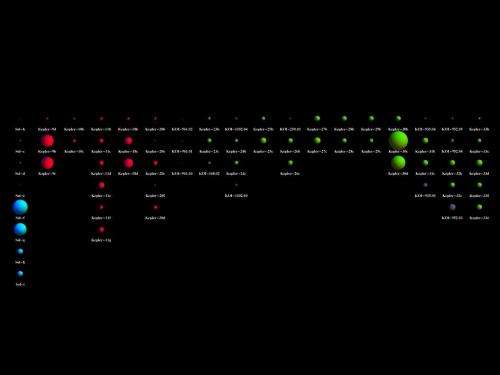
The artist's rendering depicts the multiple planet systems discovered by NASA's Kepler mission. Out of hundreds of candidate planetary systems, scientists had previously verified six systems with multiple transiting planets (denoted here in red). Now, Kepler observations have verified planets (shown here in green) in 11 new planetary systems. Many of these systems contain additional planet candidates that are yet to be verified (shown here in dark purple). For reference, the eight planets of the solar system are shown in blue. Credit: NASA Ames/Jason Steffen, Fermilab Center for Particle Astrophysics

(PhysOrg.com) -- NASA's Kepler mission has discovered 11 new planetary systems hosting 26 confirmed planets. These discoveries nearly double the number of verified Kepler planets and triple the number of stars known to have more than one planet that transits, or passes in front of, its host star. Such systems will help astronomers better understand how planets form.

The orbit close to their host stars and range in size from 1.5 times the radius of Earth to larger than Jupiter. Fifteen of them are between Earth and Neptune in size, and further observations will be required to determine which are rocky like Earth and which have thick gaseous atmospheres like . The planets orbit their host star once every six to 143 days. All are closer to their host star than Venus is to our sun.

"Prior to the , we knew of perhaps 500 across the whole sky," said Doug Hudgins, Kepler program scientist at NASA Headquarters in Washington. "Now, in just two years staring at a patch of sky not much bigger than your fist, Kepler has discovered more than 60 planets and more than 2,300 . This tells us that our galaxy is positively loaded with planets of all sizes and orbits."

Kepler identifies planet candidates by repeatedly measuring the change in brightness of more than 150,000 stars to detect when a planet passes in front of the star. That passage casts a small shadow toward Earth and the Kepler .

“Confirming that the small decrease in the star's brightness is due to a planet requires additional observations and time-consuming analysis," said Eric Ford, associate professor of astronomy at the University of Florida and lead author of the paper confirming Kepler-23 and Kepler-24. “We verified these planets using new techniques that dramatically accelerated their discovery.”
Kepler announces 11 planetary systems hosting 26 planets
Enlarge

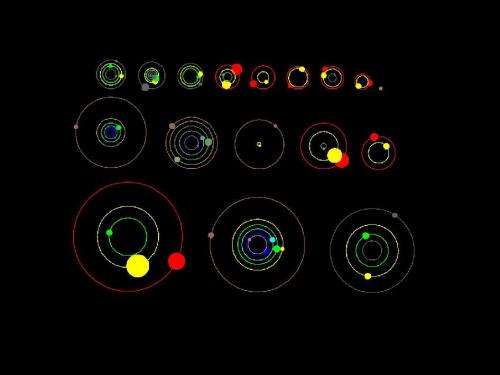
The image shows an overhead view of orbital positions of the planets in systems with multiple transiting planets discovered by NASA's Kepler mission. Credit: NASA Ames/Dan Fabrycky, UC Santa Cruz

Each of the new confirmed contains two to five closely spaced transiting planets. In tightly packed planetary systems, the gravitational pull of the planets among themselves causes one planet to accelerate and another planet to decelerate along its orbit. The acceleration causes the orbital period of each planet to change. Kepler detects this effect by measuring the changes, or so-called Transit Timing Variations (TTVs).

Planetary systems with TTVs can be verified without requiring extensive ground-based observations, accelerating confirmation of planet candidates. The TTV detection technique also increases Kepler's ability to confirm planetary systems around fainter and more distant stars.

“By precisely timing when each planet transits its star, Kepler detected the gravitational tug of the planets on each other, clinching the case for ten of the newly announced planetary systems,” said Dan Fabrycky, Hubble Fellow at the University of California, Santa Cruz and lead author for a paper confirming Kepler-29, 30, 31 and 32."

Five of the systems (Kepler-25, Kepler-27, Kepler-30, Kepler-31 and Kepler-33) contain a pair of planets where the inner planet orbits the star twice during each of the outer planet. Four of the systems (Kepler-23, Kepler-24, Kepler-28 and Kepler-32) contain a pairing where the outer planet circles the star twice for every three times the inner planet orbits its star.

“These configurations help to amplify the gravitational interactions between the planets, similar to how my sons kick their legs on a swing at the right time to go higher,” said Jason Steffen, the Brinson postdoctoral fellow at Fermilab Center for Particle Astrophysics in Batavia, Ill., and lead author of a paper confirming Kepler-25, 26, 27 and 28.

The system with the most planets among these discoveries is Kepler-33, a star that is older and more massive than our sun. Kepler-33 hosts five planets, ranging in size from 1.5 to 5 times that of Earth and all located closer to their star than any planet is to the sun.

The properties of a star provide clues for planet detection. The decrease in the star's brightness and duration of a planet transit combined with the properties of its present a recognizable signature. When astronomers detect planet candidates that exhibit similar signatures around the same star the likelihood of any of these planet candidates being a false positive is very low.

“The approach that was used to verify the Kepler-33 planets shows that the overall reliability of Kepler's candidate multiple transiting systems is quite high," said Jack Lissauer, planetary scientist at Ames Research Center at Moffett Field, Calif., and lead author of the paper confirming Kepler-33. “This is a validation by multiplicity.”

More information: These discoveries are published in the Astrophysical Journal and the Monthly Notices of the Royal Astronomical Society and can be viewed at:

J Lissauer et al - Almost All of Kepler's Multiple Planet Candidates are Planets, and Kepler-33 5-planet system
E Ford et al - Transit Timing Observations from Kepler: II. Confirmation of Two Multiplanet Systems via a Non-parametric Correlation Analysis. Confirms KOI-168=Kepler-23 and KOI 1102=Kepler-24
J Steffen et al - Transit Timing Observations from Kepler: III. Confirmation of 4 Multiple Planet Systems by a Fourier-Domain Study of Anti-correlated Transit Timing Variations
D Fabrycky et al - Transit Timing Observations From Kepler: IV. Confirmation Of 4 Multiple Planet Systems By Simple Physical Models

Provided by JPL/NASA (news : web)

Filter


Move the slider to adjust rank threshold, so that you can hide some of the comments.


Display comments: newest first

droid001
Jan 26, 2012

Rank: 3.3 / 5 (3)
We getting closer. Next stop - Life?
Osiris1
Jan 26, 2012

Rank: 1.6 / 5 (13)
Methinks our efforts at discovery are not going unnoticed by our neighbors, some of whom are probably already here; and probably 'advising' our government. Maybe some 'others' are advising other governments on our world. One day we will find the home planet of one or more of our neighbors. What then when they KNOW we found their world and are checking if it can 'support life'?
Lurker2358
Jan 26, 2012

Rank: 4.3 / 5 (6)
99% gas giants, super-earths, or well...hell planet hotter than Mercury?

Clearly not habitable to humanoid life as we know or imagine it.

Heck, you couldn't even land a probe on these even if you could get it there. The damn thing would melt from the heat.
Neurons_At_Work
Jan 26, 2012

Rank: 5 / 5 (14)
Osiris-- Judging by our current political landscape, if aliens are here and advising our government, then they are clearly MORONS and wouldn't know how to rub two sticks together, much less build interstellar craft. Therefore I reject your reality and substitute my own--namely that a truly intelligent race has put warning beacons throughout the Oort cloud; these automated beacons advise other travelers to avoid our system at all costs or risk exposure to a contagion which causes a severe breakdown of logical thought processes.
Telekinetic
Jan 26, 2012

Rank: 4.6 / 5 (9)
"What then when they KNOW we found their world and are checking if it can 'support life'?"- Osiris1

We do what every red-blooded American is taught to do- try to sell them crap they don't really need.
rubberman
Jan 27, 2012

Rank: 5 / 5 (3)
"What then when they KNOW we found their world and are checking if it can 'support life'?"- Osiris1

We do what every red-blooded American is taught to do- try to sell them crap they don't really need.


And it was probably made in china....
Tausch
Jan 28, 2012

Rank: 3 / 5 (2)
lol
Good posts. What a wonderful research topic.
At what point does life - what we label life - exhibit humor?

We'll never know if we're made fun of - outside our frame of being and mind - regardless if from lower, higher or alien life's intelligence.
Rank 5 /5 (24 votes)
Related Stories
Relevant PhysicsForums posts
  • What is this spectrum I took?
    created9 hours ago
  • Orientation of Space
    created9 hours ago
  • Geologically Active Moon Now: NASA
    created16 hours ago
  • advice on building a science fair telescope
    created22 hours ago
  • Rise of the Sun
    created22 hours ago
  • Uncertainty of planetary orbital period
    createdFeb 19, 2012
  • More from Physics Forums - General Astronomy

More news stories

Spitzer finds solid buckyballs in space

(PhysOrg.com) -- Astronomers using data from NASA's Spitzer Space Telescope have, for the first time, discovered buckyballs in a solid form in space. Prior to this discovery, the microscopic carbon spheres ...

Space & Earth / Astronomy

created 11 hours ago | popularity 4.7 / 5 (12) | comments 6 | with audio podcast

Going up: Japan builder eyes space elevator

A Japanese construction firm claimed Wednesday it could execute an out-of-this-world plan to put tourists in space within 40 years by building an elevator that stretches a quarter of the way to the moon.

Space & Earth / Space Exploration

created 18 hours ago | popularity 3.5 / 5 (13) | comments 24

ENASA satellite finds Earth's clouds are getting lower

(PhysOrg.com) -- Earth's clouds got a little lower -- about one percent on average -- during the first decade of this century, finds a new NASA-funded university study based on NASA satellite data. The results ...

Space & Earth / Earth Sciences

created 15 hours ago | popularity 5 / 5 (8) | comments 9 | with audio podcast

Fresh scandal embroils US climate science debate

A fresh scandal over climate change has erupted in the United States after leaked documents appeared to show a right-wing funded campaign to influence how climate science is taught in schools.

Space & Earth / Environment

created 7 hours ago | popularity 4.4 / 5 (7) | comments 6

World's oceans get an acid bath

Among the repercussions of global climate change, the effect of ocean acidification on marine life is one of the least-understood variables.

Space & Earth / Environment

created 14 hours ago | popularity 4.3 / 5 (6) | comments 4 | with audio podcast


Researchers build first physical 'metatronic' circuit

(PhysOrg.com) -- The technological world of the 21st century owes a tremendous amount to advances in electrical engineering, specifically, the ability to finely control the flow of electrical charges using ...

Faster than light neutrinos? More like faulty wiring

You can shelf your designs for a warp drive engine (for now) and put the DeLorean back in the garage; it turns out neutrinos may not have broken any cosmic speed limits after all.

Physicists surprised by disappearing and reappearing superconductivity in iron selenium chalcogenides

Superconductivity is a rare physical state in which matter is able to conduct electricity -- maintain a flow of electrons -- without any resistance. This phenomenon can only be found in certain materials at low temperatures, ...

Scientists create potent molecules aimed at treating muscular dystrophy

While RNA is an appealing drug target, small molecules that can actually affect its function have rarely been found. But now scientists from the Florida campus of The Scripps Research Institute have for the first time designed ...

Stanford research team cracks animated NuCaptcha

(PhysOrg.com) -- The research team from Stanford University, led by Elie Bursztein, that previously had cracked regular CAPTCHAs and then audio CAPTCHAs, now has also successfully cracked the animated version called NuCapt ...

Less is more: Study of tiny droplets could have big impact on industrial applications

(PhysOrg.com) -- Under a microscope, a tiny droplet slides between two fine hairs like a roller coaster on a set of rails until — poof — it suddenly spreads along them, a droplet no more.