Leonardo da Vinci's tree rule may be explained by wind
January 4, 2012 by Lisa Zyga
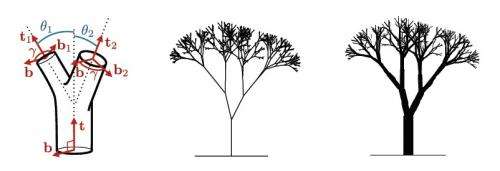
(Left) A model of tree branching. (Middle) A tree skeleton with all branches having the same thickness. (Right) The same tree with branch diameters calculated from a model accounting for wind-induced stress, which closely follows Leonardo’s rule. Image credit: Christophe Eloy. ©2011 American Physical Society
(PhysOrg.com) -- More than 500 years ago, Leonardo da Vinci observed a particular relationship between the size of a tree’s trunk and the size of its branches. Specifically, the combined cross-sectional areas of a tree’s daughter branches are equal to the cross-sectional area of the mother branch. However, da Vinci didn’t know why tree branching followed this rule, and few explanations have been proposed since then. But now in a new study, physicist Christophe Eloy from Aix-Marseille University in Aix-en-Provence, France, has shown that this tree structure may be optimal for enabling trees to resist wind-induced stresses.
In his study, which is published in a recent issue of Physical Review Letters, Eloy explains that Leonardo’s rule is so natural to the eye that it is often used in computer-generated trees. Although researchers have previously proposed explanations for the rule based on hydraulics or structure, none of these explanations have been fully convincing. For instance, the hydraulic explanation called the “pipe model” proposes that the branching proportions have to do with the way that vascular vessels connect the tree’s roots to its leaves to provide water and nutrients. But since vascular vessels account for as little as 5% of the branch cross section (for large trunks in some tree species), it seems unlikely that they would govern the tree’s entire architecture.
“The usual textbook explanation for Leonardo's rule (and, more generally, for the relation between branch diameters) involves hydraulic considerations,” Eloy said. “My study shows that an alternative explanation can be given by considering external loads, such as wind-induced forces.”
Eloy has proposed that Leonardo’s rule is a consequence of trees adapting their growth to optimally resist wind-induced stresses. It’s well-known that plants can alter their growth patterns in response to mechanical sensation, such as wind. The phenomenon, called “thigmomorphogenesis,” means that wind can influence the trunk and branch diameters of a tree as its growing. The underlying cellular mechanisms of this phenomenon are largely unknown.
Building on this line of thinking, Eloy used two models to predict the probability of a fracture at a certain point in a tree due to strong winds. He found that, when the probability of fracture is the same everywhere on the tree, so that each part bears the stress equally, Leonardo’s rule is recovered. He also showed that the diameters of each branch on a tree can be calculated by knowing the parameters of a simple tree skeleton.
Although some of the most common tree species, such as maples and oaks, seem to follow Leonardo’s rule, there are many species that don’t follow the rule, and many more that scientists have yet to analyze.
“Actually, Leonardo’s rule has not been assessed for that many species,” Eloy said. “So far, it seems to be hold for about 10 species. The problem is that it takes a lot of time to measure a single tree, which has thousands of branches, and the data are usually very scattered. Besides, some species clearly do not satisfy Leonardo's rule, such as baobabs, koas, and most bushes.”
The finding that trees seem to follow Leonardo’s rule when adapting their growth to tolerate wind-induced stresses could have applications both in nature and technology.
“It has obvious applications to the forestry industry to calculate the yields of tree stands and to evaluate the risks of breakage during storms,” Eloy said. “It could also be applied to manmade branching structures such as antennas.”
He added that there is still much more to understand about tree design, including the self-similarity shared by large trunks and smaller branches.
“I am still working on this subject, in particular to try to relate growth to external loads,” he said. “In other words, I would like to understand the dynamical growth mechanisms that lead to the intricate fractal structures of trees.”
More information: Christophe Eloy. “Leonardo’s Rule, Self-Similarity, and Wind-Induced Stresses in Trees.” Physical Review Letters 107, 258101 (2011). DOI: 10.1103/PhysRevLett.107.258101
Copyright 2012 PhysOrg.com.
All rights reserved. This material may not be published, broadcast, rewritten or redistributed in whole or part without the express written permission of PhysOrg.com.
-
Uncovering Da Vinci's rule of the trees
Nov 30, 2011 |
not rated yet |
0
-
Cotton thrips posed big problem for some South Plains farmers
Jan 02, 2012 |
not rated yet |
0
-
Unraveling malaria's genetic mysteries
Dec 22, 2011 |
not rated yet |
0
-
Researcher uses card trick to reveal unconscious knowledge
Nov 17, 2011 |
not rated yet |
0
-
Jumping fish to save the salmon industry millions of dollars: new study
Dec 05, 2011 |
not rated yet |
0
-
Stars containing dark matter should look different from other stars
Feb 20, 2012 |
4.5 / 5 (17) |
11
-
Physicists discover evidence of rare hypernucleus, a component of strange matter
Feb 17, 2012 |
4.7 / 5 (38) |
22
-
Fast photon control brings quantum photonic technologies closer
Feb 13, 2012 |
5 / 5 (8) |
1
-
Engineers build first sub-10-nm carbon nanotube transistor
Feb 01, 2012 |
4.9 / 5 (36) |
32
-
Something old, something new: Evolution and the structural divergence of duplicate genes
Jan 31, 2012 |
4.6 / 5 (7) |
1
-
which college offer Light and modern physics in summer?
59 minutes ago
-
linear wave equation vs. linear system
2 hours ago
-
adhesive force and surface tension
2 hours ago
-
Newbie here.
4 hours ago
-
Rainbows in space?
4 hours ago
-
taking mechanical physics next fall
5 hours ago
- More from Physics Forums - General Physics
More news stories
Researchers build first physical 'metatronic' circuit
(PhysOrg.com) -- The technological world of the 21st century owes a tremendous amount to advances in electrical engineering, specifically, the ability to finely control the flow of electrical charges using ...
10 hours ago |
4.7 / 5 (17) |
5
|
Faster than light neutrinos? More like faulty wiring
You can shelf your designs for a warp drive engine (for now) and put the DeLorean back in the garage; it turns out neutrinos may not have broken any cosmic speed limits after all.
10 hours ago |
4.2 / 5 (22) |
23
|
Physicists surprised by disappearing and reappearing superconductivity in iron selenium chalcogenides
Superconductivity is a rare physical state in which matter is able to conduct electricity -- maintain a flow of electrons -- without any resistance. This phenomenon can only be found in certain materials at low temperatures, ...
14 hours ago |
5 / 5 (5) |
2
|
Less is more: Study of tiny droplets could have big impact on industrial applications
(PhysOrg.com) -- Under a microscope, a tiny droplet slides between two fine hairs like a roller coaster on a set of rails until poof it suddenly spreads along them, a droplet no more.
11 hours ago |
3.7 / 5 (3) |
0
|
Study reveals switching mechanism in promising computer memory device
(PhysOrg.com) -- Sometimes knowing that a new technology works is not enough. You also must know why it works to get marketplace acceptance. New information from the National Institute of Standards and Technology ...
18 hours ago |
4 / 5 (4) |
0
|
Spitzer finds solid buckyballs in space
(PhysOrg.com) -- Astronomers using data from NASA's Spitzer Space Telescope have, for the first time, discovered buckyballs in a solid form in space. Prior to this discovery, the microscopic carbon spheres ...
Stanford research team cracks animated NuCaptcha
(PhysOrg.com) -- The research team from Stanford University, led by Elie Bursztein, that previously had cracked regular CAPTCHAs and then audio CAPTCHAs, now has also successfully cracked the animated version called NuCapt ...
Going up: Japan builder eyes space elevator
A Japanese construction firm claimed Wednesday it could execute an out-of-this-world plan to put tourists in space within 40 years by building an elevator that stretches a quarter of the way to the moon.
Flesh-eating bacteria inspire superglue
(PhysOrg.com) -- A bio-inspired superglue has been developed by Oxford University researchers that cant be matched for sticking molecules together and not letting go.
ENASA satellite finds Earth's clouds are getting lower
(PhysOrg.com) -- Earth's clouds got a little lower -- about one percent on average -- during the first decade of this century, finds a new NASA-funded university study based on NASA satellite data. The results ...
Scientists create potent molecules aimed at treating muscular dystrophy
While RNA is an appealing drug target, small molecules that can actually affect its function have rarely been found. But now scientists from the Florida campus of The Scripps Research Institute have for the first time designed ...
Jan 04, 2012
Rank: 4.2 / 5 (11)
Well, it's an architecture which requires almost no "blue print". You simply repeat the same basic shapes and relationships over and over again, which is from a certain point of view more efficient than the architecture of animals, which in most cases is less fractal in design.
I think this is also related to the breaking mass of a branch when considering gravity. The thicker a branch, the heavier it is, but also the stronger it is, but increasing length of a branch only adds weight, not strength.
Branching increases surface area and mass, which makes a tree weaker to wind and gravity, BUT increases the amount of moisture and sunlight available both to the bark and the leaves. It's a trade-off between energy and moisture absorbtion vs structural integrity of individual parent branch structure.
Jan 04, 2012
Rank: 1 / 5 (3)
Jan 04, 2012
Rank: 2.3 / 5 (3)
Jan 04, 2012
Rank: 5 / 5 (1)
Jan 04, 2012
Rank: 3.7 / 5 (3)
Jan 04, 2012
Rank: not rated yet
Jan 04, 2012
Rank: 5 / 5 (1)
Jan 05, 2012
Rank: 1 / 5 (1)
Jan 05, 2012
Rank: 1.5 / 5 (2)
"But since vascular vessels account for as little as 5% of the branch cross section (for large trunks in some tree species), it seems unlikely that they would govern the trees entire architecture."
The tree is not a weather man nor a plumber. It's probably just that the thicker parts of the tree have passed more nutrients during it's lifetime than the thinner parts,.. so obviously the trunck would be the thickest. This is also why lunch ladies are fat.
Jan 05, 2012
Rank: not rated yet
Just because vascular vessels account for only 5% of trunk diameter doesn't mean the other 95% is independent of vascular flow.
Also, suggesting wind stress adaptation as an alternate reason without considering the relationship between trunk length and branching ratio, as well as leaf profile is not very scientific.
Jan 05, 2012
Rank: 2.5 / 5 (2)
the expected linearity constant also STRONGLY shows a blueprint of sorts, by natures design standard (ADAPTATION --WHAKAPAPA). (for tall trees its more obvious). but even non linearity implies design.
the idea also implies and ability of (Re) coherence in an intrinsic part of the plant (perhaps in the entire plant). (I recall a centrifugal (or was it centripetal?) experiment that proves this is the case, for small shrubs)(how ever, roots coherence unknown? we weren't allowed to destroy the experiment)
This might be basic phys 101, but the question "what is the nature of Re coherence?" has far reaching implications that IMO ask one to correctly define quantum gravity.
Jan 07, 2012
Rank: not rated yet
Jan 08, 2012
Rank: not rated yet
Jan 08, 2012
Rank: not rated yet
Jan 09, 2012
Rank: 4 / 5 (1)
The wind loading proportional to the accustomed loading of the tree, as derived by the anchorage strength of the root system, is proportional to the divisions of restraint to stress through the system.
Simple.
Jan 16, 2012
Rank: not rated yet
The fractal nature of tree shapes also, is fairly clear. I think this just indicates that growth of plants involves some processes which get repeated, ie switched on and off, as the newly grown cells adapt to their particular environment [including location within the plant]. In some way the outcome of the process each time is fed back through the system; ie their growth entails a form of self-referencing algorithm.