Speed limit on the quantum highway
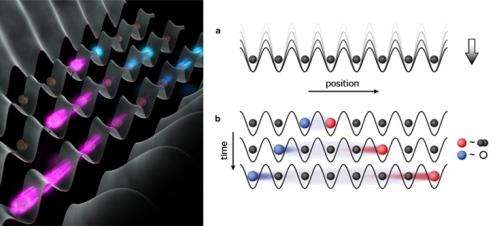
(PhysOrg.com) -- Physicists at the Max Planck Institute of Quantum Optics have measured the propagation velocity of quantum signals in a many-body system.
A quantum computer based on quantum particles instead of classical bits, can in principle outperform any classical computer. However, it still remains an open question, how fast and how efficient quantum computers really may be able to work. A critical limitation will be given by the velocity with which a quantum signal can spread within a processing unit. For the first time, a group of physicists from the Quantum Many-Body Systems division at the Max-Planck Institute of Quantum Optics (Garching near Munich) in close collaboration with theoretical physicists from the University of Geneva (Switzerland) has succeeded in observing such a process in a solid-state like system. The physicists generated a perfectly ordered lattice of rubidium atoms and then induced a quantum excitation – an “entangled” pair of a doubly occupied lattice site next to a hole. With the aid of a microscope they observed how this signal moved from lattice site to lattice site. “This measurement gives insight into very elementary processes involved in the communication and processing of quantum information”, Professor Immanuel Bloch points out.
The communication and processing of information in a quantum computer is based on concepts that are inherently different from those used in classical computers. This is due to the fundamental differences between quantum particles and classical objects. Whereas the latter are, for example, either black or white, quantum particles can take on both colours at the same time. It is only at the process of measurement that the particles decide on one of the two possible properties. As a consequence of this peculiar behaviour, two quantum objects can form one entangled state in which their properties are strictly connected, i.e. quantum correlated. At present there is no general model for predicting how fast a quantum correlation can travel after it is generated.
Now physicists from the Quantum Many-Body Systems division have been able to directly observe such a process. They start the experiment by generating an extremely cold gas of rubidium atoms. The ensemble is then kept in a light field which divides it into several parallel one-dimensional tubes. Now the tubes are superimposed with yet another light field, a standing laser light wave. By the periodic sequence of dark and bright areas, the atoms are forced to form a lattice structure: exactly one atom is trapped in each bright spot, and is separated from the neighbouring atom by a dark area which acts as a barrier.
Changing the intensity of the laser light controls the height of this barrier. At the beginning of the experiments, it is set to a value that prevents the atoms from moving to a neighbouring site. Then, in a very short time, the height of the barrier is lowered such that the system gets out of equilibrium and local excitations arise: Under the new conditions one or the other atom is allowed to “tunnel” through the barrier and reach its neighbouring site. If this happens, entangled pairs are generated, each consisting of a doubly occupied site, a so-called doublon, and a hole, named holon. According to a model developed by theoretical physicists from the University of Geneva around Professor Corinna Kollath, both doublon and holon move through the system – in opposite directions – as if they were real particles (see figure). “Regarding one entangled pair, it is not defined whether the doublon sits on the right or on the left side of the holon. Both constellations are present at the same time”, Dr. Marc Cheneau, a scientist in the Quantum Many-Body Systems division, explains. “However, once I observe a doubly occupied or an empty site, I exactly know where to find its counterpart. This is the correlation we are talking about.”
Now the scientists observe how the correlations are carried through the system. Using a new microscopic technique, they can directly image the single atoms on their lattice sites. In simplified terms, they make a series of snapshots each showing the position of the doublons and the holons at that very moment. The propagation velocity of this correlation can be deduced from the distance the two partners have moved apart in a certain period of time. The experimental results are in very good agreement with the predictions of the model mentioned above.
“As long as quantum information is communicated with light quanta, we know, that this is done with the speed of light,” Dr. Cheneau points out. “If, however, quantum bits or quantum registers are based on solid-state structures, things are different. Here the quantum correlation has to be passed on directly from bit to bit. Once we know how fast this process can happen, we have the key to understand, what will limit the velocity of future quantum computers.”
More information: Marc Cheneau, Peter Barmettler, Dario Poletti, Manuel Endres, Peter Schauß, Takeshi Fukuhara, Christian Gross, Immanuel Bloch, Corinna Kollath and Stefan Kuhr, Light-cone-like spreading of correlations in a quantum many-body system, Nature, DOI:10.1038/nature10748
Journal information: Nature
Provided by Max-Planck-Gesellschaft


