The Milky Way contains at least 100 billion planets according to survey
January 12, 2012
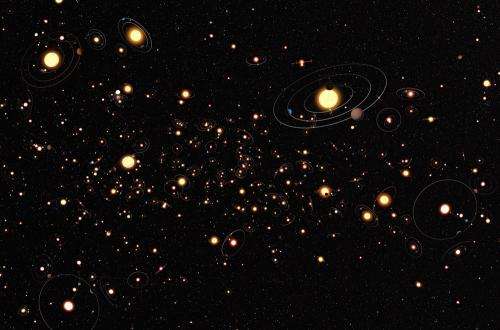
This artist's illustration gives an impression of how common planets are around the stars in the Milky Way. The planets, their orbits, and their host stars are all vastly magnified compared to their real separations. A six-year search that surveyed millions of stars using the microlensing technique concluded that planets around stars are the rule rather than the exception. The average number of planets per star is greater than one. Credit: NASA, ESA, and M. Kornmesser (ESO)
(PhysOrg.com) -- Our Milky Way galaxy contains a minimum of 100 billion planets according to a detailed statistical study based on the detection of three extrasolar planets by an observational technique called microlensing.
Kailash Sahu, of the Space Telescope Science Institute in Baltimore, Md., is part of an international team reporting today that our galaxy contains a minimum of one planet for every star on average. This means that there is likely to be a minimum of 1,500 planets within just 50 light-years of Earth.
The results are based on observations taken over six years by the PLANET (Probing Lensing Anomalies NETwork) collaboration, which Sahu co-founded in 1995. The study concludes that there are far more Earth-sized planets than bloated Jupiter-sized worlds. This is based on calibrating a planetary mass function that shows the number of planets increases for lower mass worlds. A rough estimate from this survey would point to the existence of more than 10 billion terrestrial planets across our galaxy.
The results are being published in the January 12 issue of the British science journal Nature.
The team's conclusions are gleaned from a planet search technique called microlensing. The technique takes advantage of the random motions of stars, which are generally too small to be noticed. If one star passes precisely in front of another star, the gravity of the foreground star bends the light from the background star.
This means that the foreground star acts like a giant lens amplifying the light from the background star. A planetary companion around the foreground star can produce additional brightening of the background star. This additional brightening reveals the planet, which is otherwise too faint to be seen by telescopes.
The higher the mass of the "lensing" star, the longer is the duration of the microlensing event. Typical microlensing events due to a star last about a month. But the extra brightening due to a planet typically lasts a few hours to a couple of days.
Using the microlensing technique, astronomers can determine a planet's mass. This method, however, does not reveal any clues about the world's composition.
Unlike other prominent planet-detection techniques, which measure the shadows of planets passing in front of their stars (transit) or measure the wobble of a star due to the gravitational tug of a planet (radial velocity and astrometry), the gravitational-lensing technique is unbiased in the selection of the host star.
The other techniques work best for finding planets close to their stars with short orbital periods. But microlensing can detect a planet that is as far from its star as Saturn is from our Sun, or as close as Mercury is to our Sun. The technique is also sensitive to detecting planets as small as Mercury.
Wide-field survey campaigns such as OGLE (Optical Gravitational Lensing Experiment) and MOA (Microlensing Observations in Astrophysics) cover millions of stars every clear night in order to identify and alert stellar microlensing events as early as possible. Follow-up collaborations, such as PLANET, monitor selected candidates more frequently, 24 hours a day, using a round-the-world network of telescopes.
Of the approximately 40 microlensing events closely monitored, three showed evidence for exoplanets. Using a statistical analysis, the team found that one in six stars hosts a Jupiter-mass planet. What's more, half of the stars have Neptune-mass planets, and two-thirds of the stars have Earth-mass planets. Therefore, low-mass planets are more abundant than their massive counterparts.
"This means, statistically, every star in the galaxy should have at least one planet, and probably more," said Sahu.
"Results from the three main techniques of planet detection are rapidly converging to a common result: Not only are planets common in the galaxy, but there are more small planets than large ones," said Stephen Kane, a co-author from NASA's Exoplanet Science Institute at the California Institute of Technology, Pasadena, Calif. "This is encouraging news for investigations into habitable planets."
These results are independent from a gravitational-lens survey led by Takahiro Sumi of Osaka University in Japan, which estimates there are hundreds of billions of planets with orbits larger than Saturn's orbit, or are free-floating throughout the galaxy.
-
Hubble Identifies Stellar Companion to Distant Planet
Aug 08, 2006 |
not rated yet |
0
-
Planets that have no stars: New class of planets discovered
May 18, 2011 |
not rated yet |
0
-
A wealth of habitable planets in the Milky Way
Jan 11, 2012 |
not rated yet |
0
-
Catch a new planet
Jul 01, 2008 |
not rated yet |
0
-
Massey scientist's software finds 'orphan' planets
May 19, 2011 |
not rated yet |
0
-
Stars containing dark matter should look different from other stars
Feb 20, 2012 |
4.5 / 5 (17) |
11
-
Physicists discover evidence of rare hypernucleus, a component of strange matter
Feb 17, 2012 |
4.7 / 5 (38) |
22
-
Fast photon control brings quantum photonic technologies closer
Feb 13, 2012 |
5 / 5 (8) |
1
-
Engineers build first sub-10-nm carbon nanotube transistor
Feb 01, 2012 |
4.9 / 5 (36) |
32
-
Something old, something new: Evolution and the structural divergence of duplicate genes
Jan 31, 2012 |
4.6 / 5 (7) |
1
-
Calculating the magnitude
2 hours ago
-
What is this spectrum I took?
12 hours ago
-
Orientation of Space
12 hours ago
-
Geologically Active Moon Now: NASA
19 hours ago
-
advice on building a science fair telescope
Feb 22, 2012
-
Rise of the Sun
Feb 22, 2012
- More from Physics Forums - General Astronomy
More news stories
Spitzer finds solid buckyballs in space
(PhysOrg.com) -- Astronomers using data from NASA's Spitzer Space Telescope have, for the first time, discovered buckyballs in a solid form in space. Prior to this discovery, the microscopic carbon spheres ...
14 hours ago |
4.7 / 5 (12) |
8
|
Going up: Japan builder eyes space elevator
A Japanese construction firm claimed Wednesday it could execute an out-of-this-world plan to put tourists in space within 40 years by building an elevator that stretches a quarter of the way to the moon.
Space & Earth / Space Exploration
21 hours ago |
3.5 / 5 (13) |
26
ENASA satellite finds Earth's clouds are getting lower
(PhysOrg.com) -- Earth's clouds got a little lower -- about one percent on average -- during the first decade of this century, finds a new NASA-funded university study based on NASA satellite data. The results ...
Space & Earth / Earth Sciences
18 hours ago |
5 / 5 (8) |
13
|
Fresh scandal embroils US climate science debate
A fresh scandal over climate change has erupted in the United States after leaked documents appeared to show a right-wing funded campaign to influence how climate science is taught in schools.
10 hours ago |
4.1 / 5 (9) |
8
World's oceans get an acid bath
Among the repercussions of global climate change, the effect of ocean acidification on marine life is one of the least-understood variables.
17 hours ago |
4.3 / 5 (6) |
4
|
Researchers build first physical 'metatronic' circuit
(PhysOrg.com) -- The technological world of the 21st century owes a tremendous amount to advances in electrical engineering, specifically, the ability to finely control the flow of electrical charges using ...
Faster than light neutrinos? More like faulty wiring
You can shelf your designs for a warp drive engine (for now) and put the DeLorean back in the garage; it turns out neutrinos may not have broken any cosmic speed limits after all.
Physicists surprised by disappearing and reappearing superconductivity in iron selenium chalcogenides
Superconductivity is a rare physical state in which matter is able to conduct electricity -- maintain a flow of electrons -- without any resistance. This phenomenon can only be found in certain materials at low temperatures, ...
CT colonography shown to be comparable to standard colonoscopy
Computerized tomographic (CT) colonography (CTC), also known as virtual colonoscopy, is comparable to standard colonoscopy in its ability to accurately detect cancer and precancerous polyps in people ages 65 and older, according ...
Stanford research team cracks animated NuCaptcha
(PhysOrg.com) -- The research team from Stanford University, led by Elie Bursztein, that previously had cracked regular CAPTCHAs and then audio CAPTCHAs, now has also successfully cracked the animated version called NuCapt ...
Study: Virtual colonoscopy effective screening tool for adults over 65
Computed tomography (CT) colonography can be used as a primary screening tool for colorectal cancer in adults over the age of 65, according to a new study published online in the journal Radiology.
Jan 13, 2012
Rank: 1 / 5 (2)
Something important? The quacks, ninnyhammers and masterminds remain strangely quiescent.
OT: Rather makes the Fermi Paradox even more interesting now that another of its variables can be further constrained, eh?