Blind moles use beauty for function, not fancy
January 27, 2012
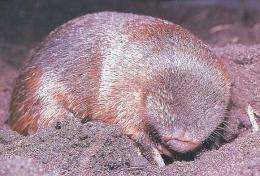
Golden mole. Image: Wikipedia.
(PhysOrg.com) -- Scientists have long wondered why a blind mole that lives in underground darkness has beautiful iridescent hair. After all, many animals or birds with magnificent features exhibit their colorful beauty for mating purposes. Now, a new study shows that the iridescent hairs of the blind golden mole, Chrysochloridae, aren’t for attracting potential mates. Instead, the shiny coats help the rodents function efficiently underground.
Colorful iridescent hues ranging from green to purple result from light reflecting off of the moles’ flat hair. The smooth hair — discovered by UA biology honors alumna Holly Snyder, along with integrated bioscience Ph.D. student Rafael Maia, postdoctoral fellow
Liliana D’Alba and associate professor of biology Matthew Shawkey — helps the moles maneuver easily through dirt and sand.
“These moles are blind and live underground and, consequently, don’t use the colors to communicate with one another as they would typically do by way of color,” Shawkey says. Shawkey and his research colleagues discovered that the moles’ hair cuticles, arranged in multiple layers of thin material, bend light and create a spectrum of colors.
Using microspectrophotometry, electron microcopy and optical modeling, the researchers also found the moles’ hair is flat like a pancake, increasing the amount of surface area and light reflected.
“The color just might be an incidental byproduct,” Shawkey says. “These moles have evolved structures that have two distinct properties: color and wear-resistance. This could give usinspiration for developing new multifunctional materials. Who knows, maybe ahair-care company could apply these findings to make human hair iridescent!”
Findings of the research team, which also includes Allison Schultz, San Diego State University; and Karen Rowe and Kevin Rowe, Museum of Vertebrate Zoology, University of California, Berkeley, and Museum Victoria, Melbourne, Victoria, Australia, are published in the Jan. 25, 2012 issue of the Royal Society journal Biology Letters at http://rsbl.royals … 11.1168.full .
Provided by University of Akron
-
High-maintenance mallards
Jun 17, 2011 |
not rated yet |
0
-
Researchers discover how feathers get their shine, inspire ideas for creating gloss
Dec 01, 2010 |
not rated yet |
0
-
New tool enhances view of muscles
Jan 23, 2012 |
not rated yet |
0
-
Study of Facebook patterns suggests interests in music, movies unlikely to spread among friends
Jan 19, 2012 |
not rated yet |
0
-
Unraveling malaria's genetic mysteries
Dec 22, 2011 |
not rated yet |
0
-
Stars containing dark matter should look different from other stars
Feb 20, 2012 |
4.5 / 5 (17) |
11
-
Physicists discover evidence of rare hypernucleus, a component of strange matter
Feb 17, 2012 |
4.7 / 5 (38) |
22
-
Fast photon control brings quantum photonic technologies closer
Feb 13, 2012 |
5 / 5 (8) |
1
-
Engineers build first sub-10-nm carbon nanotube transistor
Feb 01, 2012 |
4.9 / 5 (36) |
32
-
Something old, something new: Evolution and the structural divergence of duplicate genes
Jan 31, 2012 |
4.6 / 5 (7) |
1
-
Flowering Plant Revived After 30,000 Years in Permafrost
Feb 21, 2012
-
Toba volcano eruptions - 1.000 - 10,000 breeding pairsunb
Feb 20, 2012
-
How is a specific gene removed from DNA
Feb 20, 2012
-
Reproduction and Human evolution
Feb 19, 2012
-
Viruses: Living or Non-living organisms
Feb 19, 2012
-
Would you eat brainless animals?
Feb 16, 2012
- More from Physics Forums - Biology
More news stories
Surprising diversity at a synapse hints at complex diversity of neural circuitry
A new study reveals a dazzling degree of biological diversity in an unexpected place a single neural connection in the body wall of flies.
7 hours ago |
5 / 5 (4) |
0
|
Men might not 'become extinct' after all: Theory of the 'rotting' Y chromosome dealt a fatal blow
If you were to discover that a fundamental component of human biology has survived virtually intact for the past 25 million years, you'd be quite confident in saying that it is here to stay.
10 hours ago |
5 / 5 (6) |
1
|
Climate change affects bird migration timing in North America
Bird migration timing across North America has been affected by climate change, according to a study published Feb. 22 in the open access journal PLoS ONE.
6 hours ago |
4.5 / 5 (2) |
2
New family of legless amphibians found in India
Since before the age of dinosaurs it has burrowed unbothered beneath the monsoon-soaked soils of remote northeast India - unknown to science and mistaken by villagers as a deadly, miniature snake.
18 hours ago |
5 / 5 (8) |
3
New iridescent lizard species found in Cambodia
A new species of lizard with striking iridescent rainbow skin, a long tail and very short legs has been discovered in the rainforest in northeast Cambodia, conservationists announced Wednesday.
7 hours ago |
not rated yet |
0
Researchers build first physical 'metatronic' circuit
(PhysOrg.com) -- The technological world of the 21st century owes a tremendous amount to advances in electrical engineering, specifically, the ability to finely control the flow of electrical charges using ...
Faster than light neutrinos? More like faulty wiring
You can shelf your designs for a warp drive engine (for now) and put the DeLorean back in the garage; it turns out neutrinos may not have broken any cosmic speed limits after all.
Spitzer finds solid buckyballs in space
(PhysOrg.com) -- Astronomers using data from NASA's Spitzer Space Telescope have, for the first time, discovered buckyballs in a solid form in space. Prior to this discovery, the microscopic carbon spheres ...
Physicists surprised by disappearing and reappearing superconductivity in iron selenium chalcogenides
Superconductivity is a rare physical state in which matter is able to conduct electricity -- maintain a flow of electrons -- without any resistance. This phenomenon can only be found in certain materials at low temperatures, ...
Scientists create potent molecules aimed at treating muscular dystrophy
While RNA is an appealing drug target, small molecules that can actually affect its function have rarely been found. But now scientists from the Florida campus of The Scripps Research Institute have for the first time designed ...
Stanford research team cracks animated NuCaptcha
(PhysOrg.com) -- The research team from Stanford University, led by Elie Bursztein, that previously had cracked regular CAPTCHAs and then audio CAPTCHAs, now has also successfully cracked the animated version called NuCapt ...
Jan 27, 2012
Rank: not rated yet
"THROW AWAY THAT HOT IRON>>> FLAT HAIR FOR THE MASSES"