MSU technology spin-out company to market portable biohazard detection
January 27, 2012
MSU technology spin-out company to market portable biohazard detection

Enlarge

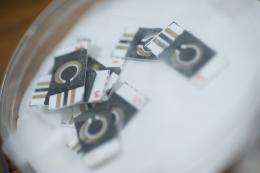
Biosensor chips for use in handheld devices for detecting biohazards in the field, developed by biosystems and agricultural engineering professor Evangelyn Alocilja. Credit: Kurt Stepnitz

A new company formed around Michigan State University nanotechnology promises to move speedy detection of deadly pathogens and toxins from the laboratory directly to the field.

Food contamination and other biohazards present a growing public health concern, but consumes precious time. The company, nanoRETE, will develop and commercialize an inexpensive test for handheld to detect a broad range of threats such as E.coli, Salmonella, and tuberculosis.

A significant leap forward in detection and diagnostic technology, it utilizes novel with magnetic, polymeric and developed by Evangelyn Alocilja, MSU professor of biosystems and agricultural engineering and chief scientific officer of nanoRETE.

“Our unique preparation, extraction and detection protocol enables the entire process to be conducted in the field, without significant training,” Alocilja said. “Results are generated in about an hour from receipt of sample to final readout, quickly identifying contaminants so that proper and prompt actions can be taken.”
MSU technology spin-out company to market portable biohazard detection
Enlarge

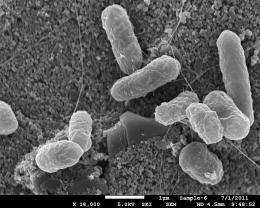
A scanning electron  microscope image of E. coli O157:H7 bacteria captured on the surface of a biosensor chip. Credit: Evangelyn Alocilja laboratory

The mobile technology comes at only a fraction of the cost of the closest currently available competing technology, company officials said.

“Although the technology originates from research for biodefense applications, its potential reaches far beyond the initial scope,” said Fred Beyerlein, CEO of nanoRETE. “Our X-MARK platform-based technology has the ability to detect multiple or toxins at one time, in a rapid, point-of-use, cost-effective manner. Imagine the potential applications for food growers, packagers or sellers. Contaminated food or water could be quickly identified, isolated and resolved before reaching the ultimate consumer – you or me.”

nanoRETE is backed by Michigan Accelerator Fund I, a Grand Rapids, Mich., investment partnership focused on Michigan-based early stage life science and technology companies.

“Our task was to find promising technologies, identify strong management and support with investment dollars,” MAF-1 managing director Dale Grogan said. “We reviewed literally hundreds of technologies developed within MSU and determined that this particular technology best fit our investment model. We are excited about nanoRETE’s future and hope this is the first of many companies we help develop with MSU.”

“We have had great faith that Dr. Alocilja’s work in nano-scale detection would be a very successful platform on which to start a new company,” said Charles Hasemann, executive director of MSU Technologies. “MAF-1 has been a great partner in building nanoRETE. With its partnership and investment, we expect to move rapidly to a marketable product.”

Provided by Michigan State University (news : web)


Rank 5 /5 (1 vote)
Related Stories
Relevant PhysicsForums posts
  • Cis-trans Selectivity in Wittig Reactions
    created4 hours ago
  • Chemical Kinetics
    created4 hours ago
  • heat-driven chemical reaction and thermodynamics
    created11 hours ago
  • phenol to benzene
    created15 hours ago
  • TQM, QA and QC
    created16 hours ago
  • oxidising power
    created22 hours ago
  • More from Physics Forums - Chemistry

More news stories

Flesh-eating bacteria inspire superglue

(PhysOrg.com) -- A bio-inspired superglue has been developed by Oxford University researchers that can’t be matched for sticking molecules together and not letting go.

Chemistry / Biochemistry

created 21 hours ago | popularity 5 / 5 (8) | comments 3 | with audio podcast

Scientists create potent molecules aimed at treating muscular dystrophy

While RNA is an appealing drug target, small molecules that can actually affect its function have rarely been found. But now scientists from the Florida campus of The Scripps Research Institute have for the first time designed ...

Chemistry / Biochemistry

created 10 hours ago | popularity 5 / 5 (4) | comments 0 | with audio podcast

Researchers discover what cancer cells need to travel

(PhysOrg.com) -- Cancer cells must prepare for travel before invading new tissues, but new Cornell research has found a possible way to stop these cells from ever hitting the road.

Chemistry / Biochemistry

created 20 hours ago | popularity 4.9 / 5 (12) | comments 0 | with audio podcast

New microfluidic device could be used to diagnose and monitor cancer and other diseases

Separating complex mixtures of cells, such as those found in a blood sample, can offer valuable information for diagnosing and treating disease. However, it may be necessary to search through billions of other ...

Chemistry / Analytical Chemistry

created 20 hours ago | popularity 5 / 5 (2) | comments 0 | with audio podcast

New way to tap largest remaining treasure trove of potential new antibiotics

Scientists are reporting use of a new technology for sifting through the world's largest remaining pool of potential antibiotics to discover two new antibiotics that work against deadly resistant microbes, ...

Chemistry / Biochemistry

created 13 hours ago | popularity 5 / 5 (4) | comments 0


Researchers build first physical 'metatronic' circuit

(PhysOrg.com) -- The technological world of the 21st century owes a tremendous amount to advances in electrical engineering, specifically, the ability to finely control the flow of electrical charges using ...

Spitzer finds solid buckyballs in space

(PhysOrg.com) -- Astronomers using data from NASA's Spitzer Space Telescope have, for the first time, discovered buckyballs in a solid form in space. Prior to this discovery, the microscopic carbon spheres ...

Faster than light neutrinos? More like faulty wiring

You can shelf your designs for a warp drive engine (for now) and put the DeLorean back in the garage; it turns out neutrinos may not have broken any cosmic speed limits after all.

Physicists surprised by disappearing and reappearing superconductivity in iron selenium chalcogenides

Superconductivity is a rare physical state in which matter is able to conduct electricity -- maintain a flow of electrons -- without any resistance. This phenomenon can only be found in certain materials at low temperatures, ...

Stanford research team cracks animated NuCaptcha

(PhysOrg.com) -- The research team from Stanford University, led by Elie Bursztein, that previously had cracked regular CAPTCHAs and then audio CAPTCHAs, now has also successfully cracked the animated version called NuCapt ...

Going up: Japan builder eyes space elevator

A Japanese construction firm claimed Wednesday it could execute an out-of-this-world plan to put tourists in space within 40 years by building an elevator that stretches a quarter of the way to the moon.