Need muscle for a tough spot? Turn to fat stem cells
January 27, 2012
Need Muscle for a Tough Spot? Turn to Fat Stem Cells

Enlarge

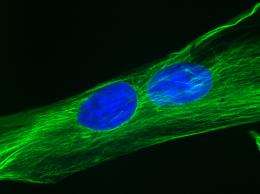
Two fat-derived stem cells display a continuous cytoskeleton, indicating that they have fused together. Bone marrow-derived stem cell fail to fuse under similar conditions in the lab. Image Credit: Yu Suk Choi

(PhysOrg.com) -- Stem cells derived from fat have a surprising trick up their sleeves: Encouraged to develop on a stiff surface, they undergo a remarkable transformation toward becoming mature muscle cells. The new research appears in the journal Biomaterials. The new cells remain intact and fused together even when transferred to an extremely stiff, bone-like surface, which has University of California, San Diego bioengineering professor Adam Engler and colleagues intrigued. These cells, they suggest, could hint at new therapeutic possibilities for muscular dystrophy.

In diseases like or a , “ begins to die and undergoes its normal wounding processes,” said Engler, a professor at the Jacobs School of Engineering at UC San Diego. “This damaged tissue is fundamentally different from a mechanical perspective” than healthy tissue.

Transplanted might be able to replace and repair diseased muscle, but up to this point the transplants haven’t been very successful in muscular dystrophy patients, he noted. The cells tend to clump into hard nodules as they struggle to adapt to their new environment of thickened and damaged tissue.

Engler, postdoctoral scholar Yu Suk Choi and the rest of the team think their fat-derived stem cells might have a better chance for this kind of therapy, since the cells seem to thrive on a stiff and unyielding surface that mimics the damaged tissue found in people with MD.

In their study in the journal Biomaterials, the researchers compared the development of bone marrow stem cells and fat-derived stem cells grown on surfaces of varying stiffness, ranging from the softness of brain tissue to the hardness of bone.

Cells from the fat lineage were 40 to 50 times better than their bone marrow counterparts at displaying the proper proteins involved in becoming muscle. These proteins are also more likely to “turn on” in the correct sequence in the fat-derived cells, Engler said.

Subtle differences in how these two types of cells interact with their environment are critical to their development, the scientists suggest. The fat-derived cells seem to sense their “niche” on the surfaces more completely and quickly than marrow-derived cells. “They are actively feeling their environment soon, which allows them to interpret the signals from the interaction of cell and environment that guide development,” Choi explained.

Perhaps most surprisingly, grown from the fat stem cells fused together, forming myotubes to a degree never previously observed. Myotubes are a critical step in muscle development, and it’s a step forward that Engler and colleagues hadn’t seen before in the lab.

The fused cells stayed fused when they were transferred to a very stiff surface. “These programmed cells are mature enough so that they don’t respond the environmental cues” in the new environment that might cause them to split apart, Engler says.

Engler and colleagues will now test how these new fused cells perform in mice with a version of muscular dystrophy. The cells survive in an environment of stiff tissue, but Engler cautions that there are other aspects of diseased tissue such as its shape and chemical composition to consider. “From the perspective of translating this into a clinically viable therapy, we want to know what components of the environment provide the most important cues for these ,” he said.

Provided by University of California - San Diego (news : web)


Rank 5 /5 (5 votes)
Relevant PhysicsForums posts
  • Eye biology videos
    created1 hour ago
  • Flowering Plant Revived After 30,000 Years in Permafrost
    createdFeb 21, 2012
  • Toba volcano eruptions - 1.000 - 10,000 breeding pairsunb
    createdFeb 20, 2012
  • How is a specific gene removed from DNA
    createdFeb 20, 2012
  • Reproduction and Human evolution
    createdFeb 19, 2012
  • Viruses: Living or Non-living organisms
    createdFeb 19, 2012
  • More from Physics Forums - Biology

More news stories

Surprising diversity at a synapse hints at complex diversity of neural circuitry

A new study reveals a dazzling degree of biological diversity in an unexpected place – a single neural connection in the body wall of flies.

Biology / Other

created 8 hours ago | popularity 5 / 5 (4) | comments 0 | with audio podcast

Men might not 'become extinct' after all: Theory of the 'rotting' Y chromosome dealt a fatal blow

If you were to discover that a fundamental component of human biology has survived virtually intact for the past 25 million years, you'd be quite confident in saying that it is here to stay.

Biology / Biotechnology

created 11 hours ago | popularity 5 / 5 (6) | comments 1 | with audio podcast

Climate change affects bird migration timing in North America

Bird migration timing across North America has been affected by climate change, according to a study published Feb. 22 in the open access journal PLoS ONE.

Biology / Ecology

created 7 hours ago | popularity 4.5 / 5 (2) | comments 2

New family of legless amphibians found in India

Since before the age of dinosaurs it has burrowed unbothered beneath the monsoon-soaked soils of remote northeast India - unknown to science and mistaken by villagers as a deadly, miniature snake.

Biology / Plants & Animals

created 18 hours ago | popularity 5 / 5 (8) | comments 3

New iridescent lizard species found in Cambodia

A new species of lizard with striking iridescent rainbow skin, a long tail and very short legs has been discovered in the rainforest in northeast Cambodia, conservationists announced Wednesday.

Biology / Plants & Animals

created 7 hours ago | popularity not rated yet | comments 0


CT colonography shown to be comparable to standard colonoscopy

Computerized tomographic (CT) colonography (CTC), also known as virtual colonoscopy, is comparable to standard colonoscopy in its ability to accurately detect cancer and precancerous polyps in people ages 65 and older, according ...

Study: Virtual colonoscopy effective screening tool for adults over 65

Computed tomography (CT) colonography can be used as a primary screening tool for colorectal cancer in adults over the age of 65, according to a new study published online in the journal Radiology.

Researchers build first physical 'metatronic' circuit

(PhysOrg.com) -- The technological world of the 21st century owes a tremendous amount to advances in electrical engineering, specifically, the ability to finely control the flow of electrical charges using ...

Spitzer finds solid buckyballs in space

(PhysOrg.com) -- Astronomers using data from NASA's Spitzer Space Telescope have, for the first time, discovered buckyballs in a solid form in space. Prior to this discovery, the microscopic carbon spheres ...

Faster than light neutrinos? More like faulty wiring

You can shelf your designs for a warp drive engine (for now) and put the DeLorean back in the garage; it turns out neutrinos may not have broken any cosmic speed limits after all.

Physicists surprised by disappearing and reappearing superconductivity in iron selenium chalcogenides

Superconductivity is a rare physical state in which matter is able to conduct electricity -- maintain a flow of electrons -- without any resistance. This phenomenon can only be found in certain materials at low temperatures, ...