NASA's NuSTAR ships to Vandenberg for March 14 launch
January 25, 2012
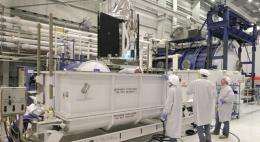
NASA's Nuclear Spectroscopic Telescope Array, or NuSTAR, mission is seen here being lowered into its shipping container at Orbital Sciences Corporation in Dulles, Va. The spacecraft is headed to Vandenberg Air Force Base in Central California, where it will be mated to its rocket. It is scheduled to launch from Kwajalein Atoll in the Marshall Islands on March 14. Image credit: NASA/JPL-Caltech/Orbital
(PhysOrg.com) -- NASA's Nuclear Spectroscopic Telescope Array, or NuSTAR, shipped to Vandenberg Air Force Base, Calif., on Tuesday, to be mated to its Pegasus launch vehicle. The observatory will detect X-rays from objects ranging from our sun to giant black holes billions of light-years away. It is scheduled to launch March 14 from an aircraft operating out of Kwajalein Atoll in the Marshall Islands.
"The NuSTAR mission is unique because it will be the first NASA mission to focus X-rays in the high-energy range, creating the most detailed images ever taken in this slice of the electromagnetic spectrum," said Fiona Harrison, the mission's principal investigator at the California Institute of Technology in Pasadena, Calif.
The observatory shipped from Orbital Sciences Corporation in Dulles, Va., where the spacecraft and science instrument were integrated. It is scheduled to arrive at Vandenberg on Jan. 27, where it will be mated to the Pegasus, also built by Orbital, on Feb. 17.
The mission will be launched from the L-1011 "Stargazer" aircraft, which will take off near the equator from Kwajalein Atoll in the Pacific. NuSTAR and its Pegasus will fly from Vandenberg to Kwajalein attached to the underside of the L-1011, and are scheduled to arrive on March 7.
On launch day, after the airplane arrives at the planned drop site over the ocean, the Pegaus will drop from the L-1011 and carry NuSTAR to an orbit around Earth.
"NuSTAR is an engineering achievement, incorporating state-of-the-art high-energy X-ray mirrors and detectors that will enable years of astronomical discovery," said Yunjin Kim, the mission's project manager at NASA's Jet Propulsion Laboratory in Pasadena.
NuSTAR's advanced telescope consists of two sets of 133 concentric shells of mirrors, which were shaped from flexible glass similar to that found in laptop screens. Because X-rays require large focusing distances, or focal lengths, the telescope has a lengthy 33-foot (10-meter) mast, which will unfold a week after launch.
These and other advances in technology will enable NuSTAR to explore the cosmic world of high-energy X-rays with much improved sensitivity and resolution over previous missions. During its two-year primary mission, NuSTAR will map the celestial sky in X-rays, surveying black holes, mapping supernova remnants, and studying particle jets travelling away from black holes near the speed of light.
NuSTAR also will probe the sun, looking for microflares theorized to be on the surface that could explain how the sun's million-degree corona, or atmosphere, is heated. It will even test a theory of dark matter, the mysterious substance making up about one-quarter of our universe, by searching the sun for evidence of a hypothesized dark matter particle.
"NuSTAR will provide an unprecedented capability to discover and study some of the most exotic objects in the universe, from the corpses of exploded stars in the Milky Way to supermassive black holes residing in the hearts of distant galaxies," said Lou Kaluzienski, NuSTAR program scientist at NASA Headquarters in Washington.
-
NASA Restarts Telescope Mission to Detect Black Holes
Sep 24, 2007 |
not rated yet |
0
-
NASA Approves X-ray Space Mission
Sep 07, 2009 |
not rated yet |
0
-
NASA NuSTAR Telescope Being Built at Nevis
Dec 17, 2009 |
not rated yet |
0
-
Small Explorer Mission to Set Solar System Boundaries
Jan 27, 2005 |
not rated yet |
0
-
Why Won't the Supernova Explode?
Jan 07, 2010 |
not rated yet |
0
-
Stars containing dark matter should look different from other stars
Feb 20, 2012 |
4.5 / 5 (17) |
11
-
Physicists discover evidence of rare hypernucleus, a component of strange matter
Feb 17, 2012 |
4.7 / 5 (38) |
22
-
Fast photon control brings quantum photonic technologies closer
Feb 13, 2012 |
5 / 5 (8) |
1
-
Engineers build first sub-10-nm carbon nanotube transistor
Feb 01, 2012 |
4.9 / 5 (36) |
32
-
Something old, something new: Evolution and the structural divergence of duplicate genes
Jan 31, 2012 |
4.6 / 5 (7) |
1
-
What is this spectrum I took?
9 hours ago
-
Orientation of Space
9 hours ago
-
Geologically Active Moon Now: NASA
16 hours ago
-
advice on building a science fair telescope
22 hours ago
-
Rise of the Sun
22 hours ago
-
Uncertainty of planetary orbital period
Feb 19, 2012
- More from Physics Forums - General Astronomy
More news stories
Spitzer finds solid buckyballs in space
(PhysOrg.com) -- Astronomers using data from NASA's Spitzer Space Telescope have, for the first time, discovered buckyballs in a solid form in space. Prior to this discovery, the microscopic carbon spheres ...
11 hours ago |
4.7 / 5 (12) |
6
|
Going up: Japan builder eyes space elevator
A Japanese construction firm claimed Wednesday it could execute an out-of-this-world plan to put tourists in space within 40 years by building an elevator that stretches a quarter of the way to the moon.
Space & Earth / Space Exploration
18 hours ago |
3.5 / 5 (13) |
24
ENASA satellite finds Earth's clouds are getting lower
(PhysOrg.com) -- Earth's clouds got a little lower -- about one percent on average -- during the first decade of this century, finds a new NASA-funded university study based on NASA satellite data. The results ...
Space & Earth / Earth Sciences
15 hours ago |
5 / 5 (8) |
9
|
Fresh scandal embroils US climate science debate
A fresh scandal over climate change has erupted in the United States after leaked documents appeared to show a right-wing funded campaign to influence how climate science is taught in schools.
7 hours ago |
4.4 / 5 (7) |
6
World's oceans get an acid bath
Among the repercussions of global climate change, the effect of ocean acidification on marine life is one of the least-understood variables.
14 hours ago |
4.3 / 5 (6) |
4
|
Researchers build first physical 'metatronic' circuit
(PhysOrg.com) -- The technological world of the 21st century owes a tremendous amount to advances in electrical engineering, specifically, the ability to finely control the flow of electrical charges using ...
Faster than light neutrinos? More like faulty wiring
You can shelf your designs for a warp drive engine (for now) and put the DeLorean back in the garage; it turns out neutrinos may not have broken any cosmic speed limits after all.
Physicists surprised by disappearing and reappearing superconductivity in iron selenium chalcogenides
Superconductivity is a rare physical state in which matter is able to conduct electricity -- maintain a flow of electrons -- without any resistance. This phenomenon can only be found in certain materials at low temperatures, ...
Scientists create potent molecules aimed at treating muscular dystrophy
While RNA is an appealing drug target, small molecules that can actually affect its function have rarely been found. But now scientists from the Florida campus of The Scripps Research Institute have for the first time designed ...
Stanford research team cracks animated NuCaptcha
(PhysOrg.com) -- The research team from Stanford University, led by Elie Bursztein, that previously had cracked regular CAPTCHAs and then audio CAPTCHAs, now has also successfully cracked the animated version called NuCapt ...
Less is more: Study of tiny droplets could have big impact on industrial applications
(PhysOrg.com) -- Under a microscope, a tiny droplet slides between two fine hairs like a roller coaster on a set of rails until poof it suddenly spreads along them, a droplet no more.