Neanderthals and their contemporaries engineered stone tools
January 24, 2012
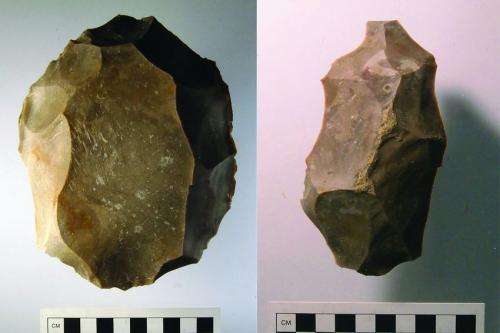
Replica Levallois core (left) and flake (right) knapped by Dr Metin Eren
(PhysOrg.com) -- New published research from anthropologists at the University of Kent has scientifically supported for the first time the long held theory that early human ancestors across Africa, Western Asia and Europe engineered their stone tools.
For over a century, anthropologists have debated the significance of a group of stone age artifacts manufactured by at least three prehistoric hominin species, including the Neanderthals (Homo neanderthalensis). These artifacts, collectively known as Levallois, were manufactured across Europe, Western Asia and Africa as early as 300,000 years ago.
Levallois artifacts are flaked stone tools described by archaeologists as prepared cores i.e. the stone core is shaped in a deliberate manner such that only after such specialised preparation could a prehistoric flintknapper remove a distinctive Levallois flake. Levallois flakes have long been suspected by researchers to be intentionally sought by prehistoric hominins for supposedly unique, standardised size and shape properties. However, such propositions were regarded as controversial by some, and in recent decades some researchers questioned whether Levallois tool production involved conscious, structured planning that resulted in predetermined, engineered products.
Now, an experimental study in which a modern-day flintknapper replicated hundreds of Levallois artifacts supports the notion that Levallois flakes were indeed engineered by prehistoric hominins. By combining experimental archaeology with morphometrics (the study of form) and multivariate statistical analysis, the Kent researchers have proved for the first time that Levallois flakes removed from these types of prepared cores are significantly more standardised than the flakes produced incidentally during Levallois core shaping (called debitage flakes). Importantly, they also identified the specific properties of Levallois flakes that would have made them preferable to past mobile hunter-gathering peoples.
Dr Metin Eren, Leverhulme Early Career Fellow at the Universitys School of Anthropology and Conservation and the flintknapper who crafted the tools, said: The more we learn about the stone tool-making of the Neanderthals and their contemporaries, the more elegant it becomes. The sophistication evident in their tool-making suggests cognitive abilities more similar to our own than not.
Dr Stephen Lycett, Senior Lecturer in Human Evolution and the researcher who conducted the laboratory analysis of the tools, commented: Mobility is a factor in the lives of all hunter-gatherer populations, including Late Pleistocene hominins. Since mobile hunter-gatherers can only carry a fixed number of tools, it is paramount that the potential usefulness of their tools is optimised relative to their weight. The new analyses indicated that Levallois flakes appear to optimise their utility in a variety of ways relative to other flakes. These flakes are on average thicker across their surface area than debitage flakes, and more uniformly thick. These properties would have optimised durability. However, relative to size, the maximum thickness of Levallois flakes is actually less than debitage flakes. This would have provided greater potential for use, resharpening, and re-use, time and again. The symmetry and evenly distributed thickness of Levallois flakes would also align the tools centre of mass with the tools motion during use, making them ergonomically desirable.
Dr Lycett also explained that amongst a variety of choices these tools are superflakes. They are not so thin that they are ineffective but they are not so thick that they could not be re-sharpened effectively or be unduly heavy to carry, which would have been important to hominins such as the Neanderthals.
More information: 'Why Levallois? A morphometric comparison of experimental 'preferential' Levallois flakes versus debitage flakes' (Metin I. Eren and Stephen J. Lycett, University of Kent) is published in the journal PLoS ONE. http://dx.plos.org … pone.0029273
Provided by University of Kent
-
Stone cutting tools link early humans to prehistoric India
Mar 25, 2011 |
not rated yet |
0
-
Russian site may show late Neanderthal refuge
May 12, 2011 |
not rated yet |
0
-
Obsidian 'trail' provides clues to how humans settled, interacted in Kuril Islands
Jun 22, 2009 |
not rated yet |
0
-
Origin of skillful stone-tool-sharpening method pushed back more than 50,000 years
Oct 28, 2010 |
not rated yet |
0
-
Flaky graphene makes reliable chemical sensors
Jan 17, 2012 |
not rated yet |
0
-
Stars containing dark matter should look different from other stars
Feb 20, 2012 |
4.5 / 5 (17) |
11
-
Physicists discover evidence of rare hypernucleus, a component of strange matter
Feb 17, 2012 |
4.7 / 5 (38) |
22
-
Fast photon control brings quantum photonic technologies closer
Feb 13, 2012 |
5 / 5 (8) |
1
-
Engineers build first sub-10-nm carbon nanotube transistor
Feb 01, 2012 |
4.9 / 5 (36) |
32
-
Something old, something new: Evolution and the structural divergence of duplicate genes
Jan 31, 2012 |
4.6 / 5 (7) |
1
-
Eye biology videos
4 hours ago
-
Flowering Plant Revived After 30,000 Years in Permafrost
Feb 21, 2012
-
Toba volcano eruptions - 1.000 - 10,000 breeding pairsunb
Feb 20, 2012
-
How is a specific gene removed from DNA
Feb 20, 2012
-
Reproduction and Human evolution
Feb 19, 2012
-
Viruses: Living or Non-living organisms
Feb 19, 2012
- More from Physics Forums - Biology
More news stories
Global influence of U.S. Constitution on the decline, study reveals
The U.S. Constitution's global influence is on the decline, finds a new study by David S. Law, JD, PhD, professor of law at Washington University in St. Louis.
Other Sciences / Economics & Business
18 hours ago |
4.5 / 5 (2) |
8
Immigration chief seeks to reassure Silicon Valley
(AP) -- The Obama administration's top immigration official said Wednesday he wants to keep more foreign-born high-tech entrepreneurs in the U.S. But to make that happen, he said he needs those entrepreneurs to turn their ...
9 hours ago |
5 / 5 (2) |
0
What is the value of a green card? Researcher calculates increase in income
Just what does it mean to get a green card? To some applicants, about $1,000 each month.
Other Sciences / Economics & Business
17 hours ago |
not rated yet |
2
Increasingly, children's books are where the wild things aren't: study
Was your favorite childhood book crawling with wild animals and set in places like jungles or deep forests? Or did it take place inside a house or in a city, with few if any untamed creatures in sight?
Other Sciences / Social Sciences
11 hours ago |
4.8 / 5 (4) |
0
Making the bones speak
In a narrow, modest laboratory in Michigan State Universitys Giltner Hall, students pore over African skeletons from the Middle Ages in an effort to make the bones speak.
Other Sciences / Archaeology & Fossils
18 hours ago |
not rated yet |
0
Researchers build first physical 'metatronic' circuit
(PhysOrg.com) -- The technological world of the 21st century owes a tremendous amount to advances in electrical engineering, specifically, the ability to finely control the flow of electrical charges using ...
Spitzer finds solid buckyballs in space
(PhysOrg.com) -- Astronomers using data from NASA's Spitzer Space Telescope have, for the first time, discovered buckyballs in a solid form in space. Prior to this discovery, the microscopic carbon spheres ...
Faster than light neutrinos? More like faulty wiring
You can shelf your designs for a warp drive engine (for now) and put the DeLorean back in the garage; it turns out neutrinos may not have broken any cosmic speed limits after all.
Physicists surprised by disappearing and reappearing superconductivity in iron selenium chalcogenides
Superconductivity is a rare physical state in which matter is able to conduct electricity -- maintain a flow of electrons -- without any resistance. This phenomenon can only be found in certain materials at low temperatures, ...
Stanford research team cracks animated NuCaptcha
(PhysOrg.com) -- The research team from Stanford University, led by Elie Bursztein, that previously had cracked regular CAPTCHAs and then audio CAPTCHAs, now has also successfully cracked the animated version called NuCapt ...
Going up: Japan builder eyes space elevator
A Japanese construction firm claimed Wednesday it could execute an out-of-this-world plan to put tourists in space within 40 years by building an elevator that stretches a quarter of the way to the moon.
Jan 24, 2012
Rank: 1 / 5 (2)
Jan 24, 2012
Rank: 1 / 5 (1)
Jan 24, 2012
Rank: 3 / 5 (2)