Nissan demos self-healing Scratch Shield iPhone case
January 17, 2012
Nissan self-healing iPhone case
Nissan today announced the latest piece of must-have kit for the iPhone - a ground-breaking self-healing iPhone case. The Nissan Scratch Shield iPhone case features the brand's pioneering self-healing paint finish, a world first in paint technology developed in 2005 and already used on a number of Nissan and Infiniti models. Now this ground-breaking technology has been applied to a product that's prone to scratches through everyday use - the smartphone - with Nissan's new Scratch Shield case meaning iPhone-lovers can keep their phone looking at its best for longer.
Developed by Nissan in collaboration with University of Tokyo and Advanced Softmaterials Inc., the unique Scratch Shield paint finish was initially designed for automotive use and is available on the Nissan Murano, 370Z and X-Trail along with the Infiniti range of products. Now, thanks to Nissan's pioneering approach, this technology is being trialled for the first time on a non-automotive product in Europe, with the Nissan Scratch Shield iPhone case.
The Nissan Scratch Shield iPhone case has been designed using several automotive engineering innovations to deliver a more durable and long-lasting paint coat, and closely fitting, tight case. The case has three key benefits: the highly flexible and elastic properties of Scratch Shield paint technology allows fine scratches to quickly mend themselves; its tactile gel-like rather than glossy surface is more scratch-resistant than conventional paint and provides a better grip; and the case itself is made of ABS plastic - a high grade substance widely used in the automotive industry which is more rigid and robust than other plastics. The outer paint' is made from polyrotaxane, which means that when damage occurs to the coating in the form of a fine scratch, the chemical structure is able to react to change back to its original shape and fill the gap - 'healing' the blemish.
An initial batch of prototypes of the innovative Scratch Shield iPhone cases has been produced by Nissan for BETA testing with selected journalists and customers, but if demand proves strong, it will look to put the cases on general sale later this year.
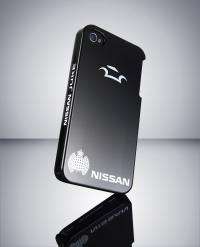
Nissan self-healing iPhone case
Bob Laishley, Overseas Programme Director Business Development for Nissan in Europe, said: "We like to think laterally by taking the great innovations we've got from an automotive point of view, and looking at how they could be applied to improve everyday issues. The Scratch Shield iPhone case is a great example of us taking a Nissan automotive technology that has had a huge impact for our customers, and then shifting the boundaries to apply it to another everyday product.
"We're really excited about the possibilities provided by this technology. In Japan, we've already linked up with world-leading mobile operator NTT DoCoMo to allow them to use the Scratch Shield technology on its Style Series N-03B mobile phones, and we think this technology has real scope beyond the automotive world. We're passionate about innovations that get people excited, and that means not being restricted to one industry or genre."
Nissan has been licensing its unique technologies for various non-automotive applications since 2004. Other technologies that have been licensed include its Miniature Thermal Imaging Sensor: initially designed to make driving at night safer by detecting the presence of people even in places not illuminated by the car's headlights; the technology has been licensed to create a device which allows customers to monitor heat generation, or collect temperature readings via infrared sensor. Nissan will continue to research and develop breakthrough technologies that can benefit other industries, and promote these non-automotive applications globally.
Source: Nissan
-
GE, Nissan join hands on electric cars
Oct 01, 2011 |
not rated yet |
0
-
Drivers of Nissan's electric Leaf report problems
Apr 11, 2011 |
not rated yet |
0
-
Nissan Leaf electric wins Japan car of the year
Dec 04, 2011 |
not rated yet |
0
-
Nissan sells out electric Leaf before it hits US showrooms
Nov 02, 2010 |
not rated yet |
0
-
Electric car Leaf's battery 'can be used at home'
Dec 17, 2010 |
not rated yet |
0
-
Stars containing dark matter should look different from other stars
Feb 20, 2012 |
4.5 / 5 (17) |
11
-
Physicists discover evidence of rare hypernucleus, a component of strange matter
Feb 17, 2012 |
4.7 / 5 (38) |
22
-
Fast photon control brings quantum photonic technologies closer
Feb 13, 2012 |
5 / 5 (8) |
1
-
Engineers build first sub-10-nm carbon nanotube transistor
Feb 01, 2012 |
4.9 / 5 (36) |
32
-
Something old, something new: Evolution and the structural divergence of duplicate genes
Jan 31, 2012 |
4.6 / 5 (7) |
1
-
Calculating forces involved in seesaw motion
4 hours ago
-
Writing shear and moment equations for a simple beam problem?
5 hours ago
-
Furnace Shell Spray Cooling Design
21 hours ago
-
Ways to measure the speed of a golf ball?
Feb 21, 2012
-
Water Skin Effect in Plastic Pipe
Feb 21, 2012
-
Undergraduate Engineering Physics To Graduate Aerospace Engineering
Feb 21, 2012
- More from Physics Forums - General Engineering
More news stories
PlayStation Vita game gadgets debut outside Asia
Sony's slick PlayStation Vita handheld videogame gadget hit major markets around the world on Wednesday as the Japanese entertainment titan bucked a trend towards play on smartphones.
Electronics / Consumer & Gadgets
11 hours ago |
not rated yet |
0
Energy-recycling computer technology from UM goes global through AMD
An energy-recycling computer circuit born at the University of Michigan will enable a new generation of power efficient laptop PCs and servers.
19 hours ago |
5 / 5 (1) |
0
Review: Vita sets new standard for portable games
(AP) -- The PlayStation Vita won't replace your smartphone. For starters, it isn't a telephone (although it will eventually let you use Skype). And it's too big to fit in your pants pocket, unless you're wearing ...
Electronics / Consumer & Gadgets
Feb 21, 2012 |
3.7 / 5 (3) |
2
Engineering research brings seven adult-sized humanoid robots together for first time in US
Seven adult-sized humanoid robots took the stage during Drexel University's celebration of National Engineers Week, in a first-of-its-kind assembly of robotic technology. A showcase event on Feb. 20 introduced all seven of ...
Feb 21, 2012 |
not rated yet |
2
British firm develops 'cheapest wireless tablet'
A British technology company claims to have developed the world's least expensive computer tablet for wireless Internet access.
Electronics / Consumer & Gadgets
Feb 19, 2012 |
4.6 / 5 (10) |
2
Researchers build first physical 'metatronic' circuit
(PhysOrg.com) -- The technological world of the 21st century owes a tremendous amount to advances in electrical engineering, specifically, the ability to finely control the flow of electrical charges using ...
Spitzer finds solid buckyballs in space
(PhysOrg.com) -- Astronomers using data from NASA's Spitzer Space Telescope have, for the first time, discovered buckyballs in a solid form in space. Prior to this discovery, the microscopic carbon spheres ...
Faster than light neutrinos? More like faulty wiring
You can shelf your designs for a warp drive engine (for now) and put the DeLorean back in the garage; it turns out neutrinos may not have broken any cosmic speed limits after all.
Physicists surprised by disappearing and reappearing superconductivity in iron selenium chalcogenides
Superconductivity is a rare physical state in which matter is able to conduct electricity -- maintain a flow of electrons -- without any resistance. This phenomenon can only be found in certain materials at low temperatures, ...
Stanford research team cracks animated NuCaptcha
(PhysOrg.com) -- The research team from Stanford University, led by Elie Bursztein, that previously had cracked regular CAPTCHAs and then audio CAPTCHAs, now has also successfully cracked the animated version called NuCapt ...
Going up: Japan builder eyes space elevator
A Japanese construction firm claimed Wednesday it could execute an out-of-this-world plan to put tourists in space within 40 years by building an elevator that stretches a quarter of the way to the moon.
