Pentagon-backed 'time cloak' stops the clock (Update)
January 4, 2012 By Bill Steele
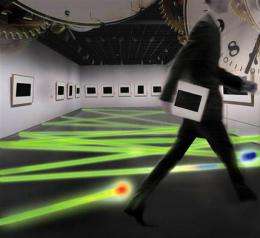
In this 2011 illustration, provided by Cornell University, scientists demonstrate how they have have created, a new invisibility technique that doesn’t just cloak an object _ like in Harry Potter books and movies _ but masks an entire event. It is a time masker that works by briefly bending the speed of light around an event. Cornell scientists explain what they are talking about in this 2011 illustration that shows that if this technique is ever scaled up an art thief can walk into a museum and steal a painting without setting off laser beam alarms or even showing up on surveillance cameras or your eyes. (AP Photo/Heather Deal, Cornell University)
Pentagon-supported physicists on Wednesday said they had devised a "time cloak" that briefly makes an event undetectable.
In movie magic, people and objects can appear or disappear or move from place to place in an instant. Just stop the camera, move things around and start it again. Now, Cornell researchers have demonstrated a similar "temporal cloak" -- albeit on a very small scale -- in the transport of information by a beam of light.
The trick is to create a gap in the beam of light, have the hidden event occur as the gap goes by and then stitch the beam back together. Alexander Gaeta, professor of applied and engineering physics, and colleagues report their work in the Jan. 5 issue of the journal Nature.
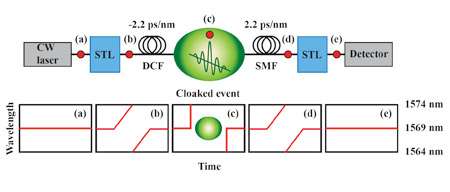
A laser beam passes through a "split-time lens" - a specially designed waveguide that bumps up the wavelength for a while then suddenly bumps it down. The signal then passes through a filter that slows down the higher-wavelength part of the signal, creating a gap in which the cloaked event takes place. A second filter works in the opposite way from the first, letting the lower wavelength catch up, and a final split-time lens brings the beam back to the original wavelength, leaving no trace of what happened during the gap. Image: Gaeta lab
The researchers created what they call a time lens, which can manipulate and focus signals in time, analogous to the way a glass lens focuses light in space. They use a technique called four-wave mixing, in which two beams of light, a "signal" and a "pump," are sent together through an optical fiber. The two beams interact and change the wavelength of the signal. To begin creating a time gap, the researchers first bump the wavelength of the signal up, then by flipping the wavelength of the pump beam, bump it down.The beam then passes through another, very long, stretch of optical fiber. Light passing through a transparent material is slowed down just a bit, and how much it is slowed varies with the wavelength. So the lower wavelength pulls ahead of the higher, leaving a gap, like the hare pulling ahead of the tortoise. During the gap the experimenters introduced a brief flash of light at a still higher wavelength that would cause a glitch in the beam coming out the other end.
Then the split beam passes through more optical fiber with a different composition, engineered to slow lower wavelengths more than higher. The higher wavelength signal now catches up with the lower, closing the gap. The hare is plodding through mud, but the tortoise is good at that and catches up. Finally, another four-wave mixer brings both parts back to the original wavelength, and the beam emerges with no trace that there ever was a gap, and no evidence of the intruding signal.
None of this will let you steal the crown jewels without anyone noticing. The gap created in the experiment was 15 picoseconds long, and might be increased up to 10 nanoseconds, Gaeta said. But the technique could have applications in fiber-optic data transmission and data processing, he added. For example, it might allow inserting an emergency signal without interrupting the main data stream, or multitasking operations in a photonic computer, where light beams on a chip replace wires.
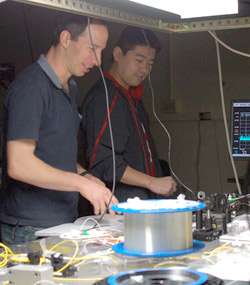
Time cloaking doesn't involve a DeLorean, just a kilometer of optical fiber coiled up on a lab table, supervised by postdoc Moti Fridman and research associate Yoshi Okawachi.
The experiment was inspired, Gaeta said, by a theoretical proposal for a space-time cloak or "history editor" published by Martin McCall, professor of physics at Imperial College in London, in the Journal of Optics in November 2010."But his method required an optical response from a material that does not exist," Gaeta said. "Now we've done it in one spatial dimension. Extending it to two [that is, hiding a moment in an entire scene] is not out of the realm of possibility. All advances have to start from somewhere."
Fridman's work was part-supported by the Defense Advanced Research Project Agency, or DARPA, a Pentagon unit which develops futuristic technology that can have a military use. Its achievements include DARPANet, a predecessor of the Internet.
More information: Nature journal announcement:
Now you detect it, now you dont (pp 62-65; N&V)
A time cloak that makes an event temporarily undetectable, albeit on the picosecond scale, is described in this weeks Nature. The work could represent a step towards the development of spatio-temporal cloaking.
Recent developments in spatial cloaking show that it is possible to hide an object by manipulating electromagnetic waves around it, creating a hole in space. Such devices currently have limited functionality. Here Moti Fridman and colleagues demonstrate that a related effect, temporal cloaking, can be achieved. They manage to create a hole in time for around 40 trillionths of a second (40 picoseconds).
The fibre-based system steers light around an event so that no evidence (a change in the temporal or spectral properties of the light beam) of the event is detectable, by speeding up and slowing down different parts of a light beam. This effect is achieved using a split time-lens that breaks light up into its slower (red) and faster (blue) components, thereby creating a tiny temporal gap.
Provided by Cornell University
-
Erasing history? Temporal cloaks adjust light's throttle to hide an event in time
Oct 12, 2011 |
not rated yet |
0
-
Physicists demonstrate a time cloaking device
Jul 18, 2011 |
not rated yet |
0
-
New invisibility cloak hides objects from human view
Jul 27, 2011 |
not rated yet |
0
-
Invisibility carpet cloak can hide objects from visible light
Jun 15, 2011 |
not rated yet |
0
-
Light speed hurdle to invisibility cloak overcome by undergraduate
Aug 09, 2011 |
not rated yet |
0
-
Stars containing dark matter should look different from other stars
Feb 20, 2012 |
4.5 / 5 (17) |
11
-
Physicists discover evidence of rare hypernucleus, a component of strange matter
Feb 17, 2012 |
4.7 / 5 (38) |
22
-
Fast photon control brings quantum photonic technologies closer
Feb 13, 2012 |
5 / 5 (8) |
1
-
Engineers build first sub-10-nm carbon nanotube transistor
Feb 01, 2012 |
4.9 / 5 (36) |
32
-
Something old, something new: Evolution and the structural divergence of duplicate genes
Jan 31, 2012 |
4.6 / 5 (7) |
1
-
linear wave equation vs. linear system
1 hour ago
-
adhesive force and surface tension
1 hour ago
-
Newbie here.
3 hours ago
-
Rainbows in space?
3 hours ago
-
taking mechanical physics next fall
5 hours ago
-
Help: maximum force of an object when given impulse and time on a graph
8 hours ago
- More from Physics Forums - General Physics
More news stories
Researchers build first physical 'metatronic' circuit
(PhysOrg.com) -- The technological world of the 21st century owes a tremendous amount to advances in electrical engineering, specifically, the ability to finely control the flow of electrical charges using ...
10 hours ago |
4.7 / 5 (17) |
5
|
Faster than light neutrinos? More like faulty wiring
You can shelf your designs for a warp drive engine (for now) and put the DeLorean back in the garage; it turns out neutrinos may not have broken any cosmic speed limits after all.
9 hours ago |
4.2 / 5 (22) |
23
|
Physicists surprised by disappearing and reappearing superconductivity in iron selenium chalcogenides
Superconductivity is a rare physical state in which matter is able to conduct electricity -- maintain a flow of electrons -- without any resistance. This phenomenon can only be found in certain materials at low temperatures, ...
13 hours ago |
5 / 5 (5) |
2
|
Less is more: Study of tiny droplets could have big impact on industrial applications
(PhysOrg.com) -- Under a microscope, a tiny droplet slides between two fine hairs like a roller coaster on a set of rails until poof it suddenly spreads along them, a droplet no more.
10 hours ago |
3.7 / 5 (3) |
0
|
Study reveals switching mechanism in promising computer memory device
(PhysOrg.com) -- Sometimes knowing that a new technology works is not enough. You also must know why it works to get marketplace acceptance. New information from the National Institute of Standards and Technology ...
17 hours ago |
4 / 5 (4) |
0
|
Spitzer finds solid buckyballs in space
(PhysOrg.com) -- Astronomers using data from NASA's Spitzer Space Telescope have, for the first time, discovered buckyballs in a solid form in space. Prior to this discovery, the microscopic carbon spheres ...
Stanford research team cracks animated NuCaptcha
(PhysOrg.com) -- The research team from Stanford University, led by Elie Bursztein, that previously had cracked regular CAPTCHAs and then audio CAPTCHAs, now has also successfully cracked the animated version called NuCapt ...
CT colonography shown to be comparable to standard colonoscopy
Computerized tomographic (CT) colonography (CTC), also known as virtual colonoscopy, is comparable to standard colonoscopy in its ability to accurately detect cancer and precancerous polyps in people ages 65 and older, according ...
Going up: Japan builder eyes space elevator
A Japanese construction firm claimed Wednesday it could execute an out-of-this-world plan to put tourists in space within 40 years by building an elevator that stretches a quarter of the way to the moon.
Scientists create potent molecules aimed at treating muscular dystrophy
While RNA is an appealing drug target, small molecules that can actually affect its function have rarely been found. But now scientists from the Florida campus of The Scripps Research Institute have for the first time designed ...
Flesh-eating bacteria inspire superglue
(PhysOrg.com) -- A bio-inspired superglue has been developed by Oxford University researchers that cant be matched for sticking molecules together and not letting go.
Jan 04, 2012
Rank: 4.6 / 5 (9)
..I know I'm pretty dense sometimes, but I don't get it ?
Jan 04, 2012
Rank: 5 / 5 (14)
Jan 04, 2012
Rank: 1 / 5 (1)
Jan 04, 2012
Rank: 3.9 / 5 (13)
It has nothing to do with cloaking "time". As the article states, they stopped light from reaching cameras. So this is the same type of light controlling cloak as nearly any other previously proposed.
PhysOrg journalism seems to sometimes be akin to Yahoo journalism.
Jan 04, 2012
Rank: 5 / 5 (12)
For example, these physicists did not "erase a split second of history"...
Jan 04, 2012
Rank: 3.7 / 5 (6)
Raygunner:
They did not change the speed of photons. Photons travel at C. The rate of propagation of the wavefront along a linear trajectory is affected by the properties of the medium. In this case the photons do not take a linear path even though the wavefront does, so the photons can move at a constant velocity (C) even though the wavefront is not propagating at that velocity.
Think of an object on a zig-zag path. The object alternates between two different trajectories, but if you average those two trajectories you get a single trajectory of travel. The objects true velocity will be greater along the two zig-zag trajectories than it will be along the single averaged trajectory. That is the only way to "slow light", to make the photons take an indirect path compared to the average path of the wave.
Jan 04, 2012
Rank: 5 / 5 (1)
Jan 04, 2012
Rank: 5 / 5 (5)
It's important to point out that this experiment did do something more than just block light like a curtain - it relinked up light from events before the blocked event and after, so that the information received outside was as if that time didn't occur at all. Which is a little more interesting.
Horrid article though.
Jan 04, 2012
Rank: 3 / 5 (2)
Jan 04, 2012
Rank: 5 / 5 (2)
Firtsly I agree the artcile was poorly written but I think you've missed the point here. At no stage did they stop any light from reaching its destination. What they did was to increase the interval of time between two photons of light without any perceptible change to the receiver. From the viewpoint of the person recieving the signal, nothing has happened. But at the point of the cloak there has been a little "hole" of time created. (hole is a bad word for it, but without anything better I'll use it).
Think of it this way:
Normally photon 1 and photon 2 have a time interval between them of X. At the point of the cloak the scintists have increased this to X Y. Yet the photons are still recieved at the detector with a time interval between them of X.
Jan 04, 2012
Rank: 4 / 5 (4)
Jan 04, 2012
Rank: 2 / 5 (4)
Jan 04, 2012
Rank: 1 / 5 (3)
With 230million in '3's first week, the incentive is there!!
Not to construct the plot but the gimmick!
Jan 04, 2012
Rank: 1 / 5 (1)
In a vacuum.
Umm. Like big words do we? The speed of light is dependent on the medium.
You all need to pay attention to the authors of articles. This one is sourced from the Associated Press. Physorg is just running it, the same as CNN, Wired, NYTimes, etc.
tkjtkj, Ghost Protocol is MI4. I'd be surprised if they let the franchise sleep another 5 years before MI5 comes out.
Jan 04, 2012
Rank: 5 / 5 (1)
Jan 04, 2012
Rank: 1 / 5 (2)
ahh..tnx for correction! I had fun at 'ghost' so apparently lost track of episodes!
Also,supporting your conjecture, the studio's are under the 'pressure' of a thing called 'the ageing process' .. Cruise already is showing the years .. not so badly as did Sean in his last episode: a ninja would dance around him like Mohammed Ali, stinging like a 1000 bee's.. So let's hope its less than 5 yrs!!
Jan 04, 2012
Rank: 1 / 5 (1)
No you didn't. Thats not even the same thing.
To use your analogy of the bag over the head thing, lets say you had a "Time Cloak" which could block out events for over a minute. You could engage your cloak and put a bag over my head. You could then remove the bag from my head after a minute and disengage the cloak. From your point of view you see me standing there for a minute with a bag on my head. From my point of view I would never have seen the bag at all.
Of course, that raises all sorts of strange questions, such as would I have felt a bag on my head for a minute without being able to see it etc?
Jan 04, 2012
Rank: 3 / 5 (2)
Jan 04, 2012
Rank: 2.3 / 5 (6)
Always.
No, the speed of the wavefront of light is dependent on the medium due to varying degrees of absorption and re-transmission of the photons. The photons always travel at C.
Jan 04, 2012
Rank: 4 / 5 (2)
Nope. Light doesn't need to be absorbed and re-emitted to be slower than C.
The speed of a photon is 1/sqrt(epsilon*mu)
where epsilon is the electric permittivity
and mu is the magnetic permeability
C is the special case for permittivity and permeability of free space (vacuum)
Jan 04, 2012
Rank: 1 / 5 (7)
Jan 04, 2012
Rank: 3 / 5 (2)
Jan 05, 2012
Rank: 1 / 5 (2)
Unless your cloak can speed up light you can ride the middle of a disruption in your magical cloak but there will always be a leading and trailing edge which signals your deception.
Jan 05, 2012
Rank: 1 / 5 (3)
One can in fact hide digital events for a long period of time; it would simple mean a delay at the receiver's end by a minimum of at least the event period.
i.e
send data,
slow data to enable data splitting.
split data along two paths
send trailing data into a loop/or slowgo
insert event after data lead.
when event's finish,
slow lead and event to separate down two paths
loop/or slowgo the lead data recalibrate with trail' data
send reunited data onward to receiver.
limited to hiding digital data though.
Real world lensing? now thats another story.
Jan 05, 2012
Rank: 3 / 5 (2)
Jan 05, 2012
Rank: 4.8 / 5 (4)
Jan 05, 2012
Rank: 4.3 / 5 (3)
Got to be the most ridiculous statement ever
Jan 05, 2012
Rank: 3.7 / 5 (3)
Don't read the comments much, do you? :D
Jan 05, 2012
Rank: 3.3 / 5 (3)
One minute you're talking about "light", the next "photons"... let's try to keep the terminology straight please. Light can refer to the wavefront itself.
Photons are mass-less, they must always travel at c as is required by relativity.
Read this:
http://en.wikiped...n_matter
"Photons may be viewed as always traveling at c, even in matter, but they have their phase shifted (delayed or advanced) upon interaction with atomic scatters: this modifies their wavelength and momentum, but not speed. A light wave made up of these photons does travel slower than the speed of light."
I work in optics/photonics...
Jan 05, 2012
Rank: 1 / 5 (1)
Jan 06, 2012
Rank: 1 / 5 (1)
Jan 06, 2012
Rank: 3 / 5 (2)
In this experiment, the detection of frequency at 1539nm, caused by the interaction of the two beams within the medium, is what they are defining as the "event." thus by introducing a "chirp" in the pump beam (introducing a phase shift using self focusing and splitting the beam into a red and blue shifted component and thus creating a temporal gap between the red and blue components) and then doing a reverse "chirp" they can create a gap in the pump beam. this is basically the cloaking mechanism. so when there's a gap in the pump beam, you can effectively "hide" the probe beam in that gap, producing no 4-wave mixing and hiding the event
Jan 06, 2012
Rank: 1 / 5 (1)
Jan 07, 2012
Rank: not rated yet
Jan 08, 2012
Rank: not rated yet
Jan 08, 2012
Rank: 1 / 5 (1)
Jan 08, 2012
Rank: 1 / 5 (1)
http://aetherwave...les.html
http://www.popsci...e-events
What these guys are essentially did is, they passed the light through artificial unidimensional metamaterial foam, which is representing space-time foam in Universe at extreme distance/energy density scales.
http://www.tomsgu...894.html
Jan 08, 2012
Rank: 1 / 5 (1)
1) The space cloaks are using spatial metamaterials, the time cloak will use the space-time metamateials
2) The metamaterials are composed of serial system of convex and concave lens, the time cloak will therefore use a serial system of convex and concave time lens
3) The convex and concave time lens were developed for time microscope, enabling to expand the signals from ultrafast phenomena in time
4) The time microscope has been developed for analyse of laser pulses at NIF base, which is dedicated to military research from 80%
5) The military research is usually sponsored with Pentagon, which explains its notion in the above headline
Got it? It's simple, my dear Watson.
Jan 08, 2012
Rank: 1 / 5 (1)
One of methods is the four-wave mixing, which is based into superposition of pulse with higher and lower harmonics of signal, which are susceptible to subsequent dispersion and vanishing during their travel through long path of dispersive environment
Jan 08, 2012
Rank: 1 / 5 (1)
The spectral function signal will travel trough dispersive environment (realized with optical fiber), which will spread them in time. Now we can apply the same wave mixing to the spectral function signal again in the opposite way - so we will restore the original signal, just expanded in time. We just realized the time lens.
Jan 08, 2012
Rank: not rated yet
Jan 09, 2012
Rank: 2.3 / 5 (3)
Jan 09, 2012
Rank: 1.5 / 5 (2)