What really happened prior to 'Snowball Earth'?
January 27, 2012
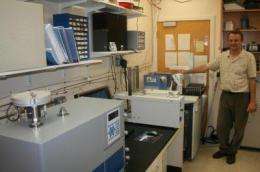
In a study published in the January 2012 issue of Geology, Swart suggests that the large changes in the carbon isotopic composition of carbonates which occurred prior to the major climatic event more than 500 million years ago, known as "Snowball Earth," are unrelated to worldwide glacial events. Credit: UM/RSMAS
In a study published in the journal Geology, scientists at the University of Miami (UM) Rosenstiel School of Marine and Atmospheric Science suggest that the large changes in the carbon isotopic composition of carbonates which occurred prior to the major climatic event more than 500 million years ago, known as 'Snowball Earth,' are unrelated to worldwide glacial events.
"Our study suggests that the geochemical record documented in rocks prior to the Marinoan glaciation or 'Snowball Earth' are unrelated to the glaciation itself," said UM Rosenstiel professor Peter Swart, a co-author of the study. "Instead the changes in the carbon isotopic ratio are related to alteration by freshwater as sea level fell."
In order to better understand the environmental conditions prior to 'Snowball Earth', the research team analyzed geochemical signatures preserved in carbonate rock cores from similar climactic events that happened more recently two million years ago during the Pliocene-Pleistocene period.
The team analyzed the ratio of the rare isotope of carbon (13C) to the more abundant carbon isotope (12C) from cores drilled in the Bahamas and the Enewetak Atoll in the Pacific Ocean. The geochemical patterns that were observed in these cores were nearly identical to the pattern seen prior to the Marinoan glaciation, which suggests that the alteration of rocks by water, a process known as diagenesis, is the source of the changes seen during that time period.
Prior to this study, scientists theorized that large changes in the cycling of carbon between the organic and inorganic reservoirs occurred in the atmosphere and oceans, setting the stage for the global glacial event known as 'Snowball Earth'.
"It is widely accepted that changes in the carbon isotopic ratio during the Pliocene-Pleistocene time are the result of alteration of rocks by freshwater," said Swart. "We believe this is also what occurred during the Neoproterozoic. Instead of being related to massive and complicated changes in the carbon cycle, the variations seen in the Neoproterozoic can be explained by simple process which we understand very well."
Scientists acknowledge that multiple sea level fluctuations occurred during the Pliocene-Pleistocene glaciations resulting from water being locked up in glaciers. Similar sea-level changes during the Neoproterozoic caused the variations in the global carbon isotopic signal preserved in the older rocks, not a change in the distribution of carbon as had been widely postulated.
More information: The study, titled "Does the global stratigraphic reproducibility of 13C in Neoproterozoic carbonates require a marine origin? A Pliocene-Pleistocene comparison" was published in the January issue of the journal Geology.
-
Global glaciation snowballed into giant change in carbon cycle
May 01, 2010 |
not rated yet |
0
-
Study debunks theory on end of 'Snowball Earth' ice age
May 25, 2011 |
not rated yet |
0
-
Snowball Earth hypothesis challenged
Oct 12, 2011 |
not rated yet |
0
-
New evidence hints at global glaciation 716.5 million years ago
Mar 04, 2010 |
not rated yet |
0
-
Explosive growth of life on Earth fueled by early greening of planet
Jul 08, 2009 |
not rated yet |
0
-
Stars containing dark matter should look different from other stars
Feb 20, 2012 |
4.5 / 5 (17) |
11
-
Physicists discover evidence of rare hypernucleus, a component of strange matter
Feb 17, 2012 |
4.7 / 5 (38) |
22
-
Fast photon control brings quantum photonic technologies closer
Feb 13, 2012 |
5 / 5 (8) |
1
-
Engineers build first sub-10-nm carbon nanotube transistor
Feb 01, 2012 |
4.9 / 5 (36) |
32
-
Something old, something new: Evolution and the structural divergence of duplicate genes
Jan 31, 2012 |
4.6 / 5 (7) |
1
-
Is the Earth really going to die
14 hours ago
-
Do some geologists actually act a lot like Randy Marsh?
Feb 11, 2012
-
Discrepancy between oxygen and carbon-dioxide levels
Feb 09, 2012
-
where gems are found in the world
Feb 09, 2012
-
Wind Waves in Reservoir ~ Wind run-up and Wind set-up
Feb 08, 2012
-
Balance of oxygen in the atmosphere
Feb 01, 2012
- More from Physics Forums - Earth
More news stories
Spitzer finds solid buckyballs in space
(PhysOrg.com) -- Astronomers using data from NASA's Spitzer Space Telescope have, for the first time, discovered buckyballs in a solid form in space. Prior to this discovery, the microscopic carbon spheres ...
14 hours ago |
4.7 / 5 (12) |
8
|
Going up: Japan builder eyes space elevator
A Japanese construction firm claimed Wednesday it could execute an out-of-this-world plan to put tourists in space within 40 years by building an elevator that stretches a quarter of the way to the moon.
Space & Earth / Space Exploration
21 hours ago |
3.5 / 5 (13) |
26
ENASA satellite finds Earth's clouds are getting lower
(PhysOrg.com) -- Earth's clouds got a little lower -- about one percent on average -- during the first decade of this century, finds a new NASA-funded university study based on NASA satellite data. The results ...
Space & Earth / Earth Sciences
18 hours ago |
5 / 5 (8) |
13
|
Fresh scandal embroils US climate science debate
A fresh scandal over climate change has erupted in the United States after leaked documents appeared to show a right-wing funded campaign to influence how climate science is taught in schools.
11 hours ago |
4.1 / 5 (9) |
8
World's oceans get an acid bath
Among the repercussions of global climate change, the effect of ocean acidification on marine life is one of the least-understood variables.
18 hours ago |
4.3 / 5 (6) |
4
|
Researchers build first physical 'metatronic' circuit
(PhysOrg.com) -- The technological world of the 21st century owes a tremendous amount to advances in electrical engineering, specifically, the ability to finely control the flow of electrical charges using ...
Faster than light neutrinos? More like faulty wiring
You can shelf your designs for a warp drive engine (for now) and put the DeLorean back in the garage; it turns out neutrinos may not have broken any cosmic speed limits after all.
Physicists surprised by disappearing and reappearing superconductivity in iron selenium chalcogenides
Superconductivity is a rare physical state in which matter is able to conduct electricity -- maintain a flow of electrons -- without any resistance. This phenomenon can only be found in certain materials at low temperatures, ...
Stanford research team cracks animated NuCaptcha
(PhysOrg.com) -- The research team from Stanford University, led by Elie Bursztein, that previously had cracked regular CAPTCHAs and then audio CAPTCHAs, now has also successfully cracked the animated version called NuCapt ...
Flesh-eating bacteria inspire superglue
(PhysOrg.com) -- A bio-inspired superglue has been developed by Oxford University researchers that cant be matched for sticking molecules together and not letting go.
Scientists create potent molecules aimed at treating muscular dystrophy
While RNA is an appealing drug target, small molecules that can actually affect its function have rarely been found. But now scientists from the Florida campus of The Scripps Research Institute have for the first time designed ...
Jan 27, 2012
Rank: 3.4 / 5 (5)
Jan 27, 2012
Rank: 1.1 / 5 (11)
Jan 27, 2012
Rank: 5 / 5 (15)
I find that entirely consistent with your avocation of every crack-pot idea on the planet. This however is a new one, so I'll bite.
1) What would cause a whole lot tiny comets to impact the earth like that?
2) Unless you think its was something that only happened to the earth, and not say... to the moon, where is the evidence something like that even occurred in the first place? I assure you that the evidence would be quite obvious if it existed.
3) what is the putative mechanism between lots of tiny comets and almost the entire planet being covered with ice?
4) Why do you nearly always automatically assume that you know better than people who have been studying this stuff for years? Scientists can be wrong for sure. And conventional wisdom has often been proved incorrect. But its almost always after painstaking experiment and research by scientists.
Jan 27, 2012
Rank: 4.6 / 5 (10)
I nominate this for comment of the Month. I litterally laughed so hard my chair almost tipped over.
Can you post it again so that I can give it another 5/5?
Jan 27, 2012
Rank: 5 / 5 (2)
Jan 27, 2012
Rank: 1 / 5 (12)
http://sohowww.na...1024.jpg
I see, we have a tiny personal problem here....;-) Nope, I don't care what the people who are have been studying this stuff for years are thinking about. Should I do?
Jan 27, 2012
Rank: 1 / 5 (12)
Jan 27, 2012
Rank: 5 / 5 (1)
Jan 28, 2012
Rank: 1 / 5 (2)
Jan 28, 2012
Rank: not rated yet
Agree... Poor Calippo/Rawa1, nobody loves you, everyone's against your stupid ideas with our gregarious instinct :)
Jan 28, 2012
Rank: 1 / 5 (3)
Jan 28, 2012
Rank: 5 / 5 (3)
Jan 29, 2012
Rank: 1 / 5 (3)
Apparently, many people here don't really think like the Feynman.
Jan 30, 2012
Rank: 5 / 5 (6)
- Carl Sagan
Jan 30, 2012
Rank: 1 / 5 (3)
Jan 30, 2012
Rank: 5 / 5 (4)
Jan 30, 2012
Rank: 1 / 5 (3)
Jan 30, 2012
Rank: 5 / 5 (4)