'Proplyd-like' objects discovered in Cygnus OB2
January 16, 2012 By Jon Voisey, Universe Today
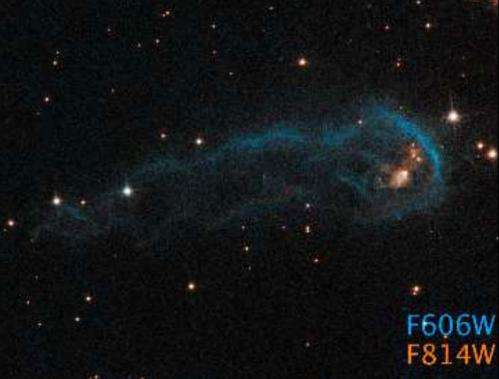
Hubble image of a Proplyd-like object in Cygnus OB2. Credit: Z. Levay and L. Frattare, STScI
The well known Orion Nebula is perhaps the most well known star forming regions in the sky. The four massive stars known as the trapezium illuminate the massive cloud of gas and dust busily forming into new stars providing astronomers a stunning vista to explore stellar formation and young systems. In the region are numerous protoplanetary disks or proplyds for short which are regions of dense gas around a newly formed star. Such disks are common around young stars and have recently been discovered in an even more massive, but less well known star forming region within our own galaxy: Cygnus OB2.
Ten times more massive than its more famous counterpart in Orion, Cygnus OB2 is a star forming region that is a portion of a larger collection of gas known as Cygnus X. The OB2 region is notable because, like the Orion nebula, it contains several exceptionally massive stars including OB2-12 which is one of the most massive and luminous stars within our own galaxy. In total the region has more than 65 O class stars, the most massive category in astronomers classification system. Yet for as bright as these stars are, Cygnus OB2 is not a popular target for amateur astronomers due to its position behind a dark obscuring cloud which blocks the majority of visible light.
But like many objects obscured in this manner, infrared and radio telescopes have been used to pierce the veil and study the region. The new study, led by Nicholas Wright at the Harvard-Smithsonian Center for Astrophysics, combines infrared and visual observations from the Hubble Space telescope. The observations revealed 10 objects similar in appearance to the Orion proplyds. The objects had long tails being blown away from the central mass due to the strong stellar winds from the central cluster similar to how proplyds in Orion point away from the trapezium. On the closer end, the objects were brightly ionized.
Yet despite the similarities, the objects may not be true proplyds. Instead, they may be regions known as evaporating gaseous globules or EGGs for short. The key difference between the two is whether or not a star has formed. EGGs are overdense regions within a larger nebula. Their size and density makes them resistant to the ionization and stripping that blows away the rest of the nebula. Because the interior regions are shielded from these dispersive forces, the center may collapse to form a star which is the requirement for a proplyd. So which are these?
In general, the newly discovered objects are far larger than those typically found in Orion. While Orion proplyds are nearly symmetric across an axis directed towards the central cluster, the OB2 objects have twisted tails with complex shapes. The objects are 18-113 thousand AU (1 AU = the distance between the Earth and Sun = 93 million miles = 150 million km) across making them significantly larger than the Orion proplyds and even larger than the largest known proplyds in NGC 6303.
Yet as different as they are, the current theoretical understanding of how proplyds work doesnt put them beyond the plausible range. In particular, the size for a true proplyd is limited by how much stripping it feels from the central stars. Since these objects are further away from OB2-12 and the other massive stars than the Orion proplyds are from the trapezium, they should feel less dispersive forces and should be able to grow as large as is seen. Attempting to pierce the thick dust the objects contain and discover if central stars were present, the team examined the objects in the infrared and radio. Of the ten objects, seven had strong candidates central stellar sources.
Still, the stark differences make conclusively identifying the objects as either EGGs or proplyds difficult. Instead, the authors suggest that these objects may be the first discovery of an inbetween stage: old, highly evolved EGGs which have nearly formed stars making them more akin to young proplyds. If further evidence supports this, this finding would help fill in the scant observational details surrounding stellar formation. This would allow astronomers to more thoroughly test theories which are also tied to the understanding of how planetary systems form.
Source: Universe Today
-
SMA Confirms Proto-Planetary Systems are Common in the Galaxy
Jun 14, 2005 |
not rated yet |
0
-
Born in beauty: Proplyds in the Orion Nebula (w/ Video)
Dec 14, 2009 |
not rated yet |
0
-
Spitzer Reveals New Wonders in the Familiar Orion Nebula
Aug 15, 2006 |
not rated yet |
0
-
An X-Ray Santa Claus in Orion
Nov 30, 2007 |
not rated yet |
0
-
Turbulence May Promote the Birth of Massive Stars
Feb 23, 2009 |
not rated yet |
0
-
Stars containing dark matter should look different from other stars
Feb 20, 2012 |
4.5 / 5 (17) |
11
-
Physicists discover evidence of rare hypernucleus, a component of strange matter
Feb 17, 2012 |
4.7 / 5 (38) |
22
-
Fast photon control brings quantum photonic technologies closer
Feb 13, 2012 |
5 / 5 (8) |
1
-
Engineers build first sub-10-nm carbon nanotube transistor
Feb 01, 2012 |
4.9 / 5 (36) |
32
-
Something old, something new: Evolution and the structural divergence of duplicate genes
Jan 31, 2012 |
4.6 / 5 (7) |
1
-
Calculating the magnitude
1 hour ago
-
What is this spectrum I took?
12 hours ago
-
Orientation of Space
12 hours ago
-
Geologically Active Moon Now: NASA
19 hours ago
-
advice on building a science fair telescope
Feb 22, 2012
-
Rise of the Sun
Feb 22, 2012
- More from Physics Forums - General Astronomy
More news stories
Spitzer finds solid buckyballs in space
(PhysOrg.com) -- Astronomers using data from NASA's Spitzer Space Telescope have, for the first time, discovered buckyballs in a solid form in space. Prior to this discovery, the microscopic carbon spheres ...
13 hours ago |
4.7 / 5 (12) |
8
|
Going up: Japan builder eyes space elevator
A Japanese construction firm claimed Wednesday it could execute an out-of-this-world plan to put tourists in space within 40 years by building an elevator that stretches a quarter of the way to the moon.
Space & Earth / Space Exploration
20 hours ago |
3.5 / 5 (13) |
26
ENASA satellite finds Earth's clouds are getting lower
(PhysOrg.com) -- Earth's clouds got a little lower -- about one percent on average -- during the first decade of this century, finds a new NASA-funded university study based on NASA satellite data. The results ...
Space & Earth / Earth Sciences
17 hours ago |
5 / 5 (8) |
12
|
Fresh scandal embroils US climate science debate
A fresh scandal over climate change has erupted in the United States after leaked documents appeared to show a right-wing funded campaign to influence how climate science is taught in schools.
10 hours ago |
4.1 / 5 (9) |
8
World's oceans get an acid bath
Among the repercussions of global climate change, the effect of ocean acidification on marine life is one of the least-understood variables.
17 hours ago |
4.3 / 5 (6) |
4
|
Researchers build first physical 'metatronic' circuit
(PhysOrg.com) -- The technological world of the 21st century owes a tremendous amount to advances in electrical engineering, specifically, the ability to finely control the flow of electrical charges using ...
Faster than light neutrinos? More like faulty wiring
You can shelf your designs for a warp drive engine (for now) and put the DeLorean back in the garage; it turns out neutrinos may not have broken any cosmic speed limits after all.
CT colonography shown to be comparable to standard colonoscopy
Computerized tomographic (CT) colonography (CTC), also known as virtual colonoscopy, is comparable to standard colonoscopy in its ability to accurately detect cancer and precancerous polyps in people ages 65 and older, according ...
Physicists surprised by disappearing and reappearing superconductivity in iron selenium chalcogenides
Superconductivity is a rare physical state in which matter is able to conduct electricity -- maintain a flow of electrons -- without any resistance. This phenomenon can only be found in certain materials at low temperatures, ...
Study: Virtual colonoscopy effective screening tool for adults over 65
Computed tomography (CT) colonography can be used as a primary screening tool for colorectal cancer in adults over the age of 65, according to a new study published online in the journal Radiology.
Stanford research team cracks animated NuCaptcha
(PhysOrg.com) -- The research team from Stanford University, led by Elie Bursztein, that previously had cracked regular CAPTCHAs and then audio CAPTCHAs, now has also successfully cracked the animated version called NuCapt ...