Researchers suggest a proximate cause of cancer
January 26, 2012
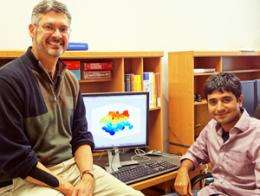
Dr. Roger T. Bonnecaze, left, and postdoctoral student Parag Katira.
(PhysOrg.com) -- Researchers from The University of Texas at Austins Department of Chemical Engineering are the first to show that mechanical property changes in cells may be responsible for cancer progression a discovery that could pave the way for new approaches to predict, treat and prevent cancer.
Postdoctoral student Parag Katira and his adviser, Roger T. Bonnecaze, department chair in the Cockrell School of Engineering and T. Brockett Hudson Professor, worked with Muhammad Zaman of Boston University to devise a 3-D cancer model that shows the softening of cells and changes in cell binding cause cancerous behavior in cells. These mechanical property changes cause cells to divide uncontrollably making them less likely to die and resulting in malignant tumor growth. The findings present a unique physics-based perspective on understanding cancer progression and were published recently in the American Physical Societys journal Physical Review Letters.
To date, cancer research has focused on biochemical factors, said Katira. Instead of looking to solve numerous interdependent biochemical carcinogenic factors, we can now focus on a small number of mechanical factors. Its a new approach.
Cancers are caused by various genetic and carcinogenic factors, such as synthetic chemicals, radiation, the environment and physical stress. However, there is an uncanny similarity in mechanical property changes, such as degree of stiffness and ability to bind to other cells, that differentiate healthy and cancerous cells, as previously observed for several types of cancers.
Cancer cells are softer than healthy cells, and when surrounded by stiffer, healthy cells, cancerous cells stay compact and do not spread. When the number of neighboring cancerous cells increases, however, the resisting force from stiffer cells is lowered and softer cancerous cells relax and expand to cover a larger surface area. Stretching of cells increases their multiplication rate and lowers cells probability of death.
The teams computational model replicates the life cycle of cells within a tissue and is used to observe how mechanical property changes affect a cells behavior and fate within that tissue. The team started with a completely healthy tissue where all the cells had the same stiffness and binding ability, and then softened a small cluster of cells at the center of the tissue. As long as the number of softened cells was less than a critical value, the tissue remained stable and healthy.
Past this threshold, there was an increase in the multiplication rate of softer cells compared with healthy, stiffer cells. Beyond this point, tumors grew by replacing surrounding healthy tissue and displayed clinically observed characteristics of malignant tumors. The researchers also analyzed how a cells ability to bind, or stick, to other cells affected metastasis, or progression. They observed that changes in the inter-cellular binding ability of softened cells controlled the rate and form of growing tumors.
The researchers believe this model identifies a common physical mechanism by which various biochemical carcinogenic or genetic factors can drive cancer progression.
Were very excited about these results because they point to a unified understanding of cancer progression, Bonnecaze said. This understanding opens up new avenues for attacking cancer.
More information: The teams full research paper, How Changes in Cell Mechanical Properties Induce Cancerous Behavior, is available on the American Physical Societys website.
-
Picking cancer stem cells out of the crowd
Jun 15, 2011 |
not rated yet |
0
-
Scientists discover how cancers generate muscle-like contractions to spread around the body
Aug 16, 2011 |
not rated yet |
0
-
Nanoparticle boosted T-cells take on cancer
May 05, 2011 |
not rated yet |
0
-
Study suggests vitamin therapy may be harmful to breast cancer patients
Jan 19, 2011 |
not rated yet |
0
-
Tissue tension regulates tumor progression
Nov 23, 2009 |
not rated yet |
0
-
Stars containing dark matter should look different from other stars
Feb 20, 2012 |
4.5 / 5 (17) |
11
-
Physicists discover evidence of rare hypernucleus, a component of strange matter
Feb 17, 2012 |
4.7 / 5 (38) |
22
-
Fast photon control brings quantum photonic technologies closer
Feb 13, 2012 |
5 / 5 (8) |
1
-
Engineers build first sub-10-nm carbon nanotube transistor
Feb 01, 2012 |
4.9 / 5 (36) |
32
-
Something old, something new: Evolution and the structural divergence of duplicate genes
Jan 31, 2012 |
4.6 / 5 (7) |
1
-
which college offer Light and modern physics in summer?
59 minutes ago
-
linear wave equation vs. linear system
2 hours ago
-
adhesive force and surface tension
2 hours ago
-
Newbie here.
4 hours ago
-
Rainbows in space?
4 hours ago
-
taking mechanical physics next fall
5 hours ago
- More from Physics Forums - General Physics
More news stories
Researchers build first physical 'metatronic' circuit
(PhysOrg.com) -- The technological world of the 21st century owes a tremendous amount to advances in electrical engineering, specifically, the ability to finely control the flow of electrical charges using ...
10 hours ago |
4.7 / 5 (17) |
5
|
Faster than light neutrinos? More like faulty wiring
You can shelf your designs for a warp drive engine (for now) and put the DeLorean back in the garage; it turns out neutrinos may not have broken any cosmic speed limits after all.
10 hours ago |
4.2 / 5 (22) |
23
|
Physicists surprised by disappearing and reappearing superconductivity in iron selenium chalcogenides
Superconductivity is a rare physical state in which matter is able to conduct electricity -- maintain a flow of electrons -- without any resistance. This phenomenon can only be found in certain materials at low temperatures, ...
14 hours ago |
5 / 5 (5) |
2
|
Less is more: Study of tiny droplets could have big impact on industrial applications
(PhysOrg.com) -- Under a microscope, a tiny droplet slides between two fine hairs like a roller coaster on a set of rails until poof it suddenly spreads along them, a droplet no more.
11 hours ago |
3.7 / 5 (3) |
0
|
Study reveals switching mechanism in promising computer memory device
(PhysOrg.com) -- Sometimes knowing that a new technology works is not enough. You also must know why it works to get marketplace acceptance. New information from the National Institute of Standards and Technology ...
18 hours ago |
4 / 5 (4) |
0
|
Spitzer finds solid buckyballs in space
(PhysOrg.com) -- Astronomers using data from NASA's Spitzer Space Telescope have, for the first time, discovered buckyballs in a solid form in space. Prior to this discovery, the microscopic carbon spheres ...
Stanford research team cracks animated NuCaptcha
(PhysOrg.com) -- The research team from Stanford University, led by Elie Bursztein, that previously had cracked regular CAPTCHAs and then audio CAPTCHAs, now has also successfully cracked the animated version called NuCapt ...
Going up: Japan builder eyes space elevator
A Japanese construction firm claimed Wednesday it could execute an out-of-this-world plan to put tourists in space within 40 years by building an elevator that stretches a quarter of the way to the moon.
Flesh-eating bacteria inspire superglue
(PhysOrg.com) -- A bio-inspired superglue has been developed by Oxford University researchers that cant be matched for sticking molecules together and not letting go.
ENASA satellite finds Earth's clouds are getting lower
(PhysOrg.com) -- Earth's clouds got a little lower -- about one percent on average -- during the first decade of this century, finds a new NASA-funded university study based on NASA satellite data. The results ...
Scientists create potent molecules aimed at treating muscular dystrophy
While RNA is an appealing drug target, small molecules that can actually affect its function have rarely been found. But now scientists from the Florida campus of The Scripps Research Institute have for the first time designed ...