REL, Inc. teams with NYU-Poly to create lightweight, ultra durable automotive brake rotor
January 19, 2012
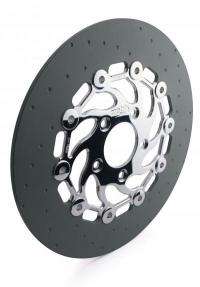
Within 12 months, NYU-Poly Associate Professor Nikhil Gupta and researchers of REL, Inc., expect to move beyond today's particle-reinforced brake rotors, such as this Matrix motorcycle rotor, to the prototype stage for a super-durable and lightweight fiber-reinforced composite for mass-market automobiles, military vehicles and heavy trucks. Credit: REL, Inc.
REL, Inc. teams with NYU-Poly to create lightweight, ultra durable automotive brake rotor
Researchers at the Polytechnic Institute of New York University (NYU-Poly) and Michigan-based REL, Inc., are creating a next-generation aluminum composite brake rotor potentially weighing 60 percent less than today's cast iron rotors with triple the life expectancy.
Due to expense, today's composite brakes have been reserved for motorcycles, race cars and high-performance sports cars, but this new, fiber reinforced, metal matrix composite (MMC) brake rotor aims at the mass market. It will be easier to manufacture, and the fiber reinforcements will provide longer life span.
The researchers also estimate that their composite rotor will shave approximately 30 pounds from a mid-size sedan a significant advantage in an industry facing fleet a fuel economy requirement of 54.5 miles per gallon by 2025.
REL, Inc., a developer of MMC transportation and aerospace components, received a $150,000 Phase I Small Business Innovation Research Grant from the National Science Foundation to develop the initial product design, material and manufacturing process. The company tapped the expertise of NYU-Poly Mechanical and Aerospace Engineering Associate Professor Nikhil Gupta and his Composites Materials and Mechanics Lab to develop the technology for automotive application. The collaboration will result in a prototype, first-of-its-kind rotor that may revolutionize a market valued at $10 billion annually.
Manufacturers have long sought to improve the durability and performance of automotive brakes, which are subject to tremendous temperature and pressure changes.
Gupta and REL are developing a one-piece brake rotor uniquely tailored to meet the extreme and variable temperature and loading conditions. Most of today's brake rotors are made of cast iron, which offers strength but at a cost of weight. Iron also doesn't adapt well to the demands placed on different sections of the rotor. A brake rotor has three functional zones, each of which requires a material with distinct strain and thermal properties to function optimally. Temperature and pressure changes across the rotor surface are a major cause of wear, warp and brake failure.
The team will replace the traditional rotor material with a high-temperature aluminum alloy reinforced with functionally graded ceramic particles and fibers to create a lightweight but extremely durable material that can be customized to best serve each section of the rotor.
"These functionally graded materials allow us to create the optimal composition for each part of the rotor," Gupta explained. "The hybrid material allows us to provide reinforcement where additional strength is needed, increase high-temperature performance, and minimize stress at the interfaces between the zones. Together, this should boost rotor life significantly, reducing warranty and replacement costs, and the weight savings will improve the vehicle's fuel efficiency."
"As auto companies strive to meet increasingly high efficiency and low emissions targets, there's a tremendous business opportunity in creating novel lightweight components which reduce overall vehicle weight and increase vehicle performance", said Adam Loukus, vice president of REL, Inc. "Professor Gupta is highly regarded in MMC research and analysis, and his expertise backed by the resources of NYU-Poly is an ideal complement to our goals for this exciting project."
"This is a valuable opportunity for our students to gain real-world business experience," Gupta added. "Working closely with the REL team, they will understand the demands of the automotive component development process."
In addition to the automotive market, the composite rotors may benefit military fleets, where up-armored vehicles operate at weights well above their design capacity. While the development of lightweight armor remains a long-term goal for the military, any weight savings on the vehicles themselves will immediately improve fleet efficiency, which can be critical to mission success where fuel delivery is difficult.
Gupta and the team at REL expect to complete a functional rotor prototype within 12 months.
Provided by Polytechnic Institute of New York University
-
Genetic and mechanistic basis for rotor syndrome uncovered
Jan 09, 2012 |
not rated yet |
0
-
NASA Tweaks Tech Toolbox to Capture Tricky Rotor Results
Jun 07, 2010 |
not rated yet |
0
-
A miracle diet for brake rotors: High-strength, high-temp aluminum
Oct 12, 2010 |
not rated yet |
0
-
Researchers build a tougher, lighter wind turbine blade
Aug 30, 2011 |
not rated yet |
0
-
Extreme testing for rotor blades
Apr 01, 2011 |
not rated yet |
0
-
Stars containing dark matter should look different from other stars
Feb 20, 2012 |
4.5 / 5 (17) |
11
-
Physicists discover evidence of rare hypernucleus, a component of strange matter
Feb 17, 2012 |
4.7 / 5 (38) |
22
-
Fast photon control brings quantum photonic technologies closer
Feb 13, 2012 |
5 / 5 (8) |
1
-
Engineers build first sub-10-nm carbon nanotube transistor
Feb 01, 2012 |
4.9 / 5 (36) |
32
-
Something old, something new: Evolution and the structural divergence of duplicate genes
Jan 31, 2012 |
4.6 / 5 (7) |
1
-
Calculating forces involved in seesaw motion
4 hours ago
-
Writing shear and moment equations for a simple beam problem?
5 hours ago
-
Furnace Shell Spray Cooling Design
21 hours ago
-
Ways to measure the speed of a golf ball?
Feb 21, 2012
-
Water Skin Effect in Plastic Pipe
Feb 21, 2012
-
Undergraduate Engineering Physics To Graduate Aerospace Engineering
Feb 21, 2012
- More from Physics Forums - General Engineering
More news stories
Stanford research team cracks animated NuCaptcha
(PhysOrg.com) -- The research team from Stanford University, led by Elie Bursztein, that previously had cracked regular CAPTCHAs and then audio CAPTCHAs, now has also successfully cracked the animated version called NuCapt ...
Tiny, implantable medical device can propel itself through bloodstream
Someday, your doctor may turn to you and say, "Take two surgeons and call me in the morning." If that day arrives, you may just have Ada Poon to thank.
17 hours ago |
5 / 5 (9) |
8
|
Italian engineer invents floating solar panels
Rays of the winter sun bounce off gleaming mirrors on the tiny lake of Colignola in Italy, where engineers have built a cost-effective prototype for floating, rotating solar panels.
Technology / Energy & Green Tech
21 hours ago |
4.7 / 5 (6) |
5
Microsoft hits Motorola, Google with EU complaint
Microsoft on Wednesday lodged a formal complaint with the European Union's competition regulator against Motorola Mobility and its soon-to-be owner Google, saying Motorola's aggressive enforcement of patent ...
17 hours ago |
2 / 5 (1) |
2
Calif. pledges better mobile privacy disclosures
(AP) -- Mobile applications seeking to collect personal information will have to forewarn users as part of an agreement reached in California.
9 hours ago |
not rated yet |
0
Researchers build first physical 'metatronic' circuit
(PhysOrg.com) -- The technological world of the 21st century owes a tremendous amount to advances in electrical engineering, specifically, the ability to finely control the flow of electrical charges using ...
Spitzer finds solid buckyballs in space
(PhysOrg.com) -- Astronomers using data from NASA's Spitzer Space Telescope have, for the first time, discovered buckyballs in a solid form in space. Prior to this discovery, the microscopic carbon spheres ...
Faster than light neutrinos? More like faulty wiring
You can shelf your designs for a warp drive engine (for now) and put the DeLorean back in the garage; it turns out neutrinos may not have broken any cosmic speed limits after all.
Physicists surprised by disappearing and reappearing superconductivity in iron selenium chalcogenides
Superconductivity is a rare physical state in which matter is able to conduct electricity -- maintain a flow of electrons -- without any resistance. This phenomenon can only be found in certain materials at low temperatures, ...
Going up: Japan builder eyes space elevator
A Japanese construction firm claimed Wednesday it could execute an out-of-this-world plan to put tourists in space within 40 years by building an elevator that stretches a quarter of the way to the moon.
Flesh-eating bacteria inspire superglue
(PhysOrg.com) -- A bio-inspired superglue has been developed by Oxford University researchers that cant be matched for sticking molecules together and not letting go.