January 25, 2012 feature
Study supports role of quantum effects in photosynthesis
(PhysOrg.com) -- Until a few years ago, photosynthesis seemed to be a straightforward and well-understood process in which plants and other organisms use sunlight to convert carbon dioxide and water into sugars, with oxygen as a waste product. But recent research showing that the light energy entering these organisms’ light-absorbing chromophore molecules may exist in two places at once – as a quantum superposition – has raised a new question: what role, if any, do quantum effects play in the vastly important and widespread process of photosynthesis?
So far, the subject has been one of great speculation. Other than the observations of coherent superpositions of light energy, researchers do not have any experimental evidence to show that such quantum effects play a functional role in photosynthesis.
Now in a new study, a team of researchers from the Swinburne University of Technology and the University of Melbourne, both in Victoria, Australia, and the University of New South Wales in Sydney, Australia, has offered some further support to the theoretical models that predict a quantum role in photosynthesis.
Quantum modeling
“Quantum effects have been predicted to play a role in the very early stages of photosynthesis where efficient energy transfer between chromophores is required,” Jeffrey Davis of the Swinburne University of Technology told PhysOrg.com. “The nature of quantum mechanics implies that energy can be reversibly transferred between states so long as everything remains coherent. As a result of this reversibility, quantum effects allow the initial excitation to explore different pathways for energy transfer.”
In this way, quantum coherence enables light energy to simultaneously investigate multiple pathways, and then choose the shortest, most efficient path, thereby leading to efficient energy transfer. But Davis also explains that it’s not as simple as it sounds, since complete coherence can actually do more harm than good.
“Interestingly, these models predict that a fully quantum mechanical system without decoherence would actually lead to a reduction in the energy transfer efficiency because the complete reversibility would mean that the energy doesn’t stay where it needs to go,” he explained. “As a result, some decoherence is required to ensure that once the energy gets where it needs to, it doesn’t go back. The models predict that with the right combination of coherent quantum effects to reversibly explore different pathways and decoherence to ensure the energy stays where it is needed, an optimal efficiency for energy transfer can be obtained.”
The observations made to date of the coherent superpositions of light energy in chromophores don’t yet provide sufficient evidence to show that these theories are correct. As Davis explains, experimental evidence would require testing the light transfer efficiency under different conditions.
“Previous studies have revealed the presence of long-lived coherent superpositions, an intrinsically quantum mechanical effect, but this does not necessarily mean that they play an important part in photosynthesis, or more specifically, the energy transfer processes,” he said. “Experimental evidence that quantum effects play a role in photosynthesis would need to demonstrate coherent and reversible energy transfer between states following the excitation of a single electronic transition. To ascertain the importance of that role, some comparison between the transfer efficiency with and without quantum effects (or with different amounts of decoherence) would be required.”
Singling out pathways
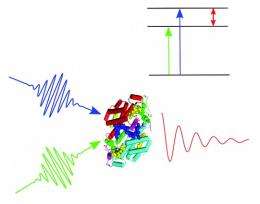
Although Davis and his coauthors have not detected such evidence in this study, they have provided further support for the argument that the long-lived quantum coherence observed previously is not merely a trivial phenomenon. To do this, the scientists used a new spectroscopy technique that, unlike previous techniques, allows them to investigate individual processes one at a time when they occur in the light-harvesting complexes of cryptophyte marine algae.
In contrast, the quantum coherence in the algae’s light-harvesting complexes was originally observed using 2D electronic spectroscopy, which uses short, broadband pulses to probe energy dynamics. The use of broadband pulses (i.e., pulses with a wide range of frequencies) excites many different pathways simultaneously. Although this technique can be useful, it also makes it difficult to isolate different processes since multiple excitations can interact and alter each other’s dynamics.
By using the newer, less common technique, called two-color photon echo spectroscopy, the researchers could excite only the pathway in which coherence occurs. Singling out this pathway revealed clear signatures for strong coupling between the electronic states and the vibrational modes of the protein matrix (phonons) in the algae’s light-harvesting complexes. As Davis explained, this type of interaction is not what is expected from the classical models that have traditionally been used to describe light harvesting and energy transfer in photosynthesis.
“Our observation of strong coupling between the electronic states and the phonon modes of the protein matrix provides strong experimental evidence that classical treatment of these interactions is not sufficient, and that models including the microscopic details of the coupling interactions are indeed required,” Davis said. “The quantum nature of these interactions increases the scope for quantum effects to have an impact and enhances the possibility of coherent energy transfer in photosynthesis.”
In the future, the researchers plan to further extend the technique to investigate these quantum mechanical interactions and the role they play in light harvesting and energy transfer.
“We are currently exploring the dependence of these coherent interactions on a number of experimental parameters, including temperature, wavelength and polarization,” Davis said. “These results will enable us to explore the nature of the excited states, their interactions with the phonon modes of the protein matrix and the role they play in energy transfer. We also plan to investigate whether such long-lived coherences also exist between other states in these systems and ultimately whether coherence transfer between states occurs and is relevant for photosynthesis.”
More information: G. H. Richards, et al. “Coherent Vibronic Coupling in Light-Harvesting Complexes from Photosynthetic Marine Algae.” The Journal of Physical Chemistry Letters, 2012, 3, 272-277. DOI: 10.1021/jz201600f
Copyright 2012 PhysOrg.com.
All rights reserved. This material may not be published, broadcast, rewritten or redistributed in whole or part without the express written permission of PhysOrg.com.


