Scientists use silk from the tasar silkworm as a scaffold for heart tissue
January 30, 2012
Scientists use silk from the tasar silkworm as a scaffold for heart tissue

Enlarge

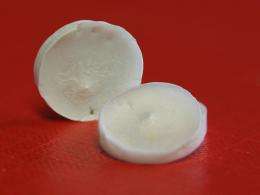
Disks cut from the cocoon of the tasar silkworm grub provide a basic scaffold for heart muscle cells. The disks are around the same size as cent coins. © MPI for Heart and Lung Research

(PhysOrg.com) -- Damaged human heart muscle cannot be regenerated. Scar tissue grows in place of the damaged muscle cells. Scientists from the Max Planck Institute for Heart and Lung Research in Bad Nauheim are seeking to restore complete cardiac function with the help of artificial cardiac tissue. They have succeeded in loading cardiac muscle cells onto a three-dimensional scaffold, created using the silk produced by a tropical silkworm.

Of all the body’s organs, the is probably the one most primed for performance and efficiency. Decade after decade, it continues to pump blood around our bodies. However, this performance optimisation comes at a high price: over the course of evolution, almost all of the body’s own regeneration mechanisms in the heart have become deactivated. As a result, a heart attack is a very serious event for patients; dead cardiac cells are irretrievably lost. The consequence of this is a permanent deterioration in the heart’s pumping power and in the patient’s quality of life.

In their attempt to develop a treatment for the repair of , scientists are pursuing the aim of growing replacement tissue in the laboratory, which could then be used to produce replacement patches for the repair of damaged cardiac muscle. The reconstruction of a three-dimensional structure poses a challenge here. Experiments have already been carried out with many different materials that could provide a substance for the loading of .

“Whether natural or artificial in origin, all of the tested fibres had serious disadvantages,” says Felix Engel, Research Group Leader at the Max Planck Institute for Heart and Lung Research in Bad Nauheim. “They were either too brittle, were attacked by the immune system or did not enable the heart muscle cells to adhere correctly to the fibres.” However, the scientists have now found a possible solution in Kharagpur, India.

At the university there, coin-sized disks are being produced from the cocoon of the tasar (Antheraea mylitta). According to Chinmoy Patra, an Indian scientist who now works in Engel’s laboratory, the fibre produced by the tasar silkworm displays several advantages over the other substances tested. “The surface has protein structures that facilitate the adhesion of heart muscle cells. It’s also coarser than other silk fibres.” This is the reason why the muscle cells grow well on it and can form a three-dimensional tissue structure. “The communication between the cells was intact and they beat synchronously over a period of 20 days, just like real ,” says Engel.

Despite these promising results, clinical application of the fibre is not currently on the agenda. “Unlike in our study, which we carried out using rat cells, the problem of obtaining sufficient human cardiac cells as starting material has not yet been solved,” says Engel. It is thought that the patient’s own stem cells could be used as starting material to avoid triggering an immune reaction. However, exactly how the conversion of the stem cells into cardiac muscle cells works remains a mystery.

More information: Chinmoy Patra, Sarmistha Talukdar, Tatyana Novoyatleva, Siva R. Velagala, Christian Mühlfeld, Banani Kundu, Subhas C. Kundu, Felix B. Engel
Silk protein fibroin from Antheraea mylitta for cardiac tissue engineering, Biomaterials, Advance Online Publication Januar 10, 2012

Provided by Max-Planck-Gesellschaft (news : web)


Rank not rated yet
Related Stories
Relevant PhysicsForums posts
  • heat-driven chemical reaction and thermodynamics
    created7 hours ago
  • phenol to benzene
    created11 hours ago
  • TQM, QA and QC
    created11 hours ago
  • oxidising power
    created18 hours ago
  • What can I use to make clear dish soap thicker?
    createdFeb 21, 2012
  • Can I use Le Châtelier's Principle to prove Henry's Law?
    createdFeb 21, 2012
  • More from Physics Forums - Chemistry

More news stories

Scientists create potent molecules aimed at treating muscular dystrophy

While RNA is an appealing drug target, small molecules that can actually affect its function have rarely been found. But now scientists from the Florida campus of The Scripps Research Institute have for the first time designed ...

Chemistry / Biochemistry

created 5 hours ago | popularity 5 / 5 (4) | comments 0 | with audio podcast

Flesh-eating bacteria inspire superglue

(PhysOrg.com) -- A bio-inspired superglue has been developed by Oxford University researchers that can’t be matched for sticking molecules together and not letting go.

Chemistry / Biochemistry

created 16 hours ago | popularity 5 / 5 (7) | comments 3 | with audio podcast

Researchers discover what cancer cells need to travel

(PhysOrg.com) -- Cancer cells must prepare for travel before invading new tissues, but new Cornell research has found a possible way to stop these cells from ever hitting the road.

Chemistry / Biochemistry

created 15 hours ago | popularity 4.9 / 5 (10) | comments 0 | with audio podcast

New microfluidic device could be used to diagnose and monitor cancer and other diseases

Separating complex mixtures of cells, such as those found in a blood sample, can offer valuable information for diagnosing and treating disease. However, it may be necessary to search through billions of other ...

Chemistry / Analytical Chemistry

created 15 hours ago | popularity 5 / 5 (2) | comments 0 | with audio podcast

New way to tap largest remaining treasure trove of potential new antibiotics

Scientists are reporting use of a new technology for sifting through the world's largest remaining pool of potential antibiotics to discover two new antibiotics that work against deadly resistant microbes, ...

Chemistry / Biochemistry

created 8 hours ago | popularity 5 / 5 (4) | comments 0


Researchers build first physical 'metatronic' circuit

(PhysOrg.com) -- The technological world of the 21st century owes a tremendous amount to advances in electrical engineering, specifically, the ability to finely control the flow of electrical charges using ...

Faster than light neutrinos? More like faulty wiring

You can shelf your designs for a warp drive engine (for now) and put the DeLorean back in the garage; it turns out neutrinos may not have broken any cosmic speed limits after all.

Spitzer finds solid buckyballs in space

(PhysOrg.com) -- Astronomers using data from NASA's Spitzer Space Telescope have, for the first time, discovered buckyballs in a solid form in space. Prior to this discovery, the microscopic carbon spheres ...

Physicists surprised by disappearing and reappearing superconductivity in iron selenium chalcogenides

Superconductivity is a rare physical state in which matter is able to conduct electricity -- maintain a flow of electrons -- without any resistance. This phenomenon can only be found in certain materials at low temperatures, ...

Less is more: Study of tiny droplets could have big impact on industrial applications

(PhysOrg.com) -- Under a microscope, a tiny droplet slides between two fine hairs like a roller coaster on a set of rails until — poof — it suddenly spreads along them, a droplet no more.

Stanford research team cracks animated NuCaptcha

(PhysOrg.com) -- The research team from Stanford University, led by Elie Bursztein, that previously had cracked regular CAPTCHAs and then audio CAPTCHAs, now has also successfully cracked the animated version called NuCapt ...