Space mountain produces terrestrial meteorites
January 2, 2012 by Dauna Coulter
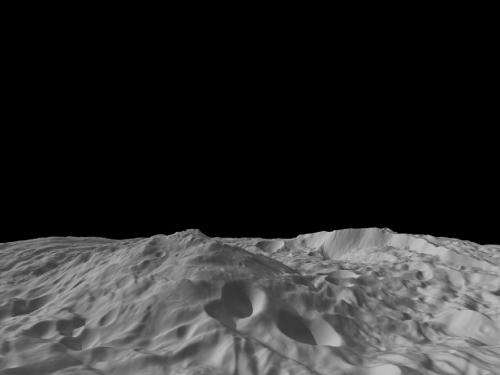
A side view of Vesta's great south polar mountain.
When NASA's Dawn spacecraft entered orbit around giant asteroid Vesta in July, scientists fully expected the probe to reveal some surprising sights. But no one expected a 13-mile high mountain, two and a half times higher than Mount Everest, to be one of them.
The existence of this towering peak could solve a longstanding mystery: How did so many pieces of Vesta end up right here on our own planet?
For many years, researchers have been collecting Vesta meteorites from "fall sites" around the world. The rocks' chemical fingerprints leave little doubt that they came from the giant asteroid. Earth has been peppered by so many fragments of Vesta, that people have actually witnessed fireballs caused by the meteoroids tearing through our atmosphere. Recent examples include falls near the African village of Bilanga Yanga in October 1999 and outside Millbillillie, Australia, in October 1960.
"Those meteorites just might be pieces of the basin excavated when Vesta's giant mountain formed," says Dawn PI Chris Russell of UCLA.
Russell believes the mountain was created by a 'big bad impact' with a smaller body; material displaced in the smashup rebounded and expanded upward to form a towering peak. The same tremendous collision that created the mountain might have hurled splinters of Vesta toward Earth.
"Some of the meteorites in our museums and labs," he says, "could be fragments of Vesta formed in the impact -- pieces of the same stuff the mountain itself is made of."
To confirm the theory, Dawn's science team will try to prove that Vesta's meteorites came from the mountain's vicinity. It's a "match game" involving both age and chemistry.
"Vesta formed at the dawn of the solar system," says Russell. "Billions of years of collisions with other space rocks have given it a densely cratered surface."
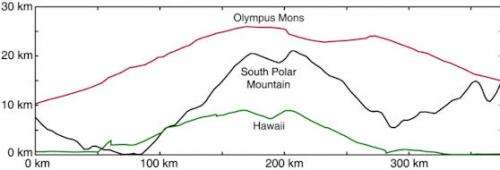
Cross-section of the south polar mountain on Vesta with the cross sections of Olympus Mons on Mars, the largest mountain in the solar system, and the Big lsland of Hawaii as measured from the floor of the Pacific, the largest mountain on Earth. These latter two mountains are both shield volcanoes.Credit: Russell et. al. (2011), EPSC
The surface around the mountain, however, is tellingly smooth. Russell believes the impact wiped out the entire history of cratering in the vicinity. By counting craters that have accumulated since then, researchers can estimate the age of the landscape."In this way we can figure out the approximate age of the mountain's surface. Using radioactive dating, we can also tell when the meteorites were 'liberated' from Vesta. A match between those dates would be compelling evidence of a meteorite-mountain connection."
For more proof, the scientists will compare the meteorites' chemical makeup to that of the mountain area.
"Vesta is intrinsically but subtly colorful. Dawn's sensors can detect slight color variations in Vesta's minerals, so we can map regions of chemicals and minerals that have emerged on the surface. Then we'll compare these colors to those of the meteorites."
Could an impact on Vesta really fill so many museum display cases on Earth? Stay tuned for answers.
Source: Science@NASA
-
New view of Vesta mountain from Dawn mission
Oct 11, 2011 |
not rated yet |
0
-
Image: Fresh impact craters on asteroid Vesta
Dec 09, 2011 |
not rated yet |
0
-
NASA's Dawn collects a bounty of beauty from Vesta
Sep 16, 2011 |
not rated yet |
0
-
The faces of Vesta (w/ video)
Jun 24, 2011 |
not rated yet |
0
-
Is Vesta the 'smallest terrestrial planet?'
Dec 12, 2011 |
not rated yet |
0
-
Stars containing dark matter should look different from other stars
Feb 20, 2012 |
4.5 / 5 (17) |
11
-
Physicists discover evidence of rare hypernucleus, a component of strange matter
Feb 17, 2012 |
4.7 / 5 (38) |
22
-
Fast photon control brings quantum photonic technologies closer
Feb 13, 2012 |
5 / 5 (8) |
1
-
Engineers build first sub-10-nm carbon nanotube transistor
Feb 01, 2012 |
4.9 / 5 (36) |
32
-
Something old, something new: Evolution and the structural divergence of duplicate genes
Jan 31, 2012 |
4.6 / 5 (7) |
1
-
Calculating the magnitude
2 hours ago
-
What is this spectrum I took?
12 hours ago
-
Orientation of Space
13 hours ago
-
Geologically Active Moon Now: NASA
20 hours ago
-
advice on building a science fair telescope
Feb 22, 2012
-
Rise of the Sun
Feb 22, 2012
- More from Physics Forums - General Astronomy
More news stories
Spitzer finds solid buckyballs in space
(PhysOrg.com) -- Astronomers using data from NASA's Spitzer Space Telescope have, for the first time, discovered buckyballs in a solid form in space. Prior to this discovery, the microscopic carbon spheres ...
14 hours ago |
4.7 / 5 (12) |
8
|
Going up: Japan builder eyes space elevator
A Japanese construction firm claimed Wednesday it could execute an out-of-this-world plan to put tourists in space within 40 years by building an elevator that stretches a quarter of the way to the moon.
Space & Earth / Space Exploration
21 hours ago |
3.5 / 5 (13) |
26
ENASA satellite finds Earth's clouds are getting lower
(PhysOrg.com) -- Earth's clouds got a little lower -- about one percent on average -- during the first decade of this century, finds a new NASA-funded university study based on NASA satellite data. The results ...
Space & Earth / Earth Sciences
18 hours ago |
5 / 5 (8) |
13
|
Fresh scandal embroils US climate science debate
A fresh scandal over climate change has erupted in the United States after leaked documents appeared to show a right-wing funded campaign to influence how climate science is taught in schools.
11 hours ago |
4.1 / 5 (9) |
8
World's oceans get an acid bath
Among the repercussions of global climate change, the effect of ocean acidification on marine life is one of the least-understood variables.
18 hours ago |
4.3 / 5 (6) |
4
|
Researchers build first physical 'metatronic' circuit
(PhysOrg.com) -- The technological world of the 21st century owes a tremendous amount to advances in electrical engineering, specifically, the ability to finely control the flow of electrical charges using ...
Faster than light neutrinos? More like faulty wiring
You can shelf your designs for a warp drive engine (for now) and put the DeLorean back in the garage; it turns out neutrinos may not have broken any cosmic speed limits after all.
Physicists surprised by disappearing and reappearing superconductivity in iron selenium chalcogenides
Superconductivity is a rare physical state in which matter is able to conduct electricity -- maintain a flow of electrons -- without any resistance. This phenomenon can only be found in certain materials at low temperatures, ...
Stanford research team cracks animated NuCaptcha
(PhysOrg.com) -- The research team from Stanford University, led by Elie Bursztein, that previously had cracked regular CAPTCHAs and then audio CAPTCHAs, now has also successfully cracked the animated version called NuCapt ...
Flesh-eating bacteria inspire superglue
(PhysOrg.com) -- A bio-inspired superglue has been developed by Oxford University researchers that cant be matched for sticking molecules together and not letting go.
Scientists create potent molecules aimed at treating muscular dystrophy
While RNA is an appealing drug target, small molecules that can actually affect its function have rarely been found. But now scientists from the Florida campus of The Scripps Research Institute have for the first time designed ...

Jan 02, 2012
Rank: 3.9 / 5 (11)
Astronomy is a great hobby and Vesta can be seen by amateur sky watchers with the right tools. Telescopes reveal much, even in this light polluted age.
Jan 02, 2012
Rank: 1.8 / 5 (19)
Jan 02, 2012
Rank: 3 / 5 (9)
I'm going to guess that the large impact on Vesta occurred during the LHB, 4.1-3.8GYa.
Jan 03, 2012
Rank: 5 / 5 (3)
You can actually link an article about an asteroid to global warming? Hard to believe.
Jan 03, 2012
Rank: 3.3 / 5 (3)
followed by this almost at the finish
Tells me that this entire piece is nothing but fiction.
Jan 03, 2012
Rank: not rated yet
Jan 03, 2012
Rank: 5 / 5 (1)
Actually, Vesta is special. It is gravitationally bound, meaning that it is a composite of many small parts held together by gravity, just like the Earth, Moon and Mars. Vesta is a layered body that formed just like a planet. I think you mis-understand how large it is. A person could not launch himself off of Vesta under his own power, like you could on Phobos, for example. You might be able to jump really high on Vesta, but you would still fall back down. Vesta actually has geological features from when it was active; rifts, volcanos, mountains, etc.
Escape velocity on Vesta is about 783 miles/hour, fyi.