Jumping spider uses fuzzy eyesight to judge distance
January 27, 2012 by Lin Edwards
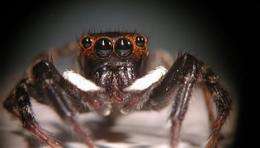
Anterior view of the jumping spider, Hasarius adansoni. A pair of principal eyes is located at the anteromedial area of the body, lying between two lateral eyes. Image © Science/AAAS
(PhysOrg.com) -- One of the ways in which humans determine distance is by estimating the sharpness of an imagecloser objects produce a sharp image, while those further away are out of focus. For us, this is a minor additional method of judging distance, but now scientists in Japan have for the first time found an animal that appears to use this method as its primary means of depth perception.
Adansons jumping spider (Hasarius adansoni) captures prey by jumping from a distance. The question that has puzzled scientists is, how do their eyes allow them to perceive depth? Their front eyes do not give them the two distinct but overlapping views needed for binocular vision, used by humans. They also do not use the motion parallax many insects use, since their head remains motionless when they are about to jump. (Motion parallax is a system in which the animal moves its head from side to side so that close objects move further across the field of view than those further away.) Now the new study reveals that the spiders use an image defocus system to enable them to judge distances.
Adansons jumping spider has excellent eyesight, provided by eight eyes: a pair of primary eyes (large and at the front), two anterior lateral eyes, one at either side of the primary eyes and also facing forward, and two smaller pairs of eyes on the top of their heads, one of which is almost undetectable by the naked eye.
The research team, led by Takashi Nagata, from Osaka City University, blocked the anterior lateral pair of eyes of the jumping spider and found that they use this smaller pair of eyes to detect motion, but blocking their vision had no effect on the spiders ability to judge distance.
It has been known since the 1980s that the retinas in the principal eyes in jumping spiders have a unique structure that is shaped like a staircase, and they contain four layers of photoreceptors rather than one layer, as human eyes have. The new study revealed that the two deeper retinal layers contain pigments sensitive to green light and the two layers closest to the surface contain pigments sensitive to ultraviolet light. Of the two layers most sensitive to green light, only the deepest receives focused images, and the other receives an out of focus image.
To test the idea that the spiders could judge depth from the amount of defocus in the second green pigment layer, the researchers placed spiders one at a time in a container, along with some fruit flies and then tested their ability to catch the flies under red and green lights.
The results showed that green light was necessary for accuracy since the spiders were able to judge their jumps successfully in green light, but often misjudged in red light (which does not contain the shorter wavelength green light). The researchers also created a mathematical model to predict how far off the jumps would be under different wavelengths of light, and found that the model did accurately predict the spiders performance.
The researchers concluded that the spiders were indeed using the extent of defocus in the second green pigment layer of the retina to judge distance, and they are the only known animals to use this system as their primary means of depth perception. Since other jumping spiders have the same type of retina, they may also use the same method.
In a paper published in the journal Science, the researchers conclude that further study of the vision system used by jumping spiders is necessary and that it could have applications in robotic and other computer vision systems.
More information: Depth Perception from Image Defocus in a Jumping Spider, Science 27 January 2012: Vol. 335 no. 6067 pp. 469-471. DOI:10.1126/science.1211667
ABSTRACT
The principal eyes of jumping spiders have a unique retina with four tiered photoreceptor layers, on each of which light of different wavelengths is focused by a lens with appreciable chromatic aberration. We found that all photoreceptors in both the deepest and second-deepest layers contain a green-sensitive visual pigment, although green light is only focused on the deepest layer. This mismatch indicates that the second-deepest layer always receives defocused images, which contain depth information of the scene in optical theory. Behavioral experiments revealed that depth perception in the spider was affected by the wavelength of the illuminating light, which affects the amount of defocus in the images resulting from chromatic aberration. Therefore, we propose a depth perception mechanism based on how much the retinal image is defocused.
© 2011 PhysOrg.com
-
The eyes have it for perfect predator
Jul 09, 2010 |
not rated yet |
0
-
Biologist tracks spiders’ eyes to learn how tiny brains process information
Oct 26, 2010 |
not rated yet |
0
-
Bigger, scarier weapons help spiders get the girl (w/ video)
Dec 12, 2011 |
not rated yet |
0
-
Scans capture spider's heart beat
Jul 07, 2011 |
not rated yet |
0
-
Researchers develop optimal algorithm for determining focus error in eyes and cameras
Sep 26, 2011 |
not rated yet |
0
-
Stars containing dark matter should look different from other stars
Feb 20, 2012 |
4.5 / 5 (17) |
11
-
Physicists discover evidence of rare hypernucleus, a component of strange matter
Feb 17, 2012 |
4.7 / 5 (38) |
22
-
Fast photon control brings quantum photonic technologies closer
Feb 13, 2012 |
5 / 5 (8) |
1
-
Engineers build first sub-10-nm carbon nanotube transistor
Feb 01, 2012 |
4.9 / 5 (36) |
32
-
Something old, something new: Evolution and the structural divergence of duplicate genes
Jan 31, 2012 |
4.6 / 5 (7) |
1
-
Flowering Plant Revived After 30,000 Years in Permafrost
Feb 21, 2012
-
Toba volcano eruptions - 1.000 - 10,000 breeding pairsunb
Feb 20, 2012
-
How is a specific gene removed from DNA
Feb 20, 2012
-
Reproduction and Human evolution
Feb 19, 2012
-
Viruses: Living or Non-living organisms
Feb 19, 2012
-
Would you eat brainless animals?
Feb 16, 2012
- More from Physics Forums - Biology
More news stories
Surprising diversity at a synapse hints at complex diversity of neural circuitry
A new study reveals a dazzling degree of biological diversity in an unexpected place a single neural connection in the body wall of flies.
8 hours ago |
5 / 5 (4) |
0
|
Men might not 'become extinct' after all: Theory of the 'rotting' Y chromosome dealt a fatal blow
If you were to discover that a fundamental component of human biology has survived virtually intact for the past 25 million years, you'd be quite confident in saying that it is here to stay.
11 hours ago |
5 / 5 (6) |
1
|
Climate change affects bird migration timing in North America
Bird migration timing across North America has been affected by climate change, according to a study published Feb. 22 in the open access journal PLoS ONE.
7 hours ago |
4.5 / 5 (2) |
2
New family of legless amphibians found in India
Since before the age of dinosaurs it has burrowed unbothered beneath the monsoon-soaked soils of remote northeast India - unknown to science and mistaken by villagers as a deadly, miniature snake.
18 hours ago |
5 / 5 (8) |
3
New iridescent lizard species found in Cambodia
A new species of lizard with striking iridescent rainbow skin, a long tail and very short legs has been discovered in the rainforest in northeast Cambodia, conservationists announced Wednesday.
7 hours ago |
not rated yet |
0
CT colonography shown to be comparable to standard colonoscopy
Computerized tomographic (CT) colonography (CTC), also known as virtual colonoscopy, is comparable to standard colonoscopy in its ability to accurately detect cancer and precancerous polyps in people ages 65 and older, according ...
Study: Virtual colonoscopy effective screening tool for adults over 65
Computed tomography (CT) colonography can be used as a primary screening tool for colorectal cancer in adults over the age of 65, according to a new study published online in the journal Radiology.
Researchers build first physical 'metatronic' circuit
(PhysOrg.com) -- The technological world of the 21st century owes a tremendous amount to advances in electrical engineering, specifically, the ability to finely control the flow of electrical charges using ...
Spitzer finds solid buckyballs in space
(PhysOrg.com) -- Astronomers using data from NASA's Spitzer Space Telescope have, for the first time, discovered buckyballs in a solid form in space. Prior to this discovery, the microscopic carbon spheres ...
Faster than light neutrinos? More like faulty wiring
You can shelf your designs for a warp drive engine (for now) and put the DeLorean back in the garage; it turns out neutrinos may not have broken any cosmic speed limits after all.
Physicists surprised by disappearing and reappearing superconductivity in iron selenium chalcogenides
Superconductivity is a rare physical state in which matter is able to conduct electricity -- maintain a flow of electrons -- without any resistance. This phenomenon can only be found in certain materials at low temperatures, ...
Jan 27, 2012
Rank: 1 / 5 (4)
Jan 27, 2012
Rank: 2.8 / 5 (4)
Jan 27, 2012
Rank: not rated yet
Espicially effective against centipedes, who can never remember which leg they put their watch on that morning.
Jan 27, 2012
Rank: 3.7 / 5 (3)
That's because spiders aren't insects. They're arachnids.
Same phylum (arthropod), different class.
Jan 27, 2012
Rank: 1 / 5 (1)
http://arthropoda...hart.jpg
Jan 28, 2012
Rank: 5 / 5 (1)
Jan 28, 2012
Rank: 1 / 5 (1)
Jan 28, 2012
Rank: 3 / 5 (1)
Binocular vision requires that the eyes are parted by a significant distance.
Our eyes are some inches apart, and we see depth that way up to maybe ten yards. After that it becomes increasingly inaccurate to judge distances that way, because the angular resolution of the eye is roughly 1/60th of a degree and the differences in the two images become too small to notice.
The spider's eyes are millimeters apart, which makes binocular vision ineffective beyond an inch or so. It may see with stereo vision, but only in the near field.
Jan 28, 2012
Rank: 2 / 5 (1)
The jumping spider can't turn its eyes. It can move the retina about a little instead, but the lens is fixed.
Jan 31, 2012
Rank: not rated yet
For example, the spider may use blur differences between the green retinas for very short distances, where binocular vision without turning eyes would require extensive neural networks a small spider can't afford. At longer distances, blur becomes a very inaccurate method. Stereo vision should be very usable between 2 to a dozen inches.
Ability to turn the eyes is not needed for stereo vision. (You know where nearby objects are even while looking at a distant mountaintop.) Nature doesn't support useless body parts, so, without stereo vision, the spider would have one bigger eye instead, like the octopus.
What biology needs, is due diligence, attention, and thinking.
Jan 31, 2012
Rank: not rated yet
An illustration on the Wikipedia page seems to show that the principal eyes do not have overlapping vision, which does exclude stereoscopic vision. However, the small front eyes do overlap. Considering the fields of the other small eyes reach each other exactly and without overlap, this frontal overlap has to be "on purpose", which would indicate coarse-grain and quick stereoscopy. (This is not studied in either paper.)
Jan 31, 2012
Rank: not rated yet
Chapter 4 (pp. 13-18) describes jumping spider vision. In essence, the small front eyes are used for stereoscopic vision and distance measurement, and the large front eyes are used as telescopes, and can look in independent directions, a little like a chameleon's eyes.
After all this, I feel Mr. Nagata is both sloppy and ignorant.