Light but stable: novel cellulose-silica gel composite aerogels
January 27, 2012
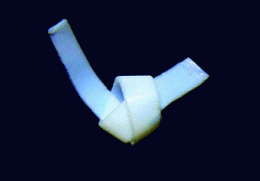
(PhysOrg.com) -- Delicate and translucent as a puff of air, yet mechanically stable, flexible, and possessing amazing heat-insulation propertiesthese are the properties of a new aerogel made of cellulose and silica gel. Researchers led by Jie Cai have introduced this novel material, which consists almost completely of air, in the journal Angewandte Chemie.
Gels are familiar to us in forms like Jell-O or hair gel. A gel is a loose molecular network that holds liquids within its cavities. Unlike a sponge, it is not possible to squeeze the liquid out of a gel. An aerogel is a gel that holds air instead of a liquid. For example, aerogels made from silicon dioxide may consist of 99.98 % air-filled pores. This type of material is nearly as light as air and is translucent like solidified smoke. In addition, it is not flammable and is a very good insulatoreven at high temperatures. One prominent application for aerogels was the insulation used on space shuttles. Because of their extremely high inner surface area, aerogels are also potential supports for catalysts or pharmaceuticals. Silica-based aerogels are also nontoxic and environmentally friendly.
One drawback, however, has limited the broader application of these airy materials: silica-based aerogels are very fragile, and thus require some reinforcement. In addition to reinforcement with synthetic polymers, biocompatible materials like cellulose are also under consideration.
The researchers at Wuhan University (China) and the University of Tokyo (Japan) have now developed a special composite aerogel from cellulose and silicon dioxide. They begin by producing a cellulose gel from an alkaline urea solution. This causes the cellulose to dissolve, and to regenerate to form a nanofibrillar gel. The cellulose gel then acts as a scaffold for the silica gel prepared by a standard solgel process, in which a dissolved organosilicate precursor is cross-linked, gelled, and deposited onto the cellulose nanofibers. The resulting liquid-containing composite gel is then dried with supercritical carbon dioxide to make an aerogel.
The novel composite aerogel demonstrates an interesting combination of advantageous properties: mechanical stability, flexibility, very low thermal conductivity, semitransparency, and biocompatibility. If required, the cellulose part can be removed through combustion, leaving behind a silicon dioxide aerogel. The researchers are optimistic: "Our new method could be a starting point for the synthesis of many new porous materials with superior properties, because it is simple and the properties of the resulting aerogels can be varied widely."
More information: Jie Cai, CelluloseSilica Nanocomposite Aerogels by In Situ Formation of Silica in Cellulose Gel, Angewandte Chemie International Edition, http://dx.doi.org/ … ie.201105730
-
Polymer-reinforced aerogel found resilient for space missions
Apr 11, 2011 |
not rated yet |
0
-
Penn Physicists Develop a Carbon Nanotube Aeroegel Optimizing Strength, Shape and Conductivity
May 16, 2007 |
not rated yet |
0
-
Advanced carbon aerogels for energy applications
Mar 15, 2011 |
not rated yet |
0
-
New 'frozen smoke' material: One ounce could carpet three football fields
Jan 12, 2011 |
not rated yet |
0
-
Carbon Nanotube Artificial Muscles for Extreme Temperatures
Mar 20, 2009 |
not rated yet |
0
-
Stars containing dark matter should look different from other stars
Feb 20, 2012 |
4.5 / 5 (17) |
11
-
Physicists discover evidence of rare hypernucleus, a component of strange matter
Feb 17, 2012 |
4.7 / 5 (38) |
22
-
Fast photon control brings quantum photonic technologies closer
Feb 13, 2012 |
5 / 5 (8) |
1
-
Engineers build first sub-10-nm carbon nanotube transistor
Feb 01, 2012 |
4.9 / 5 (36) |
32
-
Something old, something new: Evolution and the structural divergence of duplicate genes
Jan 31, 2012 |
4.6 / 5 (7) |
1
-
Cis-trans Selectivity in Wittig Reactions
4 hours ago
-
Chemical Kinetics
4 hours ago
-
heat-driven chemical reaction and thermodynamics
11 hours ago
-
phenol to benzene
15 hours ago
-
TQM, QA and QC
15 hours ago
-
oxidising power
22 hours ago
- More from Physics Forums - Chemistry
More news stories
Flesh-eating bacteria inspire superglue
(PhysOrg.com) -- A bio-inspired superglue has been developed by Oxford University researchers that cant be matched for sticking molecules together and not letting go.
21 hours ago |
5 / 5 (8) |
3
|
Scientists create potent molecules aimed at treating muscular dystrophy
While RNA is an appealing drug target, small molecules that can actually affect its function have rarely been found. But now scientists from the Florida campus of The Scripps Research Institute have for the first time designed ...
10 hours ago |
5 / 5 (4) |
0
|
Researchers discover what cancer cells need to travel
(PhysOrg.com) -- Cancer cells must prepare for travel before invading new tissues, but new Cornell research has found a possible way to stop these cells from ever hitting the road.
20 hours ago |
4.9 / 5 (12) |
0
|
New microfluidic device could be used to diagnose and monitor cancer and other diseases
Separating complex mixtures of cells, such as those found in a blood sample, can offer valuable information for diagnosing and treating disease. However, it may be necessary to search through billions of other ...
Chemistry / Analytical Chemistry
20 hours ago |
5 / 5 (2) |
0
|
New way to tap largest remaining treasure trove of potential new antibiotics
Scientists are reporting use of a new technology for sifting through the world's largest remaining pool of potential antibiotics to discover two new antibiotics that work against deadly resistant microbes, ...
13 hours ago |
5 / 5 (4) |
0
Researchers build first physical 'metatronic' circuit
(PhysOrg.com) -- The technological world of the 21st century owes a tremendous amount to advances in electrical engineering, specifically, the ability to finely control the flow of electrical charges using ...
Spitzer finds solid buckyballs in space
(PhysOrg.com) -- Astronomers using data from NASA's Spitzer Space Telescope have, for the first time, discovered buckyballs in a solid form in space. Prior to this discovery, the microscopic carbon spheres ...
Faster than light neutrinos? More like faulty wiring
You can shelf your designs for a warp drive engine (for now) and put the DeLorean back in the garage; it turns out neutrinos may not have broken any cosmic speed limits after all.
Physicists surprised by disappearing and reappearing superconductivity in iron selenium chalcogenides
Superconductivity is a rare physical state in which matter is able to conduct electricity -- maintain a flow of electrons -- without any resistance. This phenomenon can only be found in certain materials at low temperatures, ...
Stanford research team cracks animated NuCaptcha
(PhysOrg.com) -- The research team from Stanford University, led by Elie Bursztein, that previously had cracked regular CAPTCHAs and then audio CAPTCHAs, now has also successfully cracked the animated version called NuCapt ...
Going up: Japan builder eyes space elevator
A Japanese construction firm claimed Wednesday it could execute an out-of-this-world plan to put tourists in space within 40 years by building an elevator that stretches a quarter of the way to the moon.
Jan 31, 2012
Rank: not rated yet