January 11, 2012 feature
Light control technique could lead to tunable lighting and displays
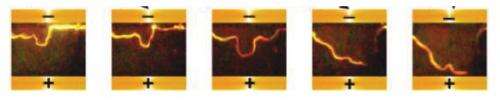
(PhysOrg.com) -- Over the past several years, organic light-emitting diodes (OLEDs) have become a popular light source due to their advantages including bright displays, wide viewing angles, and the ability to be printed on flexible substrates. A lesser known alternative to OLEDs, which has these advantages plus some additional ones such as low turn-on voltage, is electrochemical light-emitting cells (LECs). In a recent study, scientists have merged LECs with transistors to create light-emitting electrochemical transistors (LECTs), and for the first time have demonstrated that the light-emitting zone of these devices can be spatially controlled.
The scientists, Jiang Liu, Isak Engquist, Xavier Crispin, and Magnus Berggren from Linkoping University in Norrkoping, Sweden, have published their study in a recent issue of the Journal of the American Chemical Society.
As the scientists explain in their study, OLEDs have previously been combined with organic field-effect transistors to yield organic light-emitting transistors. Researchers have even achieved spatial control of these transistors’ light-emitting zones – that is, they can change the location from which light is emitted. But although researchers have combined LECs with organic transistors, they have not yet achieved spatial control of the light-emitting zone, until now. As the scientists explain, spatial control is advantageous in LECs because it could lead to easy implementation in matrix-addressed displays as well as the potential possibility to tune the LECs’ color.
The key to spatially controlling the light in an LEC lies in controlling the position of the p-n junction, which is where light is emitted. The p-n junction forms when a voltage is applied, which causes ions to migrate toward the device’s electrodes, leading to p- and n-doped regions. At the place where the doped regions meet – the p-n junction – the charge carriers (holes and electrons) recombine, emitting light.
Here, the researchers designed a three-electrode device, in which the p-n junction is located between the cathode (negative electrode) and anode (positive electrode). The third electrode (gate electrode), which is made of an ion-reactive polymer, controls the position of the p-n junction by controlling the ion distribution. For instance, in normal emission mode, a voltage is applied between the cathode and anode, so that p- and n-doping occur simultaneously and counterbalance each other, and the p-n junction is in the middle.
In n-doping mode, a positive voltage is applied between the gate and cathode, which sends more ions toward the cathode and shifts the p-n junction toward the anode. In contrast, in p-doping mode, a negative voltage is applied between the gate and anode. This has the reverse effect, sending more ions toward the anode and shifting the p-n junction toward the cathode.
All in all, the p-n junction can be moved back and forth within the 500-micrometer gap between the cathode and anode. This ability could offer the possibility of modulating the light output characteristics of light sources and display devices.
“[Potential applications of spatial control include] controlling the color (assuming that different colors are distributed laterally along the area between the two electrodes),” Berggren told PhysOrg.com. “Also, perhaps improving the lifetime by making sure that light generation is produced far from the charge-injecting electrodes. Light modulation, in-coupling of light into fibers, etc., is another possibility.”
Berggren also predicted that LECs may one day occupy a place alongside OLEDs in future lighting technology.
“The lifetime and overall performance of LECs are typically behind those of OLEDs,” he said. “However, there is a possibility for more easily produced light emitters and also more robust devices with LECs as compared to OLEDs. My guess is that LECs have a future as light sources while OLEDs are more suitable for displays.”
More information: Jiang Liu, et al. “Spatial Control of p-n Junction in an Organic Light-Emitting Electrochemical Transistor.” Journal of the American Chemical Society. DOI: 10.1021/ja210936n
Journal information: Journal of the American Chemical Society
Copyright 2012 PhysOrg.com.
All rights reserved. This material may not be published, broadcast, rewritten or redistributed in whole or part without the express written permission of PhysOrg.com.


