System to deliver organ transplant drug -- without harmful side effects
January 26, 2012
System to deliver organ transplant drug -- without harmful side effects

Enlarge

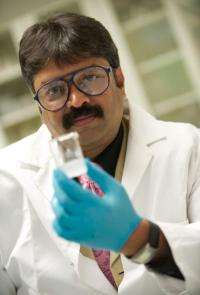
This is professor Ravi Kumar of the University of Strathclyde. Credit: University of Strathclyde

A new system for delivering a drug to organ transplant patients, which could avoid the risk of harmful side effects, is being developed by scientists at the University of Strathclyde in Glasgow.

The drug, (CsA), is widely used in transplant operations and helps prevent the patient's body rejecting the organ but it can cause , of which the most serious problems are kidney and , in the doses which are currently administered in the long term.

The gap between a safe, effective dose of the treatment and a toxic dose is extremely narrow but the Strathclyde scientists have found a way of capturing CsA in very small amounts. The new system, developed in , enables nanoparticles of the drug to be delivered orally so that the strength of the dose can be maintained, but at a level and in a form which spares kidneys from damage.

Professor Ravi Kumar, of the Strathclyde Institute of Pharmacy and , led the research. He said: "CsA is very useful in transplants and treating conditions such as arthritis, lupus and some forms of diabetes, but we need to address the risks it can present to the kidney and liver, apart from various other toxicities such as and .

"The damage it can cause can be dealt with if it's caught at an early stage but can be irreversible if it continues unchecked. Furthermore, existing formulations of cyclosporine contain castor oil-based vehicle which is used owing to the drug's poor solubility in water but which can be toxic.

"By entrapping CsA in nanoparticles, we aimed to match the maximum concentration of the most potent formulation of the drug in market. In tests, we were able to strike a balance between strength, efficacy and safety and were able to make a marked increase in the drug's bioavailability- the level of the drug which becomes active in the system.

"We were also able to reduce the on the kidneys by slow release of the nanoparticles, which brought the drug gradually to its maximum concentration.

"As well as its use in transplants, we hope to look into the effectiveness of this system with arthritis and address what is a hugely debilitating condition for many people."

The research paper has been published in the Journal of Biomedical Nanotechnology.

Further current research is aimed at proving the therapeutic efficacy and long-term safety of cyclosporine, with a special focus on the safety of carriers- polymers used in the formulation- to fulfil regulatory requirements. The safety studies element of the research has been funded by the Cunningham Trust Scotland and will conclude early in 2013.

The research forms part of Health Technologies at Strathclyde- one of the principal themes of the University's Technology and Innovation Centre (TIC), a world-leading research and technology centre transforming the way universities, business and industry collaborate.

Through Health Technologies at Strathclyde, academics work with industry and the health sector to find technologies for earlier, more accurate disease detection and better treatments, as well as life-long disease prevention.

Provided by University of Strathclyde


Rank 5 /5 (1 vote)
Related Stories
Relevant PhysicsForums posts
  • Eye biology videos
    created4 hours ago
  • Flowering Plant Revived After 30,000 Years in Permafrost
    createdFeb 21, 2012
  • Toba volcano eruptions - 1.000 - 10,000 breeding pairsunb
    createdFeb 20, 2012
  • How is a specific gene removed from DNA
    createdFeb 20, 2012
  • Reproduction and Human evolution
    createdFeb 19, 2012
  • Viruses: Living or Non-living organisms
    createdFeb 19, 2012
  • More from Physics Forums - Biology

More news stories

New nanotechnology converts heat into power when it's needed most

Never get stranded with a dead cell phone again. A promising new technology called Power Felt, a thermoelectric device that converts body heat into an electrical current, soon could create enough juice to make another call ...

Nanotechnology / Nanophysics

created 17 hours ago | popularity 4 / 5 (8) | comments 6 | with audio podcast

Researchers discover how different nanomaterial surfaces affect proteins

A new study led by nanotechnology and biotechnology experts at Rensselaer Polytechnic Institute is providing important details on how proteins in our bodies interact with nanomaterials. In their new study, published in the ...

Nanotechnology / Bio & Medicine

created 10 hours ago | popularity 5 / 5 (2) | comments 1 | with audio podcast

Graphene is thinnest known anti-corrosion coating

New research has established the "miracle material" called graphene as the world's thinnest known coating for protecting metals against corrosion. Their study on this potential new use of graphene appears ...

Nanotechnology / Nanomaterials

created 13 hours ago | popularity 4.6 / 5 (7) | comments 2 | with audio podcast

New technique produces free-standing piezoelectric ferroelectric nanostructures from PZT material

(PhysOrg.com) -- Researchers have developed a “soft template infiltration” technique for fabricating free-standing piezoelectrically active ferroelectric nanotubes and other nanostructures from PZT ...

Nanotechnology / Nanophysics

created 17 hours ago | popularity 5 / 5 (5) | comments 4 | with audio podcast

A new twist on nanowires

Nanowires — microscopic fibers that can be “grown” in the lab — are a hot research topic today, with a variety of potential applications including light-emitting diodes (LEDs) and sensors. ...

Nanotechnology / Nanophysics

created 19 hours ago | popularity 4.8 / 5 (4) | comments 0 | with audio podcast


Researchers build first physical 'metatronic' circuit

(PhysOrg.com) -- The technological world of the 21st century owes a tremendous amount to advances in electrical engineering, specifically, the ability to finely control the flow of electrical charges using ...

Spitzer finds solid buckyballs in space

(PhysOrg.com) -- Astronomers using data from NASA's Spitzer Space Telescope have, for the first time, discovered buckyballs in a solid form in space. Prior to this discovery, the microscopic carbon spheres ...

Faster than light neutrinos? More like faulty wiring

You can shelf your designs for a warp drive engine (for now) and put the DeLorean back in the garage; it turns out neutrinos may not have broken any cosmic speed limits after all.

Physicists surprised by disappearing and reappearing superconductivity in iron selenium chalcogenides

Superconductivity is a rare physical state in which matter is able to conduct electricity -- maintain a flow of electrons -- without any resistance. This phenomenon can only be found in certain materials at low temperatures, ...

CT colonography shown to be comparable to standard colonoscopy

Computerized tomographic (CT) colonography (CTC), also known as virtual colonoscopy, is comparable to standard colonoscopy in its ability to accurately detect cancer and precancerous polyps in people ages 65 and older, according ...

Stanford research team cracks animated NuCaptcha

(PhysOrg.com) -- The research team from Stanford University, led by Elie Bursztein, that previously had cracked regular CAPTCHAs and then audio CAPTCHAs, now has also successfully cracked the animated version called NuCapt ...