Unprecedented, man-made trends in ocean's acidity

January 22, 2012
These are yellow tangs frolicking among corals. Credit: Dwayne Meadows, NOAA
Recent carbon dioxide emissions have pushed the level of seawater acidity far above the range of the natural variability that existed for thousands of years, affecting the calcification rates of shell-forming organism. These findings by an international team of scientists appear in the Jan. 22 online issue of Nature Climate Change.
Nearly one-third of CO2 emissions due to human activities enters the world's oceans. By reacting with seawater, CO2 increases the water's acidity, which may significantly reduce the calcification rate of such marine organisms as corals and mollusks. The extent to which human activities have raised the surface level of acidity, however, has been difficult to detect on regional scales because it varies naturally from one season and one year to the next, and between regions, and direct observations go back only 30 years.
Combining computer modeling with observations, an international team of scientists concluded that anthropogenic CO2 emissions over the last 100 to 200 years have already raised ocean acidity far beyond the range of natural variations. The study is published in the January 22 online issue of Nature Climate Change.
The team of climate modelers, marine conservationists, ocean chemists, biologists and ecologists, led by Tobias Friedrich and Axel Timmermann at the International Pacific Research Center, University of Hawaii at Manoa, came to their conclusions by using Earth system models that simulate climate and ocean conditions 21,000 years back in time, to the Last Glacial Maximum, and forward in time to the end of the 21st century. They studied in their models changes in the saturation level of aragonite (a form of calcium carbonate) typically used to measure of ocean acidification. As acidity of seawater rises, the saturation level of aragonite drops. Their models captured well the current observed seasonal and annual variations in this quantity in several key coral reef regions.
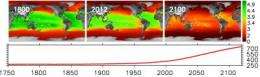
The upper panels shows simulated surface aragonite saturation for the years 1800, 2012 and 2100, respectively. White dots indicate present-day main coral reef locations. The lower panels shows atmospheric CO2 concentration in parts per million simulated for the years 1750 to 2100. Credit: Tobias Friedrich
Today's levels of aragonite saturation in these locations have already dropped five times below the pre-industrial range of natural variability. For example, if the yearly cycle in aragonite saturation varied between 4.7 and 4.8, it varies now between 4.2 and 4.3, which based on another recent study may translate into a decrease in overall calcification rates of corals and other aragonite shell-forming organisms by 15%. Given the continued human use of fossil fuels, the saturation levels will drop further, potentially reducing calcification rates of some marine organisms by more than 40% of their pre-industrial values within the next 90 years.
"Any significant drop below the minimum level of aragonite to which the organisms have been exposed to for thousands of years and have successfully adapted will very likely stress them and their associated ecosystems," says lead author Postdoctoral Fellow Tobias Friedrich.
"In some regions, the man-made rate of change in ocean acidity since the Industrial Revolution is hundred times greater than the natural rate of change between the Last Glacial Maximum and pre-industrial times," emphasizes Friedrich. "When Earth started to warm 17,000 years ago, terminating the last glacial period, atmospheric CO2 levels rose from 190 parts per million (ppm) to 280 ppm over 6,000 years. Marine ecosystems had ample time to adjust. Now, for a similar rise in CO2 concentration to the present level of 392 ppm, the adjustment time is reduced to only 100 200 years."
On a global scale, coral reefs are currently found in places where open-ocean aragonite saturation reaches levels of 3.5 or higher. Such conditions exist today in about 50% of the ocean mostly in the tropics. By end of the 21st century this fraction is projected to be less than 5%. The Hawaiian Islands, which sit just on the northern edge of the tropics, will be one of the first to feel the impact.
The study suggests that some regions, such as the eastern tropical Pacific, will be less stressed than others because greater underlying natural variability of seawater acidity helps to buffer anthropogenic changes. The aragonite saturation in the Caribbean and the western Equatorial Pacific, both biodiversity hotspots, shows very little natural variability, making these regions particularly vulnerable to human-induced ocean acidification.
"Our results suggest that severe reductions are likely to occur in coral reef diversity, structural complexity and resilience by the middle of this century," says co-author Professor Axel Timmermann."
More information: T. Friedrich, A. Timmermann, A. Abe-Ouchi, N. R. Bates, M. O. Chikamoto, M. J. Church, J. E. Dore, D. K. Gledhill, M. González-Dávila, M. Heinemann, T. Ilyina, J. H. Jungclaus, E. McLeod, A. Mouchet, and J. M. Santana-Casiano: Detecting regional anthropogenic trends in ocean acidification against natural variability. Nature Climate Change, DOI: 10.1038/NCLIMATE1372
Provided by University of Hawaii
-
Modest CO2 cutbacks may be too little, too late for coral reefs
Sep 22, 2008 |
not rated yet |
0
-
Scientist creates new hypothesis on ocean acidification
Aug 30, 2011 |
not rated yet |
0
-
Ocean acidification threatens cold-water coral ecosystems
Apr 03, 2006 |
not rated yet |
0
-
Increased acidity not an even test for coral reefs
Nov 10, 2011 |
not rated yet |
0
-
Ocean acidification will likely reduce diversity, resiliency in coral reef ecosystems: new study
May 29, 2011 |
not rated yet |
0
-
Stars containing dark matter should look different from other stars
Feb 20, 2012 |
4.5 / 5 (17) |
11
-
Physicists discover evidence of rare hypernucleus, a component of strange matter
Feb 17, 2012 |
4.7 / 5 (38) |
22
-
Fast photon control brings quantum photonic technologies closer
Feb 13, 2012 |
5 / 5 (8) |
1
-
Engineers build first sub-10-nm carbon nanotube transistor
Feb 01, 2012 |
4.9 / 5 (36) |
32
-
Something old, something new: Evolution and the structural divergence of duplicate genes
Jan 31, 2012 |
4.6 / 5 (7) |
1
-
Is the Earth really going to die
14 hours ago
-
Do some geologists actually act a lot like Randy Marsh?
Feb 11, 2012
-
Discrepancy between oxygen and carbon-dioxide levels
Feb 09, 2012
-
where gems are found in the world
Feb 09, 2012
-
Wind Waves in Reservoir ~ Wind run-up and Wind set-up
Feb 08, 2012
-
Balance of oxygen in the atmosphere
Feb 01, 2012
- More from Physics Forums - Earth
More news stories
Spitzer finds solid buckyballs in space
(PhysOrg.com) -- Astronomers using data from NASA's Spitzer Space Telescope have, for the first time, discovered buckyballs in a solid form in space. Prior to this discovery, the microscopic carbon spheres ...
14 hours ago |
4.7 / 5 (12) |
8
|
Going up: Japan builder eyes space elevator
A Japanese construction firm claimed Wednesday it could execute an out-of-this-world plan to put tourists in space within 40 years by building an elevator that stretches a quarter of the way to the moon.
Space & Earth / Space Exploration
21 hours ago |
3.5 / 5 (13) |
26
ENASA satellite finds Earth's clouds are getting lower
(PhysOrg.com) -- Earth's clouds got a little lower -- about one percent on average -- during the first decade of this century, finds a new NASA-funded university study based on NASA satellite data. The results ...
Space & Earth / Earth Sciences
18 hours ago |
5 / 5 (8) |
13
|
Fresh scandal embroils US climate science debate
A fresh scandal over climate change has erupted in the United States after leaked documents appeared to show a right-wing funded campaign to influence how climate science is taught in schools.
10 hours ago |
4.1 / 5 (9) |
8
World's oceans get an acid bath
Among the repercussions of global climate change, the effect of ocean acidification on marine life is one of the least-understood variables.
17 hours ago |
4.3 / 5 (6) |
4
|
Researchers build first physical 'metatronic' circuit
(PhysOrg.com) -- The technological world of the 21st century owes a tremendous amount to advances in electrical engineering, specifically, the ability to finely control the flow of electrical charges using ...
Faster than light neutrinos? More like faulty wiring
You can shelf your designs for a warp drive engine (for now) and put the DeLorean back in the garage; it turns out neutrinos may not have broken any cosmic speed limits after all.
Physicists surprised by disappearing and reappearing superconductivity in iron selenium chalcogenides
Superconductivity is a rare physical state in which matter is able to conduct electricity -- maintain a flow of electrons -- without any resistance. This phenomenon can only be found in certain materials at low temperatures, ...
CT colonography shown to be comparable to standard colonoscopy
Computerized tomographic (CT) colonography (CTC), also known as virtual colonoscopy, is comparable to standard colonoscopy in its ability to accurately detect cancer and precancerous polyps in people ages 65 and older, according ...
Stanford research team cracks animated NuCaptcha
(PhysOrg.com) -- The research team from Stanford University, led by Elie Bursztein, that previously had cracked regular CAPTCHAs and then audio CAPTCHAs, now has also successfully cracked the animated version called NuCapt ...
Study: Virtual colonoscopy effective screening tool for adults over 65
Computed tomography (CT) colonography can be used as a primary screening tool for colorectal cancer in adults over the age of 65, according to a new study published online in the journal Radiology.

Jan 22, 2012
Rank: 3.9 / 5 (20)
Jan 22, 2012
Rank: 1.9 / 5 (32)
The author states "The extent to which human activities have raised the surface level of acidity [what does 'surface level of acidity' mean?], however, has been difficult to detect on regional scales " in one paragraph, then states "an international team of scientists concluded that anthropogenic CO2 emissions over the last 100 to 200 years have already raised ocean acidity far beyond the range of natural variations."
These two statements are contradictory.
Climate models are not evidence, they are hypotheses. The evidence presented does not support the hypothesis.
Jan 22, 2012
Rank: 4.1 / 5 (25)
Hayduke, you may want to read past the first few lines before judging the article. First, increasing the acidity of the ocean is essentially saying the same thing as CO2 is causing a drop in pH. You're just picking the fly sh*t out of the pepper. Also, you should take a basic syntax and grammar class because in saying "HAS been difficult" this indicates a condition which existed in the past, but not necessarily now. In any case, immediately after that, to remedy that problem, computer models were combined with observations of levels of aragonite. Therefor, the hypothesis is entirely supported by the evidence. Though, I'm sure nuance and details will be lost on your kind, which are hell-bent on denying any and all science produced which affirms anthropogenic damage to the biosphere. However, your incredulity never seems to extend to the fringe climate science deniers. Good day.
Jan 22, 2012
Rank: 3.9 / 5 (14)
Jan 22, 2012
Rank: 3.7 / 5 (19)
Have you been an idiot all your life?
"Nothing is increasing the ocean's acidity, as ocean water is basic, not acid." - HaydukeTard
Jan 22, 2012
Rank: 4.1 / 5 (14)
^^^Decreasing pH is synonymous with increasing acidity...the general public understands words like "acid and base" better than the pH scale.
"The extent to which human activities have raised the surface level of acidity [what does 'surface level of acidity' mean?], however, has been difficult to detect on regional scales"
^^^Just because something was difficult, doesn't falsify the data collected.
"Climate models are not evidence, they are hypotheses. The evidence presented does not support the hypothesis."
^^^Hypotheses are generally backed by logical coherence and some evidence. You are right, they are hypotheses; however, the evidence clearly supports the claims. A hypothesis is more than just an educated guess...there's usually evidence/data backing up scientific claims.
Jan 22, 2012
Rank: 1.8 / 5 (24)
Wow, thousands of years. That's like, almost, a blink in the billions of years the planet has been around.
Climate Change = the new intelligent design. At least, that's the way it looks whenever I read the "measured" responses to anyone who disagrees with the 100% "settled" absolute climate science.
Jan 22, 2012
Rank: 1.9 / 5 (23)
Jan 22, 2012
Rank: 4.2 / 5 (19)
Which one? There are several hundred of them now from all over oceanography, Glaciology, biology, and of course Climate Science.
All essentially documenting the same warming trend or effects associated with that trend.
Jan 22, 2012
Rank: 3.6 / 5 (15)
So since the universe's temperature was infinite 13 billion years ago, you can't have any objections to someone setting your house on fire today.
Right?
What is your address by the way?
"Wow, thousands of years. That's like, almost, a blink in the billions of years the planet has been around." - MoriTard
Jan 22, 2012
Rank: 4.2 / 5 (17)
Jan 22, 2012
Rank: 2 / 5 (21)
This article is meaningless as are most articles about anthropogenic global warming.
AGW is about social redistribution of resources. It is not about climate.
Jan 22, 2012
Rank: 4 / 5 (4)
I didn't see a graph with a 120 degree angle, but maybe I didn't want to.
Jan 22, 2012
Rank: 3.8 / 5 (13)
"Computer simulations produce whatever they were designed to produce." - DogberTard
You must be referring to Conservative Economic models. You know, the ones that showed the Bush Administration zeroing America's yearly deficit by 2007?
You do know who David Stockman is don't you?
Jan 22, 2012
Rank: 2.1 / 5 (11)
Jan 22, 2012
Rank: 4.4 / 5 (12)
Um... no. See, in fields like physics, chemistry, and mathematics, you know, the hard sciences, people tend to be a lot more rigorous than for example an economist. That's because there are actual, testable relations between variables in a physical system. So models in the hard sciences are actually very powerful tools.
Jan 22, 2012
Rank: 3.7 / 5 (14)
Jan 23, 2012
Rank: 1.7 / 5 (13)
Jan 23, 2012
Rank: 3.8 / 5 (13)
So what are you asking for? A 20 set DVD pack with years worth of satellite sensor data compressed in a 100/1 ratio shipped with ever copy of Nature published across the world?
Actually all you need to do is find the right FTP site, and you can download the whole climategate data set until you run out of floppies.
Jan 23, 2012
Rank: 3.8 / 5 (13)
Since you are obviously a political hack, perhaps you would like to share with us, your source of funding that pays for your internet access and time to post on Physorg on climate change issues? Obviously since you are an expert on all things climate related, then you can divulge the source of funding for all of the anti-climate research goon squads that like to drop little hit pieces like your on public forums?
Riddle me that oohhh Goonish one!
Jan 23, 2012
Rank: 3.9 / 5 (8)
In China they're called the 50 cent party
http://en.wikiped...nt_Party
Jan 23, 2012
Rank: 3.5 / 5 (11)
Jan 23, 2012
Rank: 3 / 5 (8)
If CO2 was making oceans more acidic, it would also make large freshwater lakes more acidic. And that is not happening.
"Last month scientists at San Diego's Scripps Institution of Oceanography and other authors published a study showing how much the pH level (measuring alkalinity versus acidity) varies naturally between parts of the ocean and at different times of the day, month and year.
"On both a monthly and annual scale, even the most stable open ocean sites see pH changes many times larger than the annual rate of acidification," say the authors of the study, adding that because good instruments to measure ocean pH have only recently been deployed, "this variation has been under-appreciated." Over coral reefs, the pH decline between dusk and dawn is almost half as much as the decrease in average pH expected over the next 100 years. The noise is greater than the signal."
Jan 23, 2012
Rank: 4.3 / 5 (6)
Jan 23, 2012
Rank: 1.6 / 5 (8)
Jan 23, 2012
Rank: 3 / 5 (4)
Computer models can't account for data that the scientists may have missed, which in this case happens to be any significant sample set of pH readings from anything over ~30 years ago.
Jan 24, 2012
Rank: 3 / 5 (2)
Jan 24, 2012
Rank: 1 / 5 (1)
Jan 26, 2012
Rank: 1 / 5 (1)
void main(int argc, char **argv) {
...
...
I'm sorry about the repeated postings here. It seems the physorg programmers have changed how articles are presented, and I've kept replying to the same posting over and over and didn't see the previous->next 1,2 button. Personally I liked the old way better even if I had to scroll through 300 posts.