Project to pour water into volcano to make power
January 14, 2012 By JEFF BARNARD , Associated Press
Project to pour water into volcano to make power (AP)

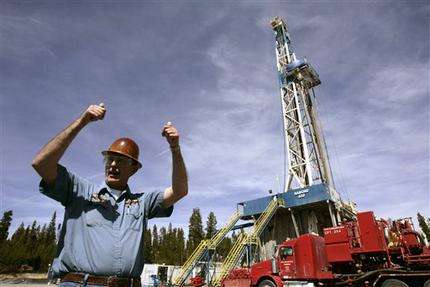
In this May 16, 2008, file photo, Newbery Crater project drilling manager Fred Wilson stands near a drilling rig at the Newberry Crater geothermal project as he describes the work near LaPine, Ore. Geothermal energy developers plan to pump 24 million gallons of water into the side of the dormant Central Oregon volcano this summer to demonstrate new technology they hope will give a boost to a green energy sector that has yet to live up to its promise. (AP Photo/Don Ryan, File)

(AP) -- Geothermal energy developers plan to pump 24 million gallons of water into the side of a dormant volcano in Central Oregon this summer to demonstrate new technology they hope will give a boost to a green energy sector that has yet to live up to its promise.

They hope the water comes back to the surface fast enough and hot enough to create cheap, clean electricity that isn't dependent on sunny skies or stiff breezes - without shaking the earth and rattling the nerves of nearby residents.

has been held back by cheap natural gas, weak demand for power and waning political concern over global warming. Efforts to use the earth's heat to generate power, known as geothermal energy, have been further hampered by technical problems and worries that tapping it can cause earthquakes.

Even so, the federal government, Google and other investors are interested enough to bet $43 million on the Oregon project. They are helping AltaRock Energy, Inc. of Seattle and Davenport Newberry Holdings LLC of Stamford, Conn., demonstrate whether the next level in geothermal power development can work on the flanks of Newberrry Volcano, located about 20 miles south of Bend, Ore.

"We know the heat is there," said Susan Petty, president of AltaRock. "The big issue is can we circulate enough water through the system to make it economic."

The heat in the earth's crust has been used to generate power for more than a century. Engineers gather hot water or steam that bubbles near the surface and use it to spin a turbine that creates electricity. Most of those areas have been exploited. The new frontier is places with hot rocks, but no cracks in the rocks or water to deliver the steam.

To tap that heat - and grow from a tiny niche into an important source of - engineers are working on a new technology called Enhanced Geothermal Systems.

"To build geothermal in a big way beyond where it is now requires new technology, and that is where EGS comes in," said Steve Hickman, a research geophysicist with the U.S. Geological Survey in Menlo Park, Calif.

Wells are drilled deep into the rock and water is pumped in, creating tiny fractures in the rock, a process known as hydroshearing.

Cold water is pumped down production wells into the reservoir, and the steam is drawn out.

Hydroshearing is similar to the process known as hydraulic fracturing, used to free natural gas from shale formations. But fracking uses chemical-laden fluids, and creates huge fractures. Pumping fracking wastewater deep underground for disposal likely led to recent earthquakes in Arkansas and Ohio.

Fears persist that cracking rock deep underground through hydroshearing can also lead to damaging quakes. EGS has other problems. It is hard to create a reservoir big enough to run a commercial power plant.

Progress has been slow. Two small plants are online in France and Germany. A third in downtown Basel, Switzerland, was shut down over complaints. A project in Australia has had drilling problems.

A new international protocol is coming out at the end of this month that urges EGS developers to keep projects out of urban areas, the so-called "sanity test," said Ernie Majer, a seismologist with the Lawrence Berkeley National Laboratory. It also urges developers to be upfront with local residents so they know exactly what is going on.

AltaRock hopes to demonstrate a new technology for creating bigger reservoirs that is based on the plastic polymers used to make biodegradable cups.

It worked in existing geothermal fields. Newberry will show if it works in a brand new EGS field, and in a different kind of geology, volcanic rock, said Colin Williams, a USGS geophysicist also in Menlo Park.

The U.S. Department of Energy has given the project $21.5 million in stimulus funds. That has been matched by private investors, among them with $6.3 million.

Majer said the danger of a major quake at Newbery is very low. The area is a kind of seismic dead zone, with no significant faults. It is far enough from population centers to make property damage unlikely. And the layers of volcanic ash built up over millennia dampen any shaking.

But the Department of Energy will be keeping a close eye on the project, and any significant quakes would shut it down at least temporarily, he said. The agency is also monitoring EGS projects at existing geothermal fields in California, Nevada and Idaho.

"That's the $64,000 question," Majer said. "What's the biggest earthquake we can have from induced seismicity that the public can worry about."

Geologists believe Newberry Volcano was once one of the tallest peaks in the Cascades, reaching an elevation of 10,000 feet and a diameter of 20 miles. It blew its top before the last Ice Age, leaving a caldera studded with towering lava flows, two lakes, and 400 cinder cones, some 400 feet tall.

Although the volcano has not erupted in 1,300 years, hot rocks close to the surface drew exploratory wells in the 1980s.

Over 21 days, AltaRock will pour 800 gallons of water per minute into the 10,600-foot test well, already drilled, for a total of 24 million gallons. According to plan, the cold water cracks the rock. The tiny plastic particles pumped down the well seal off the cracks. Then more cold water goes in, bypassing the first tier, and cracking the rock deeper in the well. That tier is sealed off, and cold water cracks a third section. Later, the plastic melts away.

Seismic sensors produce detailed maps of the fracturing, expected to produce a reservoir of cracks starting about 6,000 feet below the surface, and extending to 11,000 feet. It would be about 3,300 feet in diameter.

The U.S. Bureau of Land Management released an environmental assessment of the Newberry project last month that does not foresee any problems that would stop it. The agency is taking public comments before making a final decision in coming months.

No power plant is proposed, but one could be operating in about 10 years, said Doug Perry, president and CEO of Davenport Newberry.

EGS is attractive because it vastly expands the potential for geothermal power, which, unlike wind and solar, produces power around the clock in any weather.

Natural geothermal resources account for about 0.3 percent of U.S. electricity production, but a 2007 Massachusetts Institute of Technology report projected EGS could bump that to 10 percent within 50 years, at prices competitive with fossil-fuels.

Few people expect that kind of timetable now. Electricity prices have fallen sharply because of low natural gas prices and weak demand brought about by the Great Recession and state efficiency programs.

But the resource is vast. A 2008 USGS assessment found EGS throughout the West, where hot rocks are closer to the surface than in the East, has the potential to produce half the country's electricity.

"The important question we need to answer now," said Williams, the USGS geophysicist who compiled the assessment, "is how geothermal fits into the renewable energy picture, and how EGS fits. How much it is going to cost, and how much is available."

©2012 The Associated Press. All rights reserved. This material may not be published, broadcast, rewritten or redistributed.

3.5 /5 (18 votes)  

Filter


Move the slider to adjust rank threshold, so that you can hide some of the comments.


Display comments: newest first

Charlanalanalang
Jan 14, 2012

Rank: 2.3 / 5 (6)
Very interesting and hopefully useful to at least some extent so that we can add it to the column of green energy sources now being used and explored. That's an awful lot of water, though. I'm told that a 5 minute shower uses more water than some have in a month. Is there something about the water used that makes it a useful (not wasteful) choice? Is any of it recyclable?
nullcodes
Jan 14, 2012

Rank: 4.8 / 5 (6)
Is there something about the water used that makes it a useful (not wasteful) choice? Is any of it recyclable?

Uh, water can't get "used up" .. water never disappears from the Earth .. it's just put in places or forms that require energy or infrastructure to retrieve it. If these guys didn't use the water to generate electricity that would not be of any use to anyone who lacks access to water. You are probably better off building them pipelines and a desalination plant to get filter sea water into fresh water. And you need energy to do that.
kaasinees
Jan 14, 2012

Rank: 1.3 / 5 (9)
Uh, water can't get "used up" .. water never disappears from the Earth ..

Wrong.
http://en.wikiped...c_escape
Renewable energy has been held back by cheap natural gas

Burning natural gas is probably one of the greenest energy out there. Considering over time natural gas is released into the atmosphere one way or another by geo processes. Also not being renewable is false, it is renewed. The same goes for the heat of the volcano it is released anyway sooner or later, might as well make use for it.
kaasinees
Jan 14, 2012

Rank: 1.2 / 5 (9)
Altough releasing water in such large amounts can have a negative impact on the climate. Unless they build huge cooling towers which they probably dont because of the costs. Releasing such heat and water can have a negative impact, also we have no idea what impact this will have on the volcano, if it will reduce volcano activity we might lose more earth atmosphere, that is a bad thing.

Still its better than firing coal plants.
Grizzled
Jan 14, 2012

Rank: 2.7 / 5 (10)
So how much dudvthey spend and will still spend drilling? That's a costly and energy-hungry operation. Even when and if they make it t work - the costs of suplying all that water in the middle of nowhere (I mean energy costs as well as financial) reach even a break-even point?

Note that they themselves say they "hope" it will work. Not exactly the most convincing argument. And of course, since there are govt money involved, there is always a posibility it's just another scam to rip the taxpayer off. Remember all the failed Green projects which collapsed as soon as they went tnrough the govt grant money?

If it works - fine, but I suspect the money would be much better spent drilling for oil and gas.
ShotmanMaslo
Jan 14, 2012

Rank: 4.3 / 5 (7)
Also not being renewable is false, it is renewed.


What do you mean? Natural gas is not renewable.
kaasinees
Jan 14, 2012

Rank: 2.2 / 5 (5)
Also not being renewable is false, it is renewed.


What do you mean? Natural gas is not renewable.


methane and some other biological gasses are considere renewable.
The natural gas they are trying to combat in this article is renewed over a large time span, so its not economically renewable, but its still renewed and released by geological processes.
Callippo
Jan 14, 2012

Rank: 1.3 / 5 (16)
It's a literally "cool" method to solidify magma plugs and generate Krakatoa-type volcanic explosions in this way. What else the crazy researchers are willing to do in their avoidance of cold fusion?
antialias_physorg
Jan 14, 2012

Rank: 5 / 5 (3)
I hope they don't run into the earthquake problem of other geothermal plants.

http://www.scient...thquakes
Telekinetic
Jan 14, 2012

Rank: 1.7 / 5 (3)
I'm goin' down to the County Office right now and get my plastic abatement license so I can "clean up" when they find BPA coming out of the tap. It's gonna be a new gold rush- YeeHaw!
MNIce
Jan 14, 2012

Rank: 1.7 / 5 (3)
If the thermal power available is not adequate for large-scale power generation, it may still be useful for process heat. For example, it could be used to synthesize crude oil from organic waste such as kitchen garbage.
Vendicar_Decarian
Jan 15, 2012

Rank: 4.2 / 5 (5)
"I'm told that a 5 minute shower uses more water than some have in a month." - Charl anal

Typically, shower heads use about 2.5 liters of water per minute
or about 13 liters for a 5 minute shower.

If the water temperature at the shower head is 50'C and the water input temperature to the house is 10'C then that 5 minute shower will consume about 0.7 kilowatt hours of energy to heat the water.

In my case, this represents 10 percent of my daily consumption of electrical power.
Vendicar_Decarian
Jan 15, 2012

Rank: 4.6 / 5 (11)
"What else the crazy researchers are willing to do in their avoidance of cold fusion?" - Callippo

When E-Cat is found to be a fraud later this year, how do you intend to apologize for spamming this site with your Cold Fusion nonsense?
Vendicar_Decarian
Jan 15, 2012

Rank: 3.9 / 5 (11)
"If it works - fine, but I suspect the money would be much better spent drilling for oil and gas." - Grizzled

Is that how you intend to respond to the central U.S. reverting to a desert as the planet continues to warm?

n0ns3ns0r
Jan 15, 2012

Rank: 4 / 5 (9)
Uh, water can't get "used up" .. water never disappears from the Earth ..

Wrong.
http://en.wikiped...c_escape
Renewable energy has been held back by cheap natural gas

Burning natural gas is probably one of the greenest energy out there. Considering over time natural gas is released into the atmosphere one way or another by geo processes. Also not being renewable is false, it is renewed. The same goes for the heat of the volcano it is released anyway sooner or later, might as well make use for it.


Own goal! Try reading (or understanding) your own wikipedia link.

And do you not understand that the burning of natural gas via human processes would do what would naturally take billions of years?

Imagine exhaling all the air you'd ever breath in one breath. Poof!

That was humanity. Poof! Just like that. A flash in the pan.
n0ns3ns0r
Jan 15, 2012

Rank: 1 / 5 (8)
As for geothermal... drilling holes into volcanoes seems like a dumber idea than populating the Earth with high concentrations of deadly radioactive material for the purposes of boiling water.

We are pond scum that deserve the suicide we are committing.
kaasinees
Jan 15, 2012

Rank: 2 / 5 (5)
Own goal! Try reading (or understanding) your own wikipedia link.

So you think no water ever escapes our atmosphere ever? Think again. Its a slow process but it happens.

And do you not understand that the burning of natural gas via human processes would do what would naturally take billions of years?

Do you have any idea how much natural gas is escaping right now and goes unused? And how many ticking time bombs are waiting there to poison the air of nearby inhabitants, i geuss you dont.

Imagine exhaling all the air you'd ever breath in one breath. Poof!

That was humanity. Poof! Just like that. A flash in the pan.

Very childish.
Feldagast
Jan 15, 2012

Rank: 3.7 / 5 (3)
As for geothermal... drilling holes into volcanoes seems like a dumber idea than populating the Earth with high concentrations of deadly radioactive material for the purposes of boiling water.

We are pond scum that deserve the suicide we are committing.


So we should all suicide and save the planet? You first.
Grizzled
Jan 15, 2012

Rank: 1.5 / 5 (4)
"If it works - fine, but I suspect the money would be much better spent drilling for oil and gas." - Grizzled

Is that how you intend to respond to the central U.S. reverting to a desert as the planet continues to warm?


A truly hypothetical question if I ever saw one.

And in the meantime, the time and money continue to be wasted. This time I'm actually more concerned about the time part of it. We do need new sources of energy, but this isn't it - just a costly and wasteful distraction.
bewertow
Jan 15, 2012

Rank: 5 / 5 (2)
It's a literally "cool" method to solidify magma plugs and generate Krakatoa-type volcanic explosions in this way. What else the crazy researchers are willing to do in their avoidance of cold fusion?


If it's so easy, why don't you build your own cold fusion reactor? Oh yea, because you can't. You need a lot of energy to overcome the Coulomb barrier, and you can't do that at room temperature. Basic physics, n00b.
Parsec
Jan 15, 2012

Rank: 5 / 5 (4)
It's a literally "cool" method to solidify magma plugs and generate Krakatoa-type volcanic explosions in this way. What else the crazy researchers are willing to do in their avoidance of cold fusion?


If it's so easy, why don't you build your own cold fusion reactor? Oh yea, because you can't. You need a lot of energy to overcome the Coulomb barrier, and you can't do that at room temperature. Basic physics, n00b.

I think cold fusion is a hoax. But not because it takes too much energy to overcome the Coulomb barrier at room temp. Its because I haven't actually seen a proposed mechanism with the demonstrated by products. That is, where are the neutrons? What nuclear reaction is being proposed exactly, and where are the isotopes expected from it? Finally, where are the peer reviewed/repeatable demonstrated experiments? "Don't look behind the curtain" and "magic happens here" explanations are ludicrous. They left the realm of accepted science more than 100 years ago
Callippo
Jan 15, 2012

Rank: 1.3 / 5 (4)
When E-Cat is found to be a fraud later this year, how do you intend to apologize for spamming this site with your Cold Fusion nonsense?
What would you do, if not?
Its because I haven't actually seen a proposed mechanism with the demonstrated by products. That is, where are the neutrons?
Why there should be some? Light hydrogen has no neutrons, so that the total number of neutrons remains the same.
where are the isotopes expected from it?
It's all described in Piantelli's articles. Did you ever read some? http://newenergyt...rs.shtml
Callippo
Jan 15, 2012

Rank: 1 / 5 (4)
Finally, where are the peer reviewed/repeatable demonstrated experiments?
This is just the question, which I'm asking here too. The link above quites nearly thirty publications, which are nearly twenty years old. They were published in the mainstream journals, including the official journal of Italian Academy of Sciences. Why they weren't reviewed and checked independently? Whether the other physicists have better job to research? If I'm not wrong, no other energy source is so effective with respect to its potential contribution to the human society. If the cold fusion research will succeed, then all alternative ways of energy production, conversion, transport and storage will become less effective and as such useless - and their research too. I do believe, in just this argument the answer of the cold fusion ignorance resides too. The physicists simply don't want to research it, or their own existing jobs would become useless.

Try to prove me, I'm wrong in this point.
Wolf358
Jan 15, 2012

Rank: 5 / 5 (2)
All those little cracks, and all that magma down there; why not use stainless steel well-casings and contain all of that water in a closed loop? Much safer, I'd think...
hyongx
Jan 15, 2012

Rank: not rated yet
Re: Humanity
This. Is. Ridiculous.
*grabs another beer*
At least it is entertaining.
antialias_physorg
Jan 16, 2012

Rank: not rated yet
why not use stainless steel well-casings and contain all of that water in a closed loop?

1) Because it would get clogged pretty quickly - even if you try to put down water that is as pure as possible.
2) Because the volume of water you could put thorugh would be vastly less (i.e. the energy you could get out of this would be much less for the same engineering effort put in)

I agree that a closed loop would be much better - but that isn't (yet) feasible for an economical application of this technology.
Xbw
Jan 16, 2012

Rank: 1 / 5 (1)
I say we find a way to harness the hot air that comes out of some of the cold fusion supporters on this site and use that to power a greener future.
Rank 3.5 /5 (18 votes)
Related Stories
Relevant PhysicsForums posts

More news stories

Stanford research team cracks animated NuCaptcha

(PhysOrg.com) -- The research team from Stanford University, led by Elie Bursztein, that previously had cracked regular CAPTCHAs and then audio CAPTCHAs, now has also successfully cracked the animated version called NuCapt ...

Technology / Computer Sciences

created 18 hours ago | popularity 5 / 5 (3) | comments 6 | with audio podcast report

Tiny, implantable medical device can propel itself through bloodstream

Someday, your doctor may turn to you and say, "Take two surgeons and call me in the morning." If that day arrives, you may just have Ada Poon to thank.

Technology / Engineering

created 17 hours ago | popularity 5 / 5 (9) | comments 8 | with audio podcast

Italian engineer invents floating solar panels

Rays of the winter sun bounce off gleaming mirrors on the tiny lake of Colignola in Italy, where engineers have built a cost-effective prototype for floating, rotating solar panels.

Technology / Energy & Green Tech

created 21 hours ago | popularity 4.7 / 5 (6) | comments 5

Microsoft hits Motorola, Google with EU complaint

Microsoft on Wednesday lodged a formal complaint with the European Union's competition regulator against Motorola Mobility and its soon-to-be owner Google, saying Motorola's aggressive enforcement of patent ...

Technology / Business

created 17 hours ago | popularity 2 / 5 (1) | comments 2

Calif. pledges better mobile privacy disclosures

(AP) -- Mobile applications seeking to collect personal information will have to forewarn users as part of an agreement reached in California.

Technology / Internet

created 9 hours ago | popularity not rated yet | comments 0


Researchers build first physical 'metatronic' circuit

(PhysOrg.com) -- The technological world of the 21st century owes a tremendous amount to advances in electrical engineering, specifically, the ability to finely control the flow of electrical charges using ...

Spitzer finds solid buckyballs in space

(PhysOrg.com) -- Astronomers using data from NASA's Spitzer Space Telescope have, for the first time, discovered buckyballs in a solid form in space. Prior to this discovery, the microscopic carbon spheres ...

Faster than light neutrinos? More like faulty wiring

You can shelf your designs for a warp drive engine (for now) and put the DeLorean back in the garage; it turns out neutrinos may not have broken any cosmic speed limits after all.

Physicists surprised by disappearing and reappearing superconductivity in iron selenium chalcogenides

Superconductivity is a rare physical state in which matter is able to conduct electricity -- maintain a flow of electrons -- without any resistance. This phenomenon can only be found in certain materials at low temperatures, ...

Going up: Japan builder eyes space elevator

A Japanese construction firm claimed Wednesday it could execute an out-of-this-world plan to put tourists in space within 40 years by building an elevator that stretches a quarter of the way to the moon.

Flesh-eating bacteria inspire superglue

(PhysOrg.com) -- A bio-inspired superglue has been developed by Oxford University researchers that can’t be matched for sticking molecules together and not letting go.