Volunteers sought for simulated Mars mission and study of 'menu fatigue'
January 27, 2012 By Stacey Shackford
Volunteers sought for simulated Mars mission

Enlarge

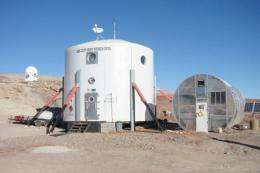
Six volunteers will live for four months in the Mars Desert Research Station habitat; researchers will study their food preparation, menu fatigue and other issues related to diet and nutrition.

(PhysOrg.com) -- Astronauts on a mission to Mars will need much more than freeze-dried ice cream to sustain them, and researchers at Cornell are working to determine the best way to keep them well nourished during their three-year journeys and four-month stays on the Red Planet.

To do so, they are seeking volunteers to spend four months in a simulated Mars habitat on the barren lava fields of Hawai'i.

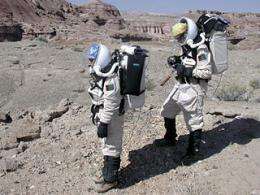
Jean Hunter, associate professor of biological and environmental engineering, and Bruce Halpern, professor of psychology and neurobiology and behavior, have teamed up with Kim Binsted, associate professor of information and computer science at the University of Hawai'i-Manoa, to conduct a $947,000, three-year NASA study on the diets of the six volunteers, who will be required to live and work like astronauts, including suiting up in space gear whenever they venture outdoors.
Volunteers sought for simulated Mars mission
Enlarge

The Mars Desert Research Station habitat crew members will have to suit up whenever they venture out of their four-month "home."

One of the biggest astronauts face is menu fatigue, Hunter said. They not only tire of eating foods they normally enjoy but also tend to eat less, which can put them at risk for nutritional deficiency, loss of bone and muscle mass, and reduced physical capabilities. Moreover, all foods decline in over time, and only a few of the many available astronaut foods have the three-to-five-year shelf life required for a .

On a landed mission, however, the planet's gravity would make cooking -- and perhaps gardening -- possible, which would give the astronauts more food variety and relieve menu fatigue, Hunter said.

She will test this theory during the Hawai'i study. The research team will assess the palatability of available instant foods and food prepared by the crew, and determine whether food preferences change over time. They will also measure the time, power and water required for meal preparation and cleanup for instant and crew-cooked foods, and compile recipes and cooking tips.

In addition, Hunter will study physical changes that astronauts undergo related to their sense of smell, which affects taste and appetite. In micro-gravity environments, food and fluids don't get pulled to the feet, and nasal passages swell, compromising smell. Bed-ridden patients on Earth experience a similar response, which the researchers are studying in a series of experiments on bed-rested subjects at the NASA Flight Analogs Research Center in Galveston, Texas.

The Mars simulation experiments will begin this summer with a four-day workshop at Cornell's School of Hotel Administration, during which the selected volunteers will learn to plan and cook interesting, varied meals from shelf-stable ingredients, track their food intake and perform olfactory tests on each other.

The researchers are hoping to attract highly educated volunteers, including scientists and engineers, with the enticement of working on their own personal research projects while in Hawai'i. The application deadline is Feb. 29.

More information: Project information and application: http://manoa.hawai … edu/hi-seas/ .

Provided by Cornell University (news : web)

Filter


Move the slider to adjust rank threshold, so that you can hide some of the comments.


Display comments: newest first

Blakut
Jan 27, 2012

Rank: 5 / 5 (3)
Hm, send grad students to mars. Only need to pack ramen.
ROBTHEGOB
Jan 27, 2012

Rank: not rated yet
Try soylent green.
Rank 5 /5 (3 votes)
Related Stories
Relevant PhysicsForums posts
  • Calculating the magnitude
    created2 hours ago
  • What is this spectrum I took?
    created12 hours ago
  • Orientation of Space
    created13 hours ago
  • Geologically Active Moon Now: NASA
    created20 hours ago
  • advice on building a science fair telescope
    createdFeb 22, 2012
  • Rise of the Sun
    createdFeb 22, 2012
  • More from Physics Forums - General Astronomy

More news stories

Spitzer finds solid buckyballs in space

(PhysOrg.com) -- Astronomers using data from NASA's Spitzer Space Telescope have, for the first time, discovered buckyballs in a solid form in space. Prior to this discovery, the microscopic carbon spheres ...

Space & Earth / Astronomy

created 15 hours ago | popularity 4.7 / 5 (12) | comments 8 | with audio podcast

Going up: Japan builder eyes space elevator

A Japanese construction firm claimed Wednesday it could execute an out-of-this-world plan to put tourists in space within 40 years by building an elevator that stretches a quarter of the way to the moon.

Space & Earth / Space Exploration

created 22 hours ago | popularity 3.5 / 5 (13) | comments 26

ENASA satellite finds Earth's clouds are getting lower

(PhysOrg.com) -- Earth's clouds got a little lower -- about one percent on average -- during the first decade of this century, finds a new NASA-funded university study based on NASA satellite data. The results ...

Space & Earth / Earth Sciences

created 19 hours ago | popularity 5 / 5 (8) | comments 13 | with audio podcast

Fresh scandal embroils US climate science debate

A fresh scandal over climate change has erupted in the United States after leaked documents appeared to show a right-wing funded campaign to influence how climate science is taught in schools.

Space & Earth / Environment

created 11 hours ago | popularity 4.1 / 5 (9) | comments 8

World's oceans get an acid bath

Among the repercussions of global climate change, the effect of ocean acidification on marine life is one of the least-understood variables.

Space & Earth / Environment

created 18 hours ago | popularity 4.3 / 5 (6) | comments 4 | with audio podcast


Researchers build first physical 'metatronic' circuit

(PhysOrg.com) -- The technological world of the 21st century owes a tremendous amount to advances in electrical engineering, specifically, the ability to finely control the flow of electrical charges using ...

Faster than light neutrinos? More like faulty wiring

You can shelf your designs for a warp drive engine (for now) and put the DeLorean back in the garage; it turns out neutrinos may not have broken any cosmic speed limits after all.

Physicists surprised by disappearing and reappearing superconductivity in iron selenium chalcogenides

Superconductivity is a rare physical state in which matter is able to conduct electricity -- maintain a flow of electrons -- without any resistance. This phenomenon can only be found in certain materials at low temperatures, ...

Stanford research team cracks animated NuCaptcha

(PhysOrg.com) -- The research team from Stanford University, led by Elie Bursztein, that previously had cracked regular CAPTCHAs and then audio CAPTCHAs, now has also successfully cracked the animated version called NuCapt ...

Flesh-eating bacteria inspire superglue

(PhysOrg.com) -- A bio-inspired superglue has been developed by Oxford University researchers that can’t be matched for sticking molecules together and not letting go.

Scientists create potent molecules aimed at treating muscular dystrophy

While RNA is an appealing drug target, small molecules that can actually affect its function have rarely been found. But now scientists from the Florida campus of The Scripps Research Institute have for the first time designed ...