Restored wetlands rarely equal condition of original wetlands
January 24, 2012
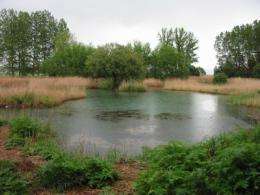
Restored wetlands like this pond converted from agricultural use in Aragon, Spain, may look natural, but a new study shows that it can take hundreds of years for restored wetlands to accumulate the plant assemblages and carbon resources of a natural, undamaged wetland. Credit: David Moreno-Mateos/UC Berkeley
Wetland restoration is a billion-dollar-a-year industry in the United States that aims to create ecosystems similar to those that disappeared over the past century. But a new analysis of restoration projects shows that restored wetlands seldom reach the quality of a natural wetland.
"Once you degrade a wetland, it doesn't recover its normal assemblage of plants or its rich stores of organic soil carbon, which both affect natural cycles of water and nutrients, for many years," said David Moreno-Mateos, a University of California, Berkeley, postdoctoral fellow. "Even after 100 years, the restored wetland is still different from what was there before, and it may never recover."
Moreno-Mateos's analysis calls into question a common mitigation strategy exploited by land developers: create a new wetland to replace a wetland that will be destroyed and the land put to other uses. At a time of accelerated climate change caused by increased carbon entering the atmosphere, carbon storage in wetlands is increasingly important, he said.
"Wetlands accumulate a lot of carbon, so when you dry up a wetland for agricultural use or to build houses, you are just pouring this carbon into the atmosphere," he said. "If we keep degrading or destroying wetlands, for example through the use of mitigation banks, it is going to take centuries to recover the carbon we are losing."
The study showed that wetlands tend to recover most slowly if they are in cold regions, if they are small less than 100 contiguous hectares, or 250 acres, in area or if they are disconnected from the ebb and flood of tides or river flows.
"These context dependencies aren't necessarily surprising, but this paper quantifies them in ways that could guide decisions about restoration, or about whether to damage wetlands in the first place," said coauthor Mary Power, UC Berkeley professor of integrative biology.
Moreno-Mateos, Power and their colleagues will publish their analysis in the Jan. 24 issue of PLoS Biology.
Wetlands provide many societal benefits, Moreno-Mateos noted, such as biodiversity conservation, fish production, water purification, erosion control and carbon storage.
He found, however, that restored wetlands contained about 23 percent less carbon than untouched wetlands, while the variety of native plants was 26 percent lower, on average, after 50 to 100 years of restoration. While restored wetlands may look superficially similar and the animal and insect populations may be similar, too the plants take much longer to return to normal and establish the carbon resources in the soil that make for a healthy ecosystem.
Moreno-Mateos noted that numerous studies have shown that specific wetlands recover slowly, but his meta-analysis "might be a proof that this is happening in most wetlands."
"To prevent this, preserve the wetland, don't degrade the wetland," he said.
Moreno-Mateos, who obtained his Ph.D. while studying wetland restoration in Spain, conducted a meta-analysis of 124 wetland studies monitoring work at 621 wetlands around the world and comparing them with natural wetlands. Nearly 80 percent were in the United States and some were restored more than 100 years ago, reflecting of a long-standing American interest in restoration and a common belief that it's possible to essentially recreate destroyed wetlands. Half of all wetlands in North America, Europe, China and Australia were lost during the 20th century, he said. S
Though Moreno-Mateos found that, on average, restored wetlands are 25 percent less productive than natural wetlands, there was much variation. For example, wetlands in boreal and cold temperate forests tend to recover more slowly than do warm wetlands. One review of wetland restoration projects in New York state, for example, found that "after 55 years, barely 50 percent of the organic matter had accumulated on average in all these wetlands" compared to what was there before, he said.
"Current thinking holds that many ecosystems just reach an alternative state that is different, and you never will recover the original," he said.
In future studies, he will explore whether the slower carbon accumulation is due to a slow recovery of the native plant community or invasion by non-native plants.
Provided by University of California - Berkeley (news : web)
-
Tibet wetlands being protected
Feb 13, 2006 |
not rated yet |
0
-
Study: Tropical wetlands hold more carbon than temperate marshes
Oct 08, 2008 |
not rated yet |
0
-
Shifts in soil bacterial populations linked to wetland restoration success
Nov 12, 2008 |
not rated yet |
0
-
Wetlands are bad and good news for Arctic warming: study
Jun 07, 2011 |
not rated yet |
0
-
Farming destroying Brazil's wetlands
Jan 11, 2006 |
not rated yet |
0
-
Stars containing dark matter should look different from other stars
Feb 20, 2012 |
4.5 / 5 (17) |
11
-
Physicists discover evidence of rare hypernucleus, a component of strange matter
Feb 17, 2012 |
4.7 / 5 (38) |
22
-
Fast photon control brings quantum photonic technologies closer
Feb 13, 2012 |
5 / 5 (8) |
1
-
Engineers build first sub-10-nm carbon nanotube transistor
Feb 01, 2012 |
4.9 / 5 (36) |
32
-
Something old, something new: Evolution and the structural divergence of duplicate genes
Jan 31, 2012 |
4.6 / 5 (7) |
1
-
Eye biology videos
4 hours ago
-
Flowering Plant Revived After 30,000 Years in Permafrost
Feb 21, 2012
-
Toba volcano eruptions - 1.000 - 10,000 breeding pairsunb
Feb 20, 2012
-
How is a specific gene removed from DNA
Feb 20, 2012
-
Reproduction and Human evolution
Feb 19, 2012
-
Viruses: Living or Non-living organisms
Feb 19, 2012
- More from Physics Forums - Biology
More news stories
Surprising diversity at a synapse hints at complex diversity of neural circuitry
A new study reveals a dazzling degree of biological diversity in an unexpected place a single neural connection in the body wall of flies.
10 hours ago |
5 / 5 (4) |
0
|
Men might not 'become extinct' after all: Theory of the 'rotting' Y chromosome dealt a fatal blow
If you were to discover that a fundamental component of human biology has survived virtually intact for the past 25 million years, you'd be quite confident in saying that it is here to stay.
13 hours ago |
5 / 5 (6) |
1
|
New family of legless amphibians found in India
Since before the age of dinosaurs it has burrowed unbothered beneath the monsoon-soaked soils of remote northeast India - unknown to science and mistaken by villagers as a deadly, miniature snake.
21 hours ago |
5 / 5 (8) |
3
Climate change affects bird migration timing in North America
Bird migration timing across North America has been affected by climate change, according to a study published Feb. 22 in the open access journal PLoS ONE.
9 hours ago |
4.5 / 5 (2) |
2
New iridescent lizard species found in Cambodia
A new species of lizard with striking iridescent rainbow skin, a long tail and very short legs has been discovered in the rainforest in northeast Cambodia, conservationists announced Wednesday.
10 hours ago |
not rated yet |
0
Researchers build first physical 'metatronic' circuit
(PhysOrg.com) -- The technological world of the 21st century owes a tremendous amount to advances in electrical engineering, specifically, the ability to finely control the flow of electrical charges using ...
Spitzer finds solid buckyballs in space
(PhysOrg.com) -- Astronomers using data from NASA's Spitzer Space Telescope have, for the first time, discovered buckyballs in a solid form in space. Prior to this discovery, the microscopic carbon spheres ...
Faster than light neutrinos? More like faulty wiring
You can shelf your designs for a warp drive engine (for now) and put the DeLorean back in the garage; it turns out neutrinos may not have broken any cosmic speed limits after all.
Physicists surprised by disappearing and reappearing superconductivity in iron selenium chalcogenides
Superconductivity is a rare physical state in which matter is able to conduct electricity -- maintain a flow of electrons -- without any resistance. This phenomenon can only be found in certain materials at low temperatures, ...
CT colonography shown to be comparable to standard colonoscopy
Computerized tomographic (CT) colonography (CTC), also known as virtual colonoscopy, is comparable to standard colonoscopy in its ability to accurately detect cancer and precancerous polyps in people ages 65 and older, according ...
Stanford research team cracks animated NuCaptcha
(PhysOrg.com) -- The research team from Stanford University, led by Elie Bursztein, that previously had cracked regular CAPTCHAs and then audio CAPTCHAs, now has also successfully cracked the animated version called NuCapt ...
Jan 24, 2012
Rank: 1 / 5 (6)
Jan 24, 2012
Rank: 5 / 5 (3)
Jan 24, 2012
Rank: not rated yet
Well, duh!
Jan 25, 2012
Rank: 5 / 5 (2)
Preservation will always be the better solution!
Therefore protection of such ecosystems should have the first priority.
I am sure we will never (but at least not in the near future) have the knowledge to really renatureate a complex eco-system adequately, independent from the available money. - But that should not be the question.
In most cases this (second best) solution is better than doing nothing.
Jan 25, 2012
Rank: 1 / 5 (4)
Jan 25, 2012
Rank: 1 / 5 (3)
Jan 28, 2012
Rank: not rated yet
Actually the oposite is true not that i expect a Probable Tool to actually seriously debate this.